
Lieferung heute & morgen

Qualitätsgarantie

Willkommens-Angebote freischalten: KOSTENLOSE Lieferung | Bis zu 80 % RABATT | Kostenlose 30-Tage-JoyPlus-Testphase
App herunterladen
Family games for ages 6 and over should combine easy-to-understand rules, age-appropriate challenges and shared play. However, choosing the right game is not always easy. Some games look versatile on the packaging but do not suit the actual number of players, or take longer than expected. Others contain small parts that could be problematic for younger siblings.
This buying guide explains what families in Germany should look for when choosing games for children, board games and card games. The selection is based on clear details such as the recommended age, number of players, playing time, format and game mechanics.
“From age 6” describes the manufacturer’s recommendation, but it does not automatically mean that every child will understand the game without support. Reading ability, concentration and experience with board games vary. With more complex strategy games for children, it can be helpful to explain the first round together.
The recommended age should also match the information on the packaging. If a game contains small parts, it must be kept away from children under 3 years of age – particularly if younger siblings live in the household.
A game for two to four people is only partly suitable for a family of five. With card games for ages 6 and over, you should therefore consider not only the maximum but also the minimum number of players. Games suitable for one parent and one child may differ from those designed for a larger family game night.
Simple rules can still lead to longer games if many rounds are planned. For travel, waiting times or a short game night, compact games with a stated playing time of around 15 to 20 minutes are often more practical. With larger board games for the family, make sure you allow enough space and time.
Check whether the game is genuinely intended for children aged 6 and over, and which skills are required. Numbers, colours and simple matching make it easier to get started. Word games, hidden information or several possible actions may require additional support.
Co-operative family games are a suitable option if children are not meant to compete directly against one another. The group works towards a shared objective. For families with different levels of experience, this can make the rules easier to explain and reduce conflicts caused by individual losses.
The details 2 to 6 players or 2 to 4 players should suit your typical family situation. For holidays, travel games for children with a manageable packed size are also a sensible choice. Check whether playing pieces, cards and card holders can be stored safely in the box once the game is over.
Boxes, cards and playing pieces should appear sufficiently durable for their intended use. A compact box is practical for travelling, while larger game boards provide a clearer overview at home. For small parts, follow the manufacturer’s safety instructions. Look for the CE marking and read the warnings before playing for the first time.
Learning objectives such as logical thinking, memory skills or recognising numbers can offer additional benefits. However, they should not be equated with a medical or therapeutic effect. With educational games for children, the enjoyment of playing should still be suitable for the age group and attention span.
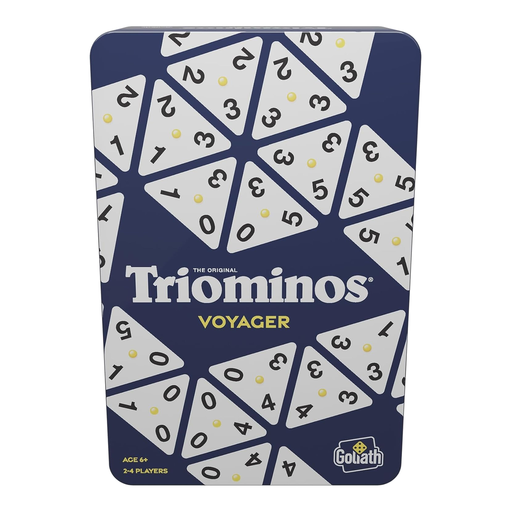
Why this product suits the profile: The rules are based on the familiar principle of dominoes, but use 56 triangular playing pieces. This makes it easy to get started while also offering combination possibilities for 2 to 4 players aged 6 and over.
The number of players, recommended age and contents are clearly stated. The four playing-piece racks help keep the pieces organised during and after the game.
Compact format measuring 12,5 × 4,5 × 19,5 cm, weighing 366 g and supplied with multilingual instructions, including German.

Why this product suits the profile: The junior version combines a game board with resources, trading rules and building objectives. It is designed for 2 to 4 players aged 6 and over, offering more structure than a quick card game.
The simplified trading rules and child-friendly elements lower the barrier to entry. Adult support may be helpful for the initial set-up and explaining the rules.
Game board measuring 29,7 × 30 × 7,5 cm, simple building and trading mechanics, plus a clearly stated objective: build seven hideouts.
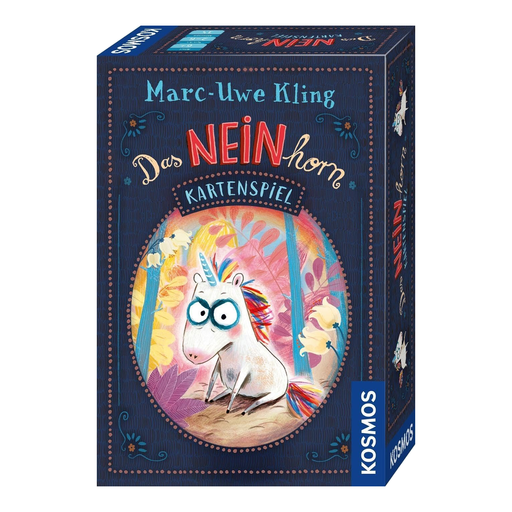
Why this product suits the profile: This card game is designed for 2 to 6 people aged 6 and over. Short rounds of around 15 minutes are ideal for families looking for a quick-to-explain game with word-based challenges.
The maximum number of players suits larger families. There is also a co-operative variant, so not every game has to be a direct one-to-one competition.
Compact magnetic box measuring 15 × 10,2 × 5,1 cm, with game materials for quick word and reaction challenges.
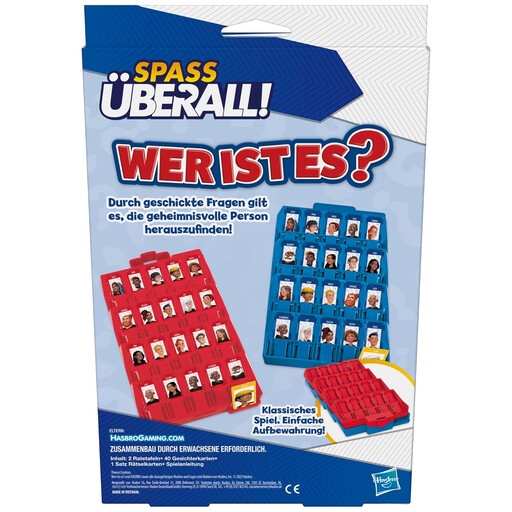
Why this product suits the profile: The compact version is designed for two people aged 6 and over, and is easy to take along on holiday, train journeys or during short breaks for play.
The number of players is clearly limited to two. This avoids creating false expectations of a group game. The storage box helps keep small parts together.
Question-and-answer mechanics, quick set-up and a portable format for playing on the go.
We have put together a complete, regularly updated list of products that fully meet these strict selection criteria and the safety regulations applicable in the EU.
Deduction games such as Guess Who Grab And Go and tile-laying games such as Triominos are suitable for two people. The key is to ensure that the stated minimum number of players is two and that the rules work without a larger group.
There is no fixed answer. For younger or less experienced players, rounds lasting around 15 to 30 minutes are often manageable. With longer board games, families can pause the game or begin with a simplified round.
The term “educational game” does not replace an assessment of the actual game mechanics. Pay attention to which skills are genuinely developed, such as number awareness, memory, vocabulary or logical combinations. The manufacturer’s information should be treated as guidance rather than a promise of specific results.