For family history research at a shared desk, match the screen size, resolution and text scaling to the digitised documents you typically use, then check the desk space available and the monitor’s adjustability. A higher resolution gives you more room for documents and side-by-side windows, but it doesn’t guarantee a comfortable text size. USB-C docking makes it easier to switch computers, but only if the laptop supports the required video output and charging power.
Who is this selection for?
Readers of digitised sources
If you’re researching historical records or digitised documents, you should be able to adjust the text to suit your preferred size. FamilySearch includes indexed German records and digitised documents, among other resources.
People sharing a desk
If several people use the same desk, the monitor’s footprint and the ability to adjust its position matter. Check the dimensions, including the stand, and the adjustment options for each model.
Researchers who switch laptops
If you regularly connect a different laptop, suitable display, USB and charging connections can make switching easier. Features vary between monitors and laptops.
What should you look for when buying?
Four questions can help you choose: can you read your sources comfortably, will the monitor fit on the desk, do you need several windows open at once, and which connections do your computers require?
| What matters |
What to check before buying |
Who will find this especially important? |
| Readable sources |
Compare the native resolution, screen size and text scaling using a typical document. |
If I want to read historical records at my preferred text size, the display needs to suit me. Around 33% of consumers prioritise readable sources. |
| Space and adjustability |
Check the desk’s width and depth, including the stand, as well as the monitor’s height, tilt and, where available, swivel adjustment. |
If several people share the desk, I want to adjust the screen position and still have room for paperwork. Around 25% of consumers prioritise an adjustable setup when desk space is limited. |
| Side-by-side windows |
Consider how you want to arrange scans, notes and your family tree, as well as the monitor’s dimensions. |
If I want to view several sources side by side, I need enough usable screen space for each window. Around 25% of consumers put side-by-side document windows first. |
| Switching computers |
Check the video output, charging requirements and peripheral connections for each laptop you use. |
If laptops are changed regularly, I want to connect them using suitable ports without unnecessary cable swapping. Around 17% of consumers prioritise easy connections for compatible computers. |
Common misconceptions
-
Focusing only on the screen size
A 27-inch monitor may offer Full HD or 4K, depending on the model. Screen size alone doesn’t tell you how many pixels are available for displaying documents.
Compare screen size, native resolution, your preferred text scaling and the dimensions of the stand together.
If the setup doesn’t suit your space, you may need to reposition the monitor later.
-
Assuming USB-C guarantees a one-cable setup
A USB-C port on the monitor doesn’t confirm that every connected laptop can output video through it or receive enough power to charge.
Check each computer’s video output and power requirements against the connections and stated charging power of the specific monitor.
Depending on your laptop, you may still need its power adapter or an additional cable.
-
Treating workplace regulations as a general buying requirement for home use
The Federal Institute for Occupational Safety and Health distinguishes ASR A6 from the use of display screen equipment outside workplaces. It is therefore not a blanket purchasing requirement for private leisure use.
If you’re buying for a specific work situation, check separately whether ASR A6 applies.
Brands worth considering
EIZO
The FlexScan EV2490 is a compact office monitor with USB-C docking.
- For this specific model, EIZO lists a 23.8-inch screen, Full HD resolution, IPS, DisplayPort Alt Mode and maximum USB-C charging power of 70 W.
- Full HD has fewer native pixels than the QHD and 4K models mentioned here. That doesn’t mean it will necessarily be less readable for you.
Dell
The Pro P2425DE is a 23.8-inch QHD option with a USB-C hub.
- For this model, Dell lists 2560 × 1440 pixels, IPS, height adjustment, a USB-C hub and 90 W power delivery.
- Check that the connections work with each laptop used at the shared desk.
ASUS
The ProArt PA279CRV combines a 27-inch screen with 4K resolution and an adjustable stand.
- For this specific model, ASUS lists 3840 × 2160 pixels, IPS, height adjustment and 96 W USB-C Power Delivery.
- The stated colour specifications and features don’t, by themselves, demonstrate any extra benefit when simply reading digitised sources.
Philips
The S-Line 273S1/00 is a 27-inch Full HD example with USB-C docking.
- Philips lists IPS, 1920 × 1080 pixels and docking for compatible laptops.
- At 27 inches, compare Full HD with higher-resolution options if you want to display lots of small document details.
LG
The UltraWide 49WQ95X-W illustrates the benefits of an extra-wide view, but it’s not a standard choice for a cramped shared desk.
- For this model, LG lists a 49-inch screen, 5120 × 1440 pixels and a width of 1215.1 mm without the stand.
- LG’s German product page marks the model as no longer available, so these details are provided only to illustrate the ultrawide format.
Joybuy products
This selection features higher-resolution 27-inch monitors for digitised documents and side-by-side windows. Several models list adjustable stands or USB-C features; check that they suit your available desk space and laptop connections.
 No image available
MSI PRO MP273UPDE E6, 27-inch, 4K UHD, IPS
A 27-inch 4K option for digitised documents; the product name specifies an IPS display.
According to the product details, the stand can be adjusted for height, tilt, swivel and pivot.
View at Joybuy
 No image available
INNOCN CB27U1, 27-inch, 4K UHD, IPS, USB-C with 90 W Power Delivery
A 4K option with USB-C for a compatible laptop; check the computer’s video output and charging requirements.
The product title also lists 120 Hz, HDR500, and PIP and PBP features. The description specifies height, tilt, swivel and pivot adjustment.
View at Joybuy
 No image available
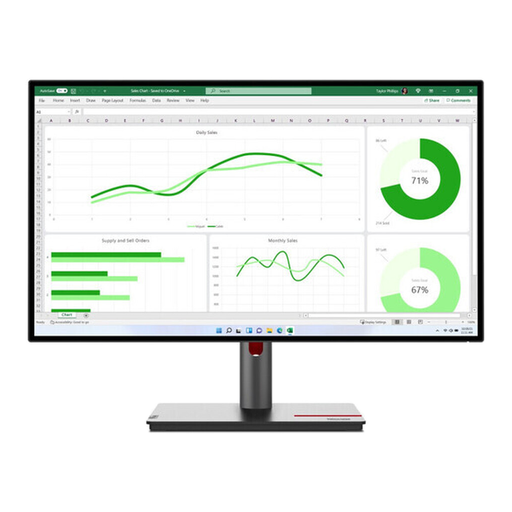
Lenovo ThinkVision P27q-30, 27-inch, QHD, IPS
A 27-inch QHD option for documents and windows; the product name specifies an IPS display.
The description lists a stand with height, tilt, swivel and pivot adjustment.
View at Joybuy
 No image available
MSI PRO MP275QPDGDE, 27-inch, WQHD, USB-C with 98 W Power Delivery
A QHD option with USB-C docking for compatible laptops; check the video output and charging requirements of each computer.
The description lists a USB hub and height, tilt, swivel and pivot adjustment.
View at Joybuy
 No image available
Dell Pro Plus P2725DE, 27-inch, QHD, USB-C hub
A QHD option for documents with a USB-C hub; check compatibility with the laptops you use.
The product description lists up to 90 W Power Delivery and height, tilt and pivot adjustment.
View at Joybuy
Frequently asked questions
Do you automatically need a 4K monitor for family history research?
No, not necessarily. Specific models are available in Full HD, QHD and 4K; the right display for you also depends on screen size, scaling, the document and your viewing distance. Try a typical document at your preferred text size.
How should I set up a monitor at a shared desk?
Before buying, check the space available and the adjustment options, then reposition the screen when someone else takes over. The Federal Institute for Occupational Safety and Health sets out the scope of ASR A6 for display screen work; according to its own guidance, the regulation does not apply as a blanket rule to private use outside workplaces.
Can any laptop receive video and power through a USB-C cable?
No, a USB-C port alone isn’t enough. Check your laptop’s video output and power requirements against the features of the specific monitor. EIZO lists DisplayPort Alt Mode and up to 70 W via the USB-C upstream port for the EV2490.
What rights apply to private online purchases in Germany?
The German consumer advice centre says that online orders generally come with a 14-day cancellation period from the date of delivery. It also distinguishes statutory rights against the seller from a voluntary guarantee; check when the period starts and whether any exceptions apply to your purchase.


