If you regularly work with a letter and a record side by side, start by checking that there’s enough usable screen space and that you can choose a comfortable scaling level. If you often enlarge handwriting, a more detailed display may matter more than having as many windows open at once as possible. The stand and connections also need to suit your desk and laptop. It’s the software you use, not the monitor, that links source files.
Which monitor is right for you?
For working with a letter and record side by side
If you’re reading a digitised source while noting down names, dates and references, check whether both windows fit side by side at your preferred text size. FamilySearch explains how to link an online copy or attach a digital copy to a family tree entry.
For reading hard-to-decipher scans
If you often enlarge handwriting, the display should still work well with input fields at a comfortable text size. EIZO lists a resolution of 3840 × 2160 pixels and 163 ppi for the FlexScan EV2740X; choosing the right scaling level is still important for readability.
For research at a laptop workstation
If you regularly switch between using your laptop on the go and working at a desk, check the video support, charging requirements and connections of your specific devices. Dell, Lenovo and EIZO list USB-C features for certain models; this doesn’t mean they’re compatible with every laptop.
What should you look for when buying?
First, decide whether you’ll get more use from having windows open side by side or from being able to enlarge scans clearly. Then consider the screen position and laptop connections you actually need.
| Buying priority |
What should you look for? |
Who is it most important to? |
| Space for the source and data-entry form |
Screen size and resolution; check the usable window width at your preferred text size. |
If I want to compare a letter and a record at the same time, I need enough room for both views. Around 36% of consumers put space for the source and data-entry form first. |
| Readability of enlarged handwriting |
Check the resolution and scaling in your operating system and software from your intended viewing distance. |
If you often enlarge hard-to-read scans, you need a display that keeps input fields clear too. Around 29% of consumers prioritise scan readability. |
| Adjustable screen position |
Look for height adjustment and, if needed, pivot; take the room lighting and desk space into account. |
If I’m reading and entering information for a long time, I want to be able to position the screen to suit my desk. Around 21% of consumers put an adjustable working position first. |
| Laptop connection |
Check that your laptop’s USB-C video support and charging requirements match the monitor’s connections and power delivery. |
If I regularly switch between my laptop and a fixed workstation, it matters whether the monitor supports the connections I need. Around 14% of consumers prioritise the right laptop connection. |
Common buying misconceptions
-
4K automatically means text is easy to read
The native resolution doesn’t determine how large menus, source fields and handwriting will appear at your chosen scaling level.
Try a typical letter and data-entry form with a magnification level that works for you.
-
Any USB-C connection lets you use a single cable
Video and power depend on the capabilities of your laptop and the connections on the specific monitor.
Before buying, compare your laptop’s specifications with the monitor’s input and the charging power you need.
-
Pivot gives you room for two windows
In portrait orientation, there’s less width for viewing a letter and a record side by side.
Think about what you do most often: do you mainly read a full letter page, or compare a source and an entry at the same time?
-
Monitor features do the job of genealogy software
Colour or docking features won’t create source references or link files for you.
First check what your software can do, then choose a monitor based on readability, window layout and the connections you need.
Key brands at a glance
Dell
The Dell P2725DE is a 27-inch QHD office monitor with a USB-C hub for laptop workstations.
- Dell Germany lists a resolution of 2560 × 1440 pixels and power delivery of up to 90 W for this model.
- Whether the connections allow a single-cable setup depends on your laptop; these specifications don’t apply to all Dell monitors.
Lenovo
The ThinkVision T27h-30 combines QHD with docking connections and an adjustable stand.
- Lenovo lists a resolution of 2560 × 1440 pixels, 155 mm of height adjustment and portrait rotation for this model.
- In portrait orientation, there’s less width for a letter and record side by side. Manufacturer claims about eye strain aren’t independent evidence of effectiveness.
EIZO
The FlexScan EV2740X is a 27-inch 4K monitor with USB-C docking for viewing detailed documents.
- EIZO Germany lists a resolution of 3840 × 2160 pixels, 163 ppi and USB-C power delivery of up to 94 W.
- Even with a high pixel density, scaling needs to suit your preferred text size. KVM features aren’t essential for simply indexing letters.
Philips
The 27E1N1600AE/00 is a 27-inch QHD monitor with USB-C, making it an option for office work.
- Philips lists a resolution of 2560 × 1440 pixels and USB-C with Power Delivery for this model.
- Check compatibility with your laptop; the specifications don’t show that it’s particularly suited to deciphering scans.
ASUS
The ProArt PA279CRV is a 27-inch 4K monitor with an anti-glare surface.
- ASUS lists a resolution of 3840 × 2160 pixels and an anti-glare surface for this model.
- Professional colour features aren’t automatically a deciding factor for text-based work.
Joybuy products for working with documents
This selection includes monitors for viewing documents side by side, enlarging scans and adjusting screen position.
 No image available
Z-Edge AGEX QHD Gaming Monitor, 27-inch
Could be worth considering for viewing a letter and data-entry window side by side; check whether both fit at your preferred scaling level.
Listed in the product name: 27-inch, QHD or 1440P, and a height-adjustable stand.
View at Joybuy
 No image available
MSI MAG 274UPDFDE E16M
Could be worth considering for viewing detailed documents; make sure scaling keeps input fields and menus easy to read.
Listed in the product name: 27-inch, UHD, 160 Hz/FHD 320 Hz and Mini-LED Rapid IPS.
View at Joybuy
 No image available
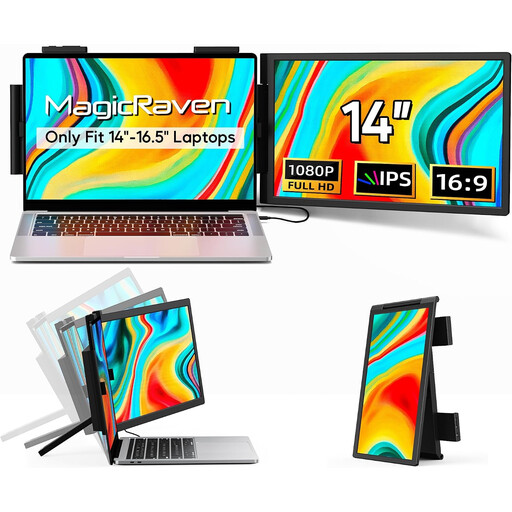
14-inch Dual-Screen Expansion, FHD 1080p
Could be worth considering as an extra laptop display if you want to show the letter and record on separate screens; compare the screen size with the way you work.
Listed in the product name: 14-inch, FHD 1080p, 60 Hz and IPS. Described as compatible with 14 to 16.5-inch laptops, as well as Windows, Mac and Android; HDMI, USB-A and USB-C are listed.
View at Joybuy
 No image available
KTC H27T27 Office Monitor, 27-inch
Could work for letter and data-entry windows arranged side by side, as long as both have enough room at your preferred text size.
Listed in the product name: 27-inch, 2560 × 1440 or QHD, Fast IPS and a tilt-adjustable stand.
View at Joybuy
 No image available
Samsung ViewFinity S7 S70H, 27-inch
Could be worth considering for viewing detailed digitised letters; set the display so that source fields are easy to read too.
Listed in the product name: 27-inch, 4K UHD and IPS.
View at Joybuy
Frequently asked questions
Can the monitor automatically link letter files to a family tree entry?
No. The screen displays your workspace; source references, links and file attachments are created in the relevant application. FamilySearch describes these options for its family tree. Check the features of the software you actually use.
How should I set up the display to read old letters?
Adjust magnification and text size so that the source and input fields are clear from where you sit, and avoid distracting reflections. The BAuA rule ASR A6 applies to screen-based work in workplaces and home-based workstations within its scope.
What should I check before connecting a laptop?
Compare your laptop’s supported video output and charging requirements with the connections and power delivery of the specific monitor. EIZO lists DisplayPort Alt Mode over USB-C and a maximum of 94 W for the EV2740X; this doesn’t prove compatibility with every USB-C laptop.
Are a guarantee and statutory consumer rights the same thing in Germany?
No. For a consumer purchase, your statutory rights apply against the seller; a guarantee is an additional voluntary promise subject to its own terms. The Verbraucherzentrale recommends getting any promised services in writing.
Can I put an old monitor in household rubbish?
No. The German Environment Agency advises that electrical and electronic waste must be collected separately from mixed municipal waste. Retail take-back schemes are subject to specific conditions.


