Who is a family pack a good choice for?

Households that regularly eat rusks

If several people enjoy rusks at coffee breaks, it’s worth considering not just the total weight but also how much you’ll need to store once the pack is opened. Individually wrapped packs can make it easier to enjoy them over several breaks.

Shoppers with specific ingredient requirements

If you check sugar levels, lactose or allergens, compare the exact variety you’re considering. Classic rusks and varieties with specific claims don’t necessarily have the same ingredients.

Shoppers buying in store

If you want to buy a particular pack from a supermarket or discount store, check availability at your local branch. For own-brand products, it’s also important to check the information on the specific pack.

What should you look for when buying?

First, check that the pack size and format suit how quickly you’ll get through it. Then consider the ingredients and where you can actually buy it.

What to considerWhat to checkWho should consider it?
Stocking up and keeping rusks crisp Compare the total weight and any individual packs with how quickly you’ll get through them; store opened rusks somewhere dry in an airtight container if possible. If several people will be helping themselves over a number of coffee breaks, I don’t want to leave the whole quantity open for too long. This stocking-up consideration is likely to be the top priority for around 31% of shoppers.
Ingredients and allergens Check the ingredients list, allergen information and sugar per 100 g for the exact variety. If everyone at the table is eating the same rusks, the ingredients need to suit their individual requirements. For around 31% of shoppers, ingredients and allergens are likely to be the main factor in their buying decision.
Where to buy Check availability at your chosen store or in your delivery area, as well as the information on the specific pack. I want to be able to get the family pack I’ve chosen where I shop, rather than rely on a general product image. Where to buy is likely to be the priority for around 23% of shoppers.
How you’ll enjoy them Check that classic slices and the recipe you’ve chosen are suitable for eating plain, topped or soaked. If I also want to top or soak my rusks, how I’ll use them matters more to me than stocking up on a large quantity. For around 15% of shoppers, this is likely to be their first buying priority.

Common buying mistakes

  • Focusing only on the total weight

    A large pack won’t stay crisp after opening just because it’s within its best-before date. That date applies to unopened products stored appropriately.

    Compare the amount you’ll get through between coffee breaks with the size of each individual pack. Store opened rusks somewhere dry in an airtight container if possible.

    If a large quantity is left open for too long, some of it may lose quality and go to waste.

  • Assuming ‘no added sugar’ means ‘sugar-free’

    REWE states that Brandt branded rusks with no added sugar contain 4.5 g of sugar per 100 g. So the claim doesn’t mean the sugar content is zero.

    Read the ingredients list and compare the sugar content per 100 g for the variety you want.

  • Taking ‘lactose-free’ to mean free from all allergens

    According to the product information, Brandt rusks labelled lactose-free contain ingredients including wheat and barley malt extract. The lactose-free claim doesn’t tell you whether these ingredients are present.

    If you have specific requirements, check the ingredients and highlighted allergens on the exact pack.

  • Assuming a particular pack will be available

    EDEKA notes that GUT&GÜNSTIG rusks may not be available in every store. A product being listed doesn’t necessarily mean you’ll find it where you plan to shop.

    Check availability at your chosen store or in your delivery area just before buying.

    An unsuccessful trip to the store costs you extra time.

Brands to consider

Brandt

Brandt describes its 450 g pack of classic branded rusks as a family pack. Separate 225 g varieties are also listed with no-added-sugar and lactose-free claims.

  • REWE lists 48 portions per pack for the classic 450 g branded rusks.
  • According to the product information, the classic branded rusks contain ingredients including wheat, barley, milk and soya. Claims made for other varieties don’t apply to this pack.

GUT&GÜNSTIG

EDEKA sells GUT&GÜNSTIG rusks in a 450 g pack containing three individual 150 g packs.

  • You can open the packs one at a time if you’ll be enjoying the rusks over several breaks.
  • EDEKA lists wheat, barley and milk, as well as possible traces of egg, sesame and soya, and advises checking the information on the specific pack.

GOLDÄHREN

ALDI SÜD sells a 450 g pack of GOLDÄHREN rusks.

  • You can compare the listed pack size with how much you’ll need for several coffee breaks.
  • ALDI SÜD notes that ingredients and nutritional information may vary between suppliers. So check the specific pack and its availability in store.

Rusks at Joybuy

This twin pack could be a good fit for regular shared coffee breaks if 450 g is the right amount for your household.
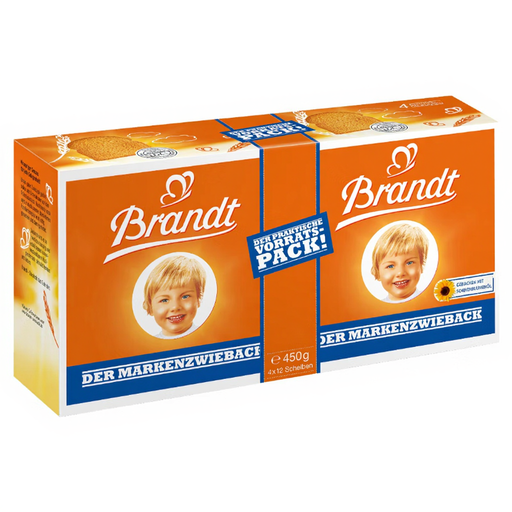
Brandt rusks, twin pack of 2 × 225 g

Brandt rusks, twin pack, 2 × 225 g

For regular rusk eaters at coffee breaks, if the total quantity suits your household.

The pack contains two 225 g units. Store opened rusks somewhere dry in an airtight container if possible.

The allergen information for egg is contradictory. If you have an egg allergy, check the label on the specific pack before buying.

View at Joybuy

Frequently asked questions

Is a 450 g pack automatically a good choice for several coffee breaks?

No. It depends on how quickly you’ll get through the opened pack. If it’ll take you a while, individual packs can help; store opened rusks somewhere dry in an airtight container if possible.

Are rusks with no added sugar sugar-free?

No. REWE states that Brandt branded rusks with no added sugar contain 4.5 g of sugar per 100 g. Compare the nutritional information per 100 g for the variety you want.

Are lactose-free rusks also free from gluten-containing grains?

Not necessarily: wheat flour and barley malt extract are listed in Brandt lactose-free rusks. When choosing a product, check the ingredients and allergen information on the specific pack rather than relying on the ‘lactose-free’ claim alone.

What does the best-before date mean for rusks?

The best-before date is not a use-by date. According to the German Food Federation, it indicates how long the product’s stated qualities are guaranteed for, provided it remains unopened and is stored appropriately. After this date, check the rusks for an unusual smell, a change in texture or mould. If you notice any of these, don’t eat them.