
Lieferung heute & morgen

Qualitätsgarantie

Willkommens-Angebote freischalten: KOSTENLOSE Lieferung | Bis zu 80 % RABATT | Kostenlose 30-Tage-JoyPlus-Testphase
App herunterladen
A family tent for 4 to 6 people needs to offer more than a large sleeping area. Families and groups generally need separate sleeping areas, a dry living space, effective ventilation and a setup that can be managed even without much camping experience. At the same time, some details in product descriptions can easily lead to unsuitable purchases.
The description “for 6 people” does not automatically mean six comfortable sleeping spaces with room for luggage. The key factors are the internal dimensions, the number of sleeping compartments and the usable living area. When choosing a camping tent for 5 or 6 people, you should also check whether the stated capacity is intended for adults, children or a mixture of both.
For family camping, a large tent with a sleeping compartment is often more practical than a single interior space. A porch or separate living area provides room for shoes, bags and shared meals.
A waterproof tent should include specific information about its hydrostatic head rating and seams. Figures such as 2,000 or 3,000 mm refer to the water pressure the fabric can withstand under test conditions. However, they are not the only guarantee of a dry interior.
You should also look for:
A pop-up tent, quick-pitch tent or inflatable tent can make setup easier. Even so, the overall weight, packed size and stability remain important criteria. An automatic aluminium pole system is convenient, but on a larger family tent it may weigh more than a simple dome tent.
For car camping, a higher weight is often less of an issue. If you need to carry the tent over longer distances, however, you should compare the packed size and net weight before buying.
For four people, a dedicated sleeping compartment may be sufficient if the tent is mainly used for sleeping. For longer stays, a tent with a porch or separate living area is a sensible choice. This helps keep sleeping spaces and luggage separate.
Do not compare the floor area only in square metres; also consider the layout. A tunnel tent often provides a long living zone, while a tipi tent creates plenty of standing height in the centre. However, the usable space around the edges may be more limited.
Polyester fabric with a PU coating is commonly used for family tents. Product details should ideally list the hydrostatic head rating for the outer tent and groundsheet separately. For example, the Portal 60514 is specified with a 3,000 mm hydrostatic head rating and a fully sewn-in groundsheet. These are verifiable material and construction details, but they are not a guarantee for every weather condition.
A groundsheet with taped seams reduces potential entry points for water. After camping, every tent should be dried completely before being stored. Moisture in the carry bag can encourage mould and unpleasant material odours.
Multiple doors, mesh windows and ventilation openings support air circulation. Cross-ventilation is particularly important in a family tent with several sleeping spaces, as condensation can form from exhaled air and wet clothing.
Blackout or coated outer materials can reduce the amount of light entering the tent. Some models also include specifications such as UPF50+ or UV30. These values relate to the material’s sun protection and should not be treated as complete protection from heat or UV radiation.
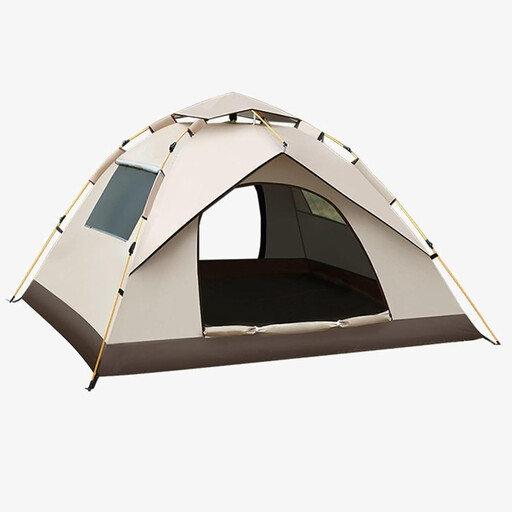
Why this product suits this profile: This inflatable tent is aimed at beginners and smaller families looking for an uncomplicated setup for short breaks or stays in the park. The stated capacity is more suitable for two to three adults or up to four children.
The description specifies a hydrostatic head rating of up to 3,000 mm, two doors and two windows. This provides key information about rain protection and ventilation. Nevertheless, the capacity limit should be taken into account.
Automatic opening system, detachable outer tent and a compact packed size of approximately 76 × 17 × 14 cm according to the product details.
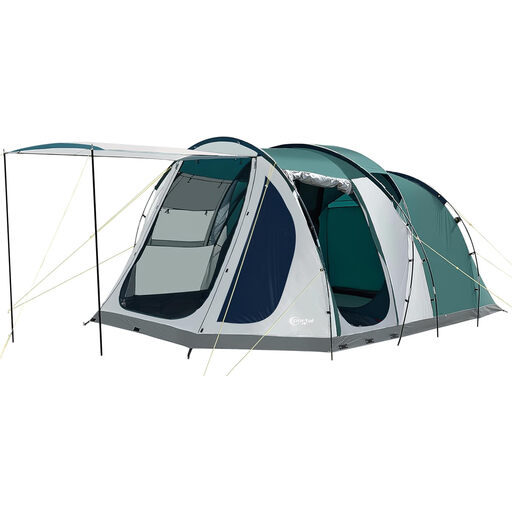
Why this product suits this profile: This tunnel tent offers separate sleeping and living areas, making it suitable for families who plan to stay in the same spot for several days while car camping.
The specifications state 7.05 m² of sleeping space, 5.8 m² of living space, a 3,000 mm hydrostatic head rating and a firmly sewn-in groundsheet. This makes it easier to assess the space required than by relying on the stated capacity alone.
Two doors, side windows, a rear ventilation opening and a mesh section between the living and sleeping areas; setup by two people is recommended.

Why this product suits this profile: This tipi tent is designed for glamping, group stays and trips where plenty of freedom of movement is important. Its 3-metre standing height can make the interior feel particularly spacious.
The product data lists the external and internal dimensions, material, a 3,000 mm hydrostatic head rating, taped seams and ten guy lines. This makes it easier to assess the available space and stability. The tall construction needs to be guyed out carefully.
450 × 390 cm floor area, 300 cm height, breathable inner tent, plus integrated mosquito nets and ventilation openings.
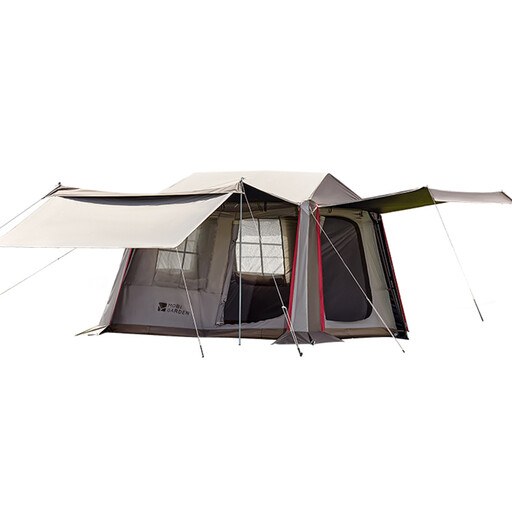
Why this product suits this profile: This quick-pitch tent is aimed at beginners in family camping who want a flexible living area for stays in the park or car camping. Its capacity is stated as 2–4 people.
The specifications state PU2000 mm for the outer material and groundsheet, as well as taped groundsheet seams. Mesh windows on all four sides support ventilation and insect protection. According to the stated capacity, it is not designed for five or six people.
Automatic aluminium pole system, 5.9 m² of tent space and approximately 15.2 m² of total space with the canopies extended.
We have put together a complete, regularly updated list of products that fully meet these strict selection criteria and the safety regulations applicable in the EU.
A family tent should be pitched on level ground that is free from sharp objects. Fully tension the outer tent, groundsheet and guy lines, even if the weather forecast initially looks dry. With a tunnel or tipi tent, correct guying has a significant effect on stability.
These basic rules will help extend its service life:
For four adults, a dedicated sleeping compartment is usually rather cramped, particularly with luggage. Separate sleeping areas and an additional living space are more practical. A camping tent for 4 people can be more compact for families with children, provided that clothing and equipment are stored outside or in the porch.
An inflatable tent can simplify setup through pre-assembled or automatic components. Nevertheless, check whether a pump is required, how the tent is guyed out and whether its weight is suitable for transport. “Automatic” does not mean that pegs and guy lines are unnecessary.
Its lifespan depends, among other things, on UV radiation, moisture, wind, cleaning and storage. A tent stored dry, with carefully maintained poles and intact seams, can remain usable for longer than one that is regularly packed away wet or left exposed to sunlight for long periods. Technical details such as material thickness and hydrostatic head rating can help with your initial selection, but they do not replace regular care.