Cooks with limited worktop space
If your holiday home kitchen is small, the oven’s external dimensions, a suitable place to position it and its usable interior all need to work together.


When choosing a fan-assisted countertop oven, first check that your fillet and roasting dish will fit, and that the location meets the instructions for that specific appliance. A larger oven may give you more room for other oven-cooked dishes, but it will also take up more worktop space. For core temperature, the Federal Institute for Risk Assessment (BfR) recommends at least 70 °C for two minutes throughout the food. A recipe suggesting 60–65 °C for pink pork fillet has a different aim, so the two recommendations are not interchangeable.
If your holiday home kitchen is small, the oven’s external dimensions, a suitable place to position it and its usable interior all need to work together.
If you want to cook a whole fillet in a dish, compare the internal and tray dimensions rather than relying on the stated capacity in litres.
If you also want to bake or cook side dishes in the oven, weigh up the cooking functions you need against the space required.
For cooking pork fillet in a holiday home, the main considerations are whether the dish fits the oven, whether there’s a suitable place to position it, how you’ll check that the meat is cooked, and whether any extra features will be useful day to day.
| What matters | What to check before buying | Who is this important to? |
|---|---|---|
| Will the fillet and dish fit? | Measure the fillet and dish, then compare them with the internal and tray dimensions of the specific model. CASO gives the TO 20 SilverStyle’s internal dimensions as 300 × 170 × 290 mm (W × H × D); Rommelsbacher lists the BGE 1580/E tray as 32.5 × 28.5 cm. | If I want to cook a whole fillet in a dish I already own, I need the usable dimensions to match, not just a capacity in litres. Roughly 33% of consumers prioritise fit. |
| Is there a suitable place to position it? | Check the external dimensions, connection requirements and clearances specified in the instructions for that model. CASO gives the TO 20 SilverStyle’s external dimensions as 450 × 270 × 395 mm (W × H × D). The instructions for the Steba KB 23 specify, among other things, a 10 cm gap from the kitchen wall; this does not automatically apply to other models. | If worktop space is limited, I want to know in advance whether I can position the appliance safely with the required clearances. Roughly 27% of consumers prioritise checking where the appliance will go. |
| How can I check whether the food is cooked? | An oven setting is no substitute for measuring the temperature inside the meat. The BfR recommends heating food to at least 70 °C throughout for two minutes. The Animal Welfare Initiative gives a core temperature of 60–65 °C for pink pork fillet; this is a different target. | If getting the food cooked to the right level matters to me, I want to be able to check its temperature and understand the relevant cooking recommendation. Roughly 27% of consumers prioritise monitoring how thoroughly food is cooked. |
| Are extra features worth having? | Consider only cooking functions, accessories and cleaning features you’ll actually use. Rommelsbacher says the BGE 1580/E has switchable fan-assisted cooking and a removable crumb tray. The consumer advice centre recommends looking at actual electricity use rather than estimating consumption from the appliance’s size or energy-efficiency rating alone. | If I want to use the oven for other dishes too, the right cooking functions and easy cleaning matter to me. Roughly 13% of consumers prioritise versatility. |
The oven’s capacity does not tell you whether a particular dish will fit or whether there will be enough space between it and the heating elements.
Before you buy, compare the dimensions of your fillet and dish with the internal dimensions or tray size of the specific model.
Cooking functions vary from model to model. For example, Severin says the TO 2052 does not have a fan-assisted cooking function.
Check that fan-assisted cooking is specifically listed for the exact model you’re considering.
The Animal Welfare Initiative recommends a core temperature of 60–65 °C for pink pork fillet. This is not the same as the BfR recommendation to heat food to at least 70 °C throughout for two minutes.
Check the temperature inside the meat with a food thermometer, and treat the recipe’s target and general food-safety advice as separate recommendations.
The rated power alone does not show how much electricity an appliance will use in a particular situation.
Compare consumption figures only when they’re based on comparable tests and usage. The consumer advice centre recommends taking the appliance’s actual consumption into account.
The BGE 1580/E is a 30-litre fan-assisted countertop oven.
The TO 20 SilverStyle is a freestanding fan-assisted oven with a capacity of around 20 litres.
Features vary between models: the TO 2068 is a 20-litre baking and toast oven with fan-assisted cooking, while the TO 2074 combines a 30-litre oven with fan-assisted cooking and two hotplates.
The KB 27 U.2 is a 20-litre oven with a continuously running fan and separately selectable conventional heating functions.
This selection includes mini and countertop ovens for compact kitchens and a range of oven-cooked dishes. If you need fan-assisted cooking, check that this function is listed for the exact model.
 Image unavailable
The 32-litre capacity may suit a range of oven-cooked dishes. For the food you want to prepare, check whether this model includes fan-assisted cooking.
The product name lists a capacity of 32 l and power of 1600 W. The product description says a baking tray, wire rack and crumb tray are included. It also lists a temperature range of 100 to 250 °C and a 60-minute timer.
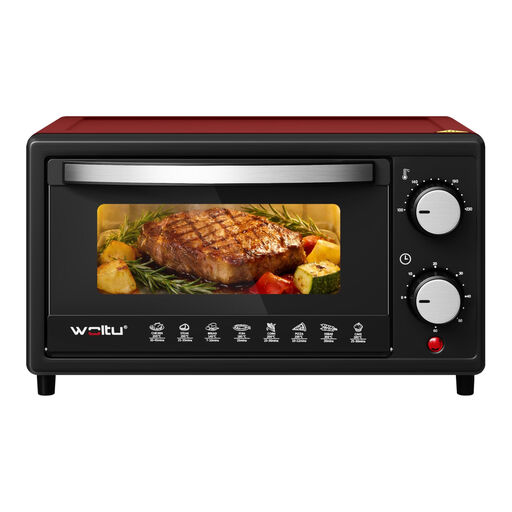 Image unavailable
This compact appliance is described as suitable for smaller oven-cooked dishes. If you need fan-assisted cooking, check that the exact model includes this function before buying.
The product information lists a capacity of 10 l, power of 800 W and a temperature range of 100 to 230 °C. A baking tray and wire rack are included, according to the description, which also lists a 60-minute timer.
 Image unavailable
The product title specifically describes this model as a mini convection oven. Still, compare the dimensions of the oven cavity and your dish before planning to cook a whole fillet in it.
The product description lists a capacity of 28 l, three heating modes, a temperature range of 100 to 230 °C and a 60-minute timer. A baking tray, wire rack and crumb tray are also listed.
No. The oven setting alone does not tell you the temperature throughout the meat. The BfR recommends heating food to at least 70 °C throughout for two minutes. The Animal Welfare Initiative’s recommendation of 60–65 °C for pink pork fillet has a different aim and should not be described as meeting the BfR recommendation.
No. Before using it, check the instructions for the specific appliance. The instructions for the Steba KB 23 explicitly state that it is not designed for built-in installation and specify an accessible, earthed socket and a 10 cm gap behind the appliance from the kitchen wall. These requirements apply to this model and do not automatically apply to other ovens.
Let the appliance cool down and follow the instructions for the model you own. Rommelsbacher lists a removable crumb tray and a detachable door for the BGE 1580/E; this does not tell you how to clean other models.
If the appliance is faulty, you have statutory rights against the seller. The first step may be to ask them to put things right by repairing or replacing it. A manufacturer’s voluntary guarantee is separate and subject to its own terms. The consumer advice centre also highlights this distinction.
Electrical appliances covered by the relevant harmonised EU rules must carry the CE marking. The European Union says that the manufacturer uses it to declare conformity with the applicable product rules. It is not an independent quality assessment and does not prove that a model will suit your roasting dish or the place where you plan to put it.