
Lieferung heute & morgen

Qualitätsgarantie

Willkommens-Angebote freischalten: KOSTENLOSE Lieferung | Bis zu 80 % RABATT | Kostenlose 30-Tage-JoyPlus-Testphase
App herunterladen
A fan heater can warm up a bedroom, office, study or smaller living area quickly. The choice ranges from a basic electric fan heater to a ceramic fan heater with a thermostat, remote control and timer. However, technical terms such as “Eco”, “quiet” or “fast heat” are not always directly comparable.
Three common buying misconceptions are particularly likely to lead to disappointment:
The right power level depends on the room size, insulation, ceiling height, outside temperature and how quickly you want the room to heat up. For a small area around a desk, a unit with 750 to 1500 W may be sufficient. Larger, well-insulated rooms often call for 2000-W fan heaters or other electric heaters.
Important: The stated room size is generally a manufacturer’s specification, not a guarantee of a particular room temperature. A product described as suitable for 15 to 25 m² may perform differently in a poorly insulated room than in a modern, well-insulated one.
A fan heater usually works with a fan and a heating element. It warms the air quickly, but the heat is distributed evenly only when there is sufficient air circulation. Furniture, curtains and walls should not obstruct the airflow.
A ceramic fan heater often uses a PTC heating element. PTC refers to an electrical resistance whose behaviour depends on temperature. Product specifications may list different power settings, such as 900, 1300 and 1500 W or 1000 and 2000 W.
The following points are relevant when comparing models:
A fan heater with thermostat is useful for anyone who does not want to keep adjusting the settings manually. Oscillation through 45, 70, 90 or 120 degrees can distribute warm air across a wider angle. It does not, however, replace the need for a clear area around the heater.
For a quiet fan heater in the bedroom or office, specific decibel figures are more useful than general advertising claims. The product specifications of the models featured include figures such as under 51 dB, around 34 dB or 25 to 42 dB. As measuring conditions and power settings can vary, these figures should be treated as a guide.
A fan heater with timer switches off automatically after a set period. Depending on the model, the timer may run for up to 12 or 24 hours. A remote control makes it easier to operate the heater from your bed or desk. For households with children, a child lock may also be relevant.
A portable fan heater should be placed on a level, stable and heat-resistant surface. Carpets, bed linen and soft surfaces can affect its stability or air supply.
Look out for the following functions and information:
Before buying, you should also check the CE marking, operating instructions, manufacturer’s information and details of the responsible person in the EU. A marking alone does not indicate how suitable a heater is for your particular room.
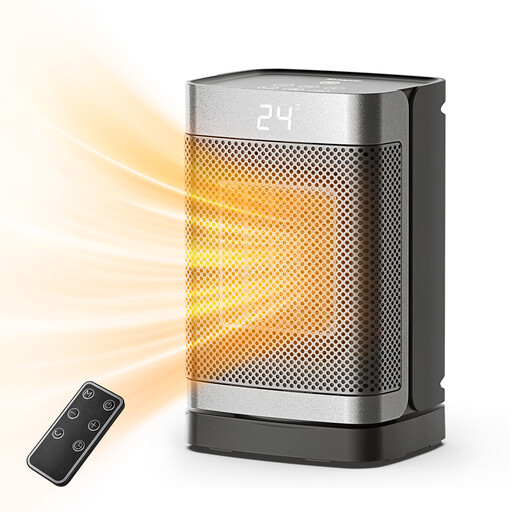
Why this product suits this profile: This compact heater is designed for bedrooms, offices and smaller personal areas, and offers two heat settings plus a remote control.
The 12-hour shut-off limits extended operating times. Tip-over protection and overheating protection are expressly listed in the product specifications.
1500 W, LED display, remote control, oscillation and a compact design with a stated weight of approximately 1.8 kg.

Why this product suits this profile: This model combines 2000 W, an adjustable thermostat from 5 to 35 °C, a remote control and 70-degree oscillation.
The manufacturer specifies noise levels of 25 to 42 dB, along with several safety features rather than making just a general safety statement.
PTC ceramic element, stated heating coverage of 15–25 m², 24-hour timer, ECO mode, tip-over protection and overheating protection.

Why this product suits this profile: With its compact design, remote control, timer and low stated noise levels, this model is suitable for bedrooms, studies and offices.
The manufacturer states 34 dB, as well as a range of 25 to 42 dB. Tip-over protection and overheating detection are also listed.
1500 W, temperature range from 5 to 35 °C, 12-hour timer, PTC technology and a stated weight of approximately 1.44 kg.
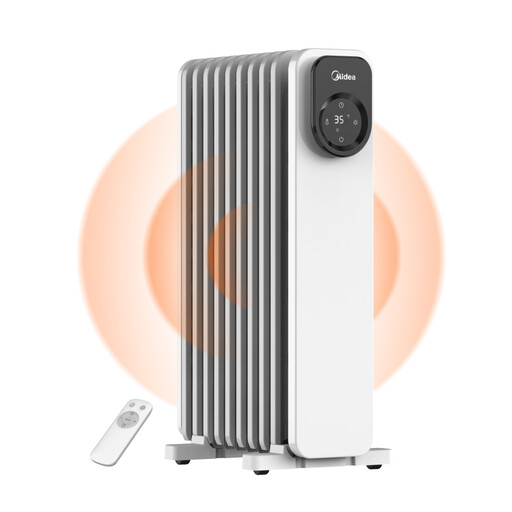
Why this product suits this profile: As a portable oil radiator with a thermostat, remote control and 2000 W, this heater is aimed at users who prefer consistent heat output rather than an immediate airflow.
The product description expressly recommends using it in well-insulated rooms or occasionally. This helps prevent unrealistic expectations about heating costs.
Nine fins, four operating modes, LED touchscreen, remote control, plus overheating and tip-over protection according to the product specifications.
We have put together a complete, regularly updated list of products that fully meet these strict selection criteria and the safety regulations applicable in the EU.
The cost of an electric fan heater can be estimated as follows:
Power in kW × operating time in hours × electricity price per kWh = electricity cost
A 2000-W fan heater is equivalent to 2 kW. If it runs for three hours, it will theoretically use 6 kWh when operating continuously at full power. A thermostat, ECO mode and lower heat settings can reduce the actual running time or power consumption. However, the precise saving depends on the room, settings and electricity tariff, so it should not be promised as a general rule.
A portable room heater can be practical for occasional supplementary warmth. However, a compact fan heater is often unsuitable as the main heating source for poorly insulated or large rooms. Before buying, check the room size, the intended operating time and the connection requirements.
For small personal areas, 750 to 1500 W may be sufficient. A 2000-W fan heater offers more maximum power, but uses proportionally more electrical energy at full output. Insulation and room size are equally important when choosing a model.
A thermostat can reduce the heat output or interrupt the heating process once the set temperature has been reached. This can reduce the operating time. Actual consumption depends on the room, temperature, insulation and duration of use.
This depends on the operating instructions and safety features of the model in question. Place the heater securely and away from textiles, do not cover it and never leave it unattended. A timer, tip-over protection and overheating protection can provide additional features, but they do not replace safe operation.