
Lieferung heute & morgen

Qualitätsgarantie

Willkommens-Angebote freischalten: KOSTENLOSE Lieferung | Bis zu 80 % RABATT | Kostenlose 30-Tage-JoyPlus-Testphase
App herunterladen
A dead laptop battery right before a major presentation or a smartphone that dies on you while travelling—these situations are more than just an annoyance. A high-performance power bank with fast-charging capabilities is the solution. However, the market is crowded and full of technical promises that don't always deliver. Many buyers invest in a device that fails to meet their expectations because critical details get lost in the marketing.
This guide will show you which critical features to look for to make an informed decision. We'll highlight the most common pitfalls and explain the technical specifications that truly matter.
Before you invest, you should be aware of the typical marketing traps that often lead to a bad purchase.
To make the right choice, focus on these three objective criteria.
Capacity is usually listed in mAh, but for a direct comparison and for air travel, the energy content in Watt-hours (Wh) is the more accurate metric. It is calculated from the capacity (in ampere-hours, Ah) and the voltage (in volts, V).
For air travel, an internationally recognised limit applies: Power banks up to 100 Wh are generally allowed in carry-on luggage. Devices between 100 Wh and 160 Wh often require airline approval. A flight-safe power bank should therefore be under 100 Wh. For example, a typical 20,000 mAh power bank with a 3.7V cell voltage has 74 Wh (20 Ah × 3.7 V), making it compliant.
The charging speed, measured in watts (W), determines how quickly your devices are charged. Look for the following standards:
The variety of ports and integrated features determine the user convenience.
Here are some recommendations tailored to specific use cases that avoid the pitfalls mentioned.
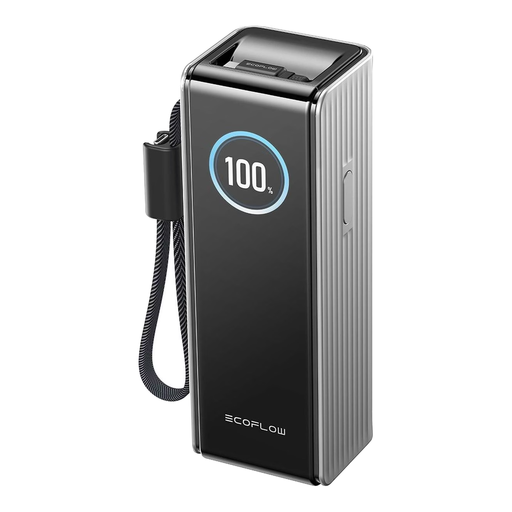
Why This Fits Their Persona: Ideal for professionals and travellers who need to charge multiple devices, including a laptop, at maximum speed. Its high capacity and power output make it a mobile charging station.
Solves the vague 'fast charging' problem with a clear specification of 100W Power Delivery per USB-C port. The integrated, retractable cable also prevents tangled messes and ensures you're never without it.
High total output of 170W for charging up to four devices. The 25,000 mAh (90 Wh) capacity is flight-safe. The TFT display provides detailed, real-time information.
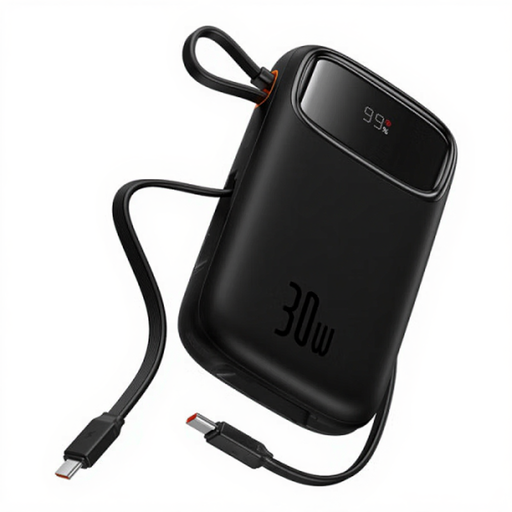
Why This Fits Their Persona: Perfect for commuters and students who need a compact yet powerful solution for their smartphone and accessories. The built-in cable makes it extremely convenient for on-the-go use.
The 30W PD fast-charging capability is clearly specified and sufficient for modern smartphones. The digital display shows the true remaining capacity, preventing any unpleasant surprises.
Compact design with two integrated USB-C cables for maximum flexibility. The 10,000 mAh capacity offers a great balance of size and power for daily use.
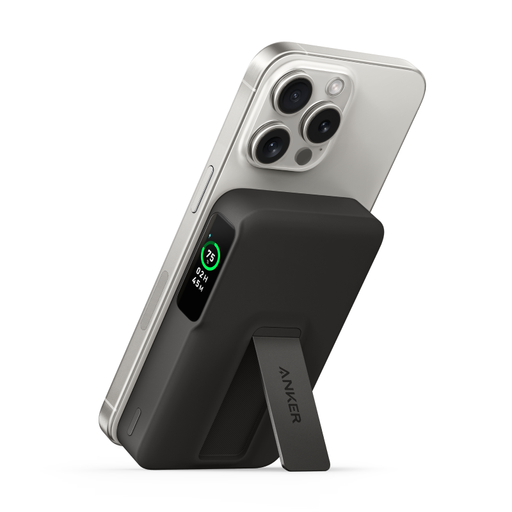
Why This Fits Their Persona: Designed for iPhone users who want a seamless, wireless charging experience. The magnetic attachment and integrated kickstand are perfect for media consumption while charging.
It relies on the future-proof Qi2 standard, which offers a guaranteed 15W charging speed—twice as fast as many older MagSafe-compatible or Qi chargers.
The combination of 10,000 mAh capacity, 15W wireless charging, and a smart display that shows remaining charging time offers a high degree of convenience and control.
We've compiled a complete, up-to-date list of products that fully meet these strict selection criteria and UK safety regulations.
This depends on your smartphone's battery capacity and the power bank's efficiency. As a rule of thumb, a 10000mAh power bank with a rated capacity of around 6,500 mAh can fully charge an iPhone 15 Pro (approx. 3,274 mAh) about 1.8 to 2 times. A Samsung Galaxy S24 (approx. 4,000 mAh) can be charged about 1.5 times.
Yes, power banks are allowed in carry-on luggage as long as their energy content does not exceed 100 Watt-hours (Wh). Most commercially available power banks, even models with 20,000 mAh or 25,000 mAh, fall below this limit and are therefore flight-safe. Transporting them in checked luggage is prohibited for safety reasons.
Power Delivery (PD) is a universal fast-charging standard that works via the USB-C port. It allows for a flexible and significantly higher power output than conventional USB standards. A power bank with PD can intelligently adjust the charging voltage and current to match the connected device—from a small smartphone to a powerful laptop. This ensures safe and maximally fast charging.