
Lieferung heute & morgen

Qualitätsgarantie

Willkommens-Angebote freischalten: KOSTENLOSE Lieferung | Bis zu 80 % RABATT | Kostenlose 30-Tage-JoyPlus-Testphase
App herunterladen
A foldable e-bike with wide tires promises maximum flexibility: it combines the all-terrain capability of a fat bike with the space-saving format of a folding bike and the assistance of an electric motor. However, the market is filled with models whose marketing promises often don't hold up to reality. Before you make an investment, it's crucial to know the common pitfalls that can lead to disappointment and unnecessary expenses.
The most common problems stem from three critical errors in judgment when buying:
To avoid a bad purchase, you should base your decision on objective technical data. Focus on three core areas that directly impact your e-bike's performance and everyday usability.
The most important metric for an e-bike's endurance is its battery capacity, measured in watt-hours (Wh). It's calculated from the voltage (Volts, V) and the nominal charge (amp-hours, Ah). For example, a battery with 48V and 20Ah provides 960 Wh. For a heavier long-range fat bike, a capacity of over 700 Wh is recommended to reliably cover distances of 60 km and more, even in demanding conditions. The motor should not exceed a nominal continuous power of 250 watts to be classified as a pedelec in Germany and be rideable without an insurance plate.
Most foldable fat bikes use 20-inch tires. A 20-inch folding e-bike represents a good balance between compact folded dimensions and stable handling. The typical 4.0-inch tire width provides cushioning and traction on loose surfaces, making it an ideal foldable all-terrain e-bike. For users who need maximum compactness, such as RV owners or commuters with limited storage space, models with 16-inch tires can also be a sensible alternative. Always check the exact folded dimensions on the spec sheet and compare them with your available space.
With a total weight often exceeding 30 kg plus the rider, hydraulic disc brakes are not an option, but a necessity. Unlike mechanical brakes, they offer significantly higher, more consistent, and better-modulated stopping power with less effort at the brake lever. The frame, usually made of an aluminium alloy, should feature clean welds and a robust-looking folding mechanism. A sturdy frame is the foundation for a safe folding e-bike for commuters and for use as a camping e-bike.
Instead of making a one-size-fits-all recommendation, we have identified models that meet specific user needs and purposefully avoid the pitfalls mentioned earlier.
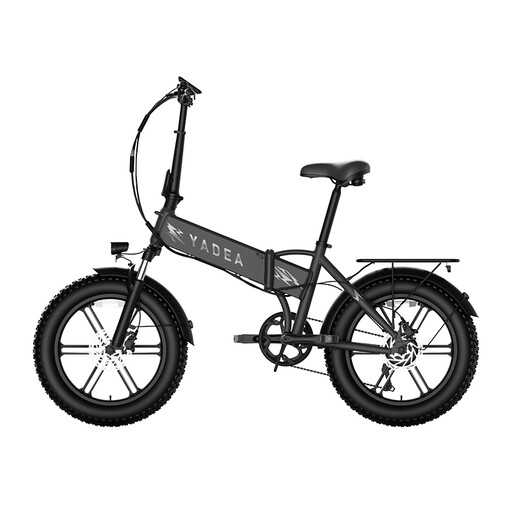
Why This Fits Their Persona: Ideal for riders looking for a versatile e-bike for the daily commute and for weekend trips on forest and gravel paths. The combination of 20-inch tires, a suspension fork, and a Shimano drivetrain offers comfort and reliability on varied terrain.
The inclusion of hydraulic disc brakes directly addresses the safety requirements for a heavy bike. The stated range of 90–120 km is backed by a high-capacity battery and is more realistic for mixed-use profiles.
Shimano 7-speed drivetrain for efficient power transfer and a lockable suspension fork to adapt to road or off-road conditions. CE certified according to EN 15194.
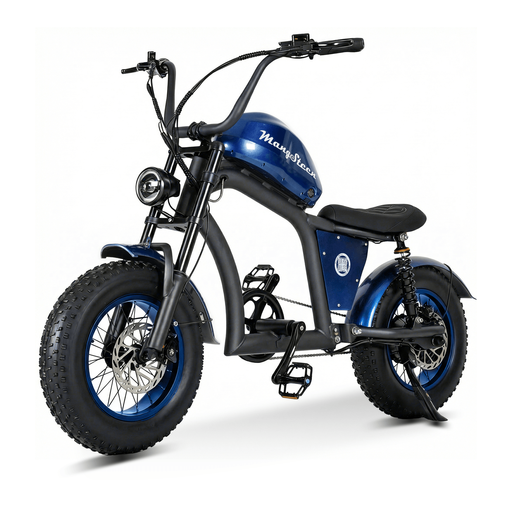
Why This Fits Their Persona: Perfect for users with extremely limited storage space, such as RV owners or commuters who store their bike in an apartment or office. The 16-inch format is exceptionally compact, yet still offers comfort and all-terrain capability thanks to its 4.0-inch tires.
Despite its small size, it avoids the range trap with an exceptionally large 48V 22.5Ah battery (1080 Wh). Furthermore, it is equipped with front and rear hydraulic disc brakes, which is not a given for this compact form factor and ensures high safety.
Extremely high battery capacity for its class, enabling a range of up to 100 km (according to manufacturer claims). The battery is removable for flexible charging.
The selection of all-terrain bikes and accessories is vast. If you want to compare more models with rugged tires for various surfaces, you'll find a suitable collection here.
No, generally not. As long as it is a so-called Pedelec (Pedal Electric Cycle) that meets the following criteria, it is legally treated like a bicycle:
Weight is a key factor for handling the bike when folded. Due to the robust frame, motor, large battery, and wide tires, most models weigh between 28 and 35 kilograms. Lighter models are rare and often come with significant compromises in battery size or stability. Consider this weight if you need to carry the bike regularly, for instance, into an apartment or onto public transport.
Maintenance is straightforward but crucial for longevity and safety.