
Lieferung heute & morgen

Qualitätsgarantie
App herunterladen
Kategorien
A fat bike, often described as a mountain bike with thick tires, is distinguished by its exceptionally wide tires. This design creates a large contact patch with the ground. By reducing tire pressure, the rider's weight is distributed over a larger area, which minimises sinking into soft surfaces like sand, snow, or mud. These physical properties make the fat bike a versatile all-terrain bicycle, capable of being used on surfaces where conventional mountain bikes would reach their limits.
Selecting the right fat bike is based on objective technical parameters. It is crucial to match the tire size, frame material, and braking system to the intended use and the rider's height.
The wheel size, measured in inches, is a primary criterion that directly correlates with the user's height.
The tire width on fat bikes is typically 4.0 inches. This width is the key to their characteristic off-road capability, especially as a bike for snow and sand.
The frame forms the skeleton of the bicycle. Many entry-level and recreational models use Hi-Ten steel (high-tensile steel). This material is characterised by its high robustness and durability. Compared to aluminium frames, steel has superior natural damping properties, meaning it can better absorb vibrations and minor impacts from the ground. This contributes to a more comfortable ride on uneven trails.
For a bicycle designed for challenging terrain and changing weather conditions, a reliable braking system is essential. A mountain bike with disc brakes offers clear functional advantages over rim brakes. Mechanical disc brakes, as found on many fat bikes, provide consistent braking performance that is less affected by wetness, mud, or snow. The braking force is generally easy to modulate and sufficient for controlled stops in most riding situations.
A derailleur system with multiple gears is of great importance for an all-terrain bicycle. It allows the rider to adapt the gear ratio to the specific incline and surface. A 7-speed drivetrain, for example from Shimano, represents a proven and functional base configuration that is sufficient for most recreational applications, from climbs to flat sections.
The following models from the HILAND Fatbike brand are based on the technical specifications mentioned above and are aimed at budget-conscious beginners and recreational riders.
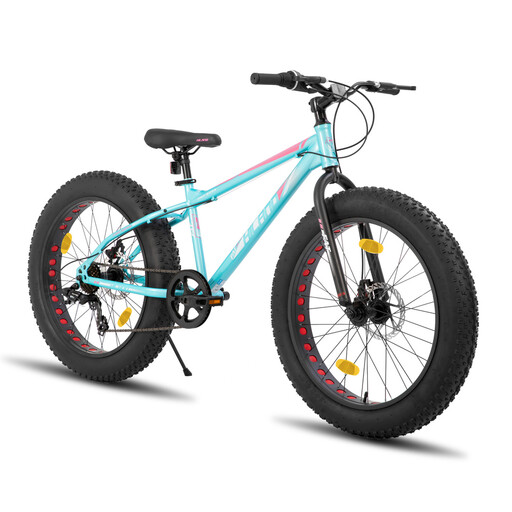
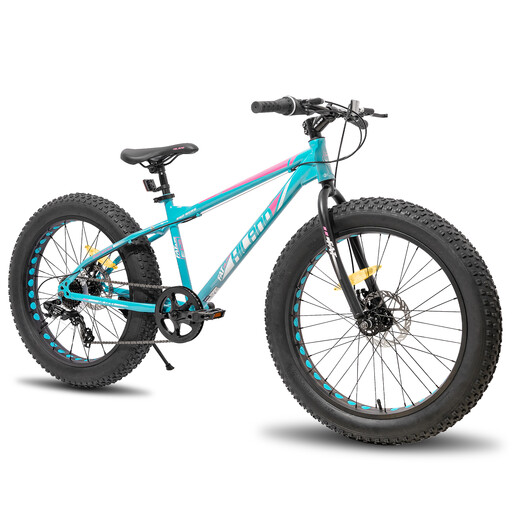
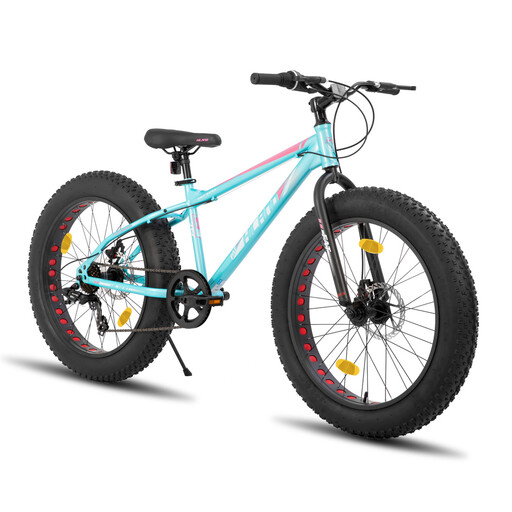
While fat bikes offer great versatility, a classic children's bike can be a sensible alternative for very young riders or for primary use on paved paths. You can find a selection of corresponding models in our Girls' Bikes category.
1. Can you ride a fat bike on asphalt? Yes, riding on asphalt is possible. However, due to the wide tires and the associated higher rolling resistance, it is less efficient than with a road or trekking bike. The riding comfort is high due to the excellent damping, but the speed is lower.
2. Are fat bikes hard to pedal? The effort required is higher compared to a bike with narrow tires, especially when accelerating and on solid ground. However, on the terrain they are designed for (e.g., sand or snow), the wide tires allow you to keep moving where other bikes would get stuck. The drivetrain helps to adjust the pedalling resistance to the terrain.
3. What is a fat bike mainly good for? A fat bike is primarily designed for riding on soft, loose, or uneven surfaces. This includes sandy beaches, snowy trails, muddy forest paths, and gravel tracks. Its strength lies in its ability to provide traction and stability where narrow tires fail.