
Lieferung heute & morgen

Qualitätsgarantie

Willkommens-Angebote freischalten: KOSTENLOSE Lieferung | Bis zu 80 % RABATT | Kostenlose 30-Tage-JoyPlus-Testphase
App herunterladen
High-quality duvets and feather pillows differ in more than just price. The key factors are the filling ratio, fill weight, cover, dimensions and verifiable certifications. If you focus only on terms such as ‘extra warm’, ‘luxurious’ or ‘hypoallergenic’, you could end up buying a duvet that doesn’t suit the way you sleep or the temperature of your room.
A higher fill weight doesn’t automatically mean greater comfort. Depending on the type of filling and the blend, a winter duvet containing down and feathers will weigh more than one with a high down content. Down forms light, lofty pockets of air, while feathers add structure and weight.
Always compare the filling ratio and fill weight together. A summer duvet containing down and feathers often has a lower fill weight per square metre, while a warm feather duvet for cold rooms can be considerably heavier.
A duvet described as ‘extra warm’ may feel too warm in a well-heated bedroom. Conversely, a lightweight duvet may not be warm enough if your room is cool. Room temperature, how warm or cool you tend to feel, and whether you’ll use the duvet in summer or winter matter more than marketing labels.
Claims such as OEKO-TEX-certified down duvet, RDS-certified duvet or ‘suitable for allergy sufferers’ should be clearly supported by the product information. For example, a certificate may apply to the cover, rather than automatically covering every component. If you have sensitive skin, also check the cover material, washing instructions and manufacturer’s information. Certification is not a substitute for personal medical advice.
Down is soft and lightweight, while feathers have a firmer quill and give the filling more structure. A product with 70% down and 30% feathers will generally feel different from one filled with 30% down and 70% feathers. The latter may appeal if you prefer a duvet with more structure and weight.
Also check the filling weight per square metre. The products featured here range from 200 g/m² for lightweight summer options to 350 g/m² for warmer duvets. According to their product descriptions, some winter duvets have a fill weight of 650 g/m².
A cotton percale cover is tightly woven and has a smooth feel. When choosing a duvet, consider the material, thread density and construction. A 100% cotton cover can absorb moisture and feels comfortable against the skin for many people. Even a breathable duvet should be aired regularly, but avoid leaving it in direct, strong sunlight for long periods.
Square quilting helps keep the filling in separate compartments, reducing movement. Also check whether the duvet has fastening points if you plan to use a cover with ties.
Choosing the right dimensions helps prevent your duvet from shifting during the night. For a single bed, you could choose a 140x200 cm down duvet or a 155x220 cm down duvet. Larger single or double beds may need a 200x200 cm, 220x240 cm, 240x260 cm or 240x280 cm down duvet.
Before buying, measure your existing bedding and check how much extra length you’d like. Couples should also decide whether they’d prefer to share one duvet or use two separate duvets with different warmth ratings.
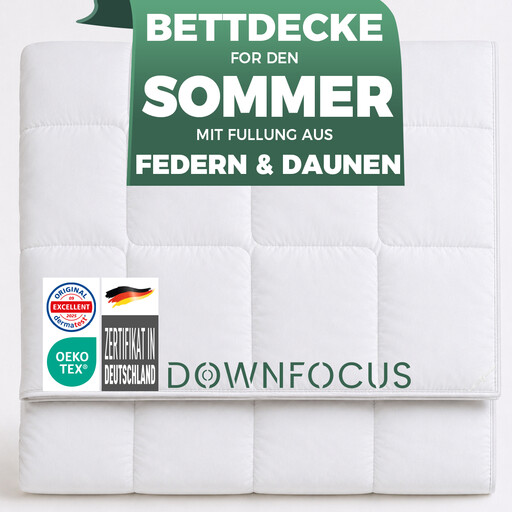
Why this product suits this profile: This 155 × 220 cm summer duvet is a good choice if you’re looking for a lightweight option for warm nights. According to the product information, it has a fill weight of 200 g/m² and is made with 10% down and 90% feathers.
The stated fill weight makes it easier to distinguish a lightweight summer duvet from a winter-weight option. Check the product page for certification details before buying.
155 × 220 cm, 200 g/m², 100% cotton cover according to the product information, plus references to OEKO-TEX and RDS.

Why this product suits this profile: According to La Couette Française’s product information, this duvet is made in France and contains 70% down and 30% feathers, with a fill weight of 250 g/m². The cover is made from 100% cotton percale with a thread density of 91 threads/cm².
The stated blend and fill weight make it easier to check that the materials meet your needs. According to the product description, the square quilting helps keep the filling evenly distributed.
240 × 260 cm, 250 g/m², cotton percale, machine washable at 40 degrees and a five-year commercial warranty according to the product information.

Why this product suits this profile: This pillow is a good choice if you’re looking for a soft pillow in a classic size. According to the product information, it contains 70% down and has a cover made from 100% cotton percale.
The precise size and down content make it easier to find a suitable match for your existing pillowcases. Checking the care instructions first helps you avoid washing the pillow incorrectly.
65 × 65 cm, 70% down, cotton percale, machine washable at 40 °C and a five-year commercial warranty according to the product information.
We’ve put together a comprehensive, regularly updated list of products that meet these strict selection criteria and the safety regulations in force across the EU.
Always follow the care label. Some products are machine washable at 40 °C, while feather pillows may be suitable for higher washing temperatures. After washing, make sure the duvet is completely dry so that no moisture remains in the filling. Regularly fluffing it helps redistribute the filling, but it doesn’t replace professional cleaning if the manufacturer recommends it.
If you have sensitive skin, a tightly woven cover, regularly changed bedding and a dry sleeping environment can all help. Claims such as hypoallergenic duvet should be understood as a feature of the specific product, not a general guarantee that it won’t cause a reaction.
Common options for a standard single bed are 140 × 200 cm or 155 × 220 cm. The right choice depends on your bed size, height and preferred extra length. Before buying, make sure the duvet dimensions match your existing cover.
Lifespan depends on the quality of the filling and cover, how often the bedding is used, and how it’s cared for and stored. Air bedding in a dry place, avoid storing it compressed for long periods and follow the washing instructions. A warranty, such as the five-year warranty offered on some products, sets out the manufacturer’s terms and doesn’t automatically guarantee a particular overall lifespan.
There’s no single answer. Check the cover, certifications, filling and care instructions. If you have a known allergy or skin condition, speak to a doctor when deciding which product to choose.