
Lieferung heute & morgen

Qualitätsgarantie

Willkommens-Angebote freischalten: KOSTENLOSE Lieferung | Bis zu 80 % RABATT | Kostenlose 30-Tage-JoyPlus-Testphase
App herunterladen
Felt-tip pens vary considerably in terms of nib, ink, ergonomics and intended use. An affordable pen set may be perfectly adequate for children’s drawings, while illustrators or students working on journalling and sketches have different requirements. However, if you only look at the number of colours, you can easily end up buying duplicate shades, unsuitable nibs or ink that bleeds through the paper.
A set with 50 or 60 colours may seem comprehensive. What matters, however, is whether the shades are genuinely suitable for your project and clearly distinguishable. A few basic colours are often enough for schoolwork. For portraits, fashion drawings or illustrations, graduated skin tones, greys and shades may be more useful than a large assortment with no colour system.
A colour chart or numbered caps makes choosing easier. With larger sets, you should also check whether a blender, replacement nibs or a storage solution is included.
Water-soluble ink can be blended with water on suitable paper. This does not automatically mean that stains will come out completely from every textile. Even children’s felt-tip pens described as washable can leave marks on delicate fabrics. Fresh stains should be treated as quickly as possible in line with the care instructions for the particular textile.
For artwork, it is also important to know whether the ink spreads in a controlled way on watercolour paper or bleeds on thin copier paper.
A fine fibre nib is suitable for outlines and notes, while a broad or flexible brush nib allows you to cover larger areas and create variable line widths. A classic highlighter with a chisel tip, on the other hand, is designed for marking passages of text and is not automatically suitable for detailed drawings. With dual-tip markers, buyers should therefore check both nib types and their specific line widths.
For everyday writing and colouring tasks, robust fibre nibs with a line width of around 1 mm are practical. Broad, rounded nibs distribute colour evenly over large areas and are easier for younger children to control. Brush pens with flexible brush nibs are suitable for variable lines, hand lettering and calligraphy.
Highlighters often have a chisel tip with several usable widths, for example 1 to 5 mm. The angle determines whether you create a fine underline or a broader mark.
A triangular or hexagonal barrel can help support the correct finger position. For small children, a broad barrel, a pressure-resistant nib and a ventilated safety cap are important features. Pen caps and replacement parts are small parts that could be swallowed. Recommended ages and warnings should therefore be taken into account before buying.
To maximise their lifespan, close the caps firmly after every use and store the pens according to the manufacturer’s instructions. For many water-based fibre-tip pens, horizontal storage is advisable so that the ink remains evenly distributed.
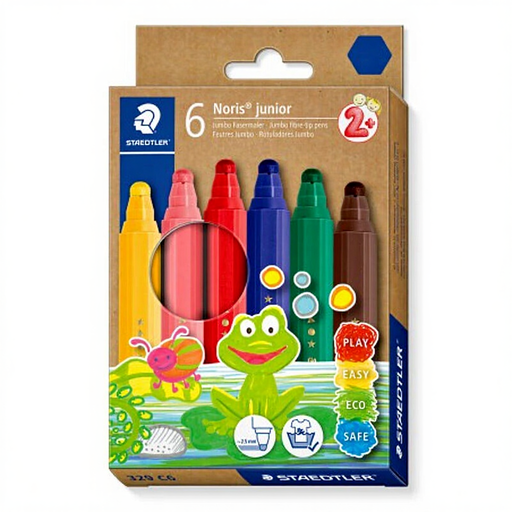
Why this product suits this profile: The six-piece set offers a manageable introduction for nursery, home or first colouring activities. The broad, rounded fibre tip and hexagonal barrel are designed for smaller hands.
The small number of colours prevents unnecessary duplication. The water-based, washable ink and ventilated safety cap are practical features for the intended children’s use.
6 colours, broad pressure-resistant round tip, water-based ink and ventilated cap in accordance with the stated ISO 11540 and BS 7272-1/2 standards.
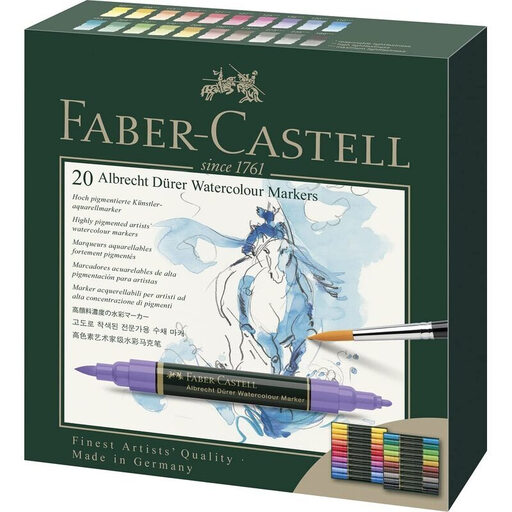
Why this product suits this profile: The combination of a brush tip and sturdy fibre tip is aimed at illustrators, artists and hobby users who want to switch between areas, outlines and watercolour techniques.
The 20 colours are arranged in a case. Two tips per marker reduce the need for separate drawing pens. Watercolour paper should be used for water-based techniques.
20 water-soluble, pigmented markers with brush and fibre tips; according to the product information, they offer high lightfastness and are suitable for watercolour effects.
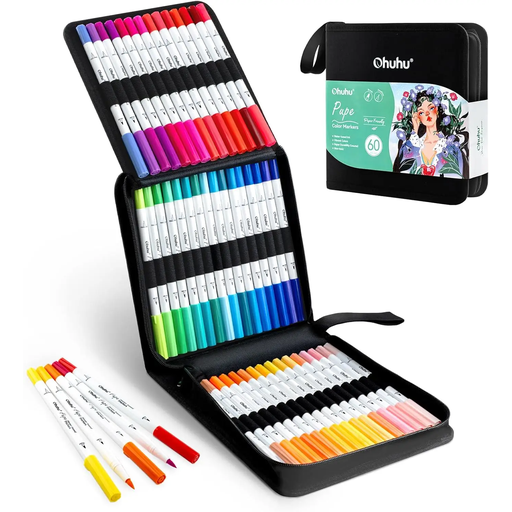
Why this product suits this profile: This set is aimed at users of calligraphy, journalling, colouring and illustration who need a wide range of colour gradations as well as two tips per pen.
The fine 0.4 mm tip and flexible 1–5 mm brush tip cover different tasks. A colour swatch card helps you assess the actual shades rather than relying on the colours of the caps.
60 pens including a colourless blender, two tips per pen and water-based ink according to the product description; stored in a case.
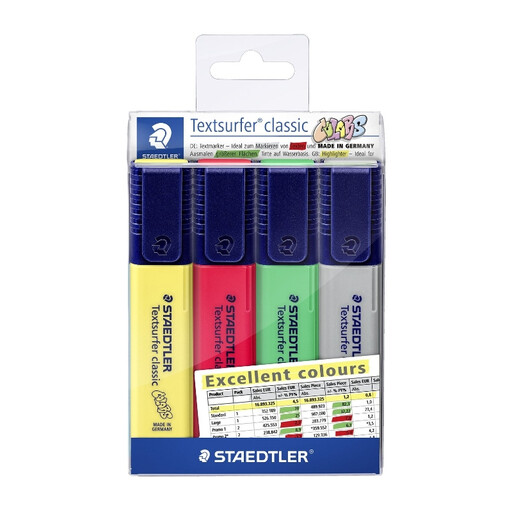
Why this product suits this profile: For study notes, printouts and office folders, a well-controlled chisel tip matters more than a large colour palette. The four-piece set covers colour-coded highlighting.
The large ink reservoir and quick-drying, water-based ink address the common problems of frequent refilling and smudging. The line width of around 1–5 mm allows for underlining and highlighting larger areas.
4 colours, soft chisel tip, large ink reservoir and automatic pressure regulation according to the product information. Designed for paper, fax and photocopies.
For washable felt-tip pens for children, the CRAYOLA Supertips with 24 colours or the Faber-Castell Connector set with 80 pens are also worth considering. The Connector system allows the pens to be linked together. For dot art and early colouring, the Jar Melo Dot Markers with six colours and a jumbo barrel are designed for small hands.
For occasional everyday highlighting, products such as the Pelikan Textmarker 490 Eco with 1, 2 and 5 mm marking widths are sufficient. If you need a wider office selection, the Faber-Castell Textliner set offers 24 colours, including neon, pastel and metallic shades. Alcohol-based markers such as the Ohuhu Skin Tone Art Marker Set should, however, be checked for bleed-through and used with adequate ventilation.
We have put together a complete, regularly updated list of products that fully meet these strict selection criteria and the safety regulations applicable in the EU.
For younger children, broad, pressure-resistant tips, an easy-to-grip barrel, ventilated caps and an appropriate recommended age are important. Washable ink makes cleaning easier, but is not a guarantee against every type of fabric stain. Small parts such as caps must be kept away from children under three.
Caps should be closed firmly immediately after use. Pens should be stored in a dry place, protected from direct sunlight and – where recommended by the manufacturer – horizontally. With DRY-SAFE fibre-tip pens, certain products can remain uncapped for longer; the specific manufacturer’s information remains decisive.
No marker is completely resistant to bleed-through on every type of paper. Water-based fibre-tip pens can work more controllably on heavier drawing or watercolour paper. Before starting larger projects, testing on the reverse side is advisable. Brush pens and alcohol-based markers should generally be used with heavier paper or a protective sheet underneath.