
Lieferung heute & morgen

Qualitätsgarantie

Willkommens-Angebote freischalten: KOSTENLOSE Lieferung | Bis zu 80 % RABATT | Kostenlose 30-Tage-JoyPlus-Testphase
App herunterladen
Felt-tip pens are part of the basic equipment in many homes, schools and creative workspaces. However, a large marker set is not automatically suitable for every application. If you only look at the number of colours, you can easily overlook the nib, ink base or recommended age.
Three common buying mistakes lead to disappointing purchases particularly often:
The type of nib determines how versatile a pen can be:
Do not just look for the term “marker”; check specific details such as the nib shape and line width. A flexible brush tip is less suitable for a toddler than a pressure-resistant, rounded nib.
The type of ink affects drying time, blendability and the risk of staining:
For children and use at home, water-based, washable felt-tip pens are usually the easiest option. Artist felt-tip pens with permanent ink are better suited to illustrations, sketches and archival work.
For children’s sets, check the recommended age and the design of the caps. A ventilated safety cap can reduce the risk if a cap is swallowed. According to the product information, STAEDTLER Noris Junior felt-tip pens have a ventilated safety cap in accordance with ISO 11540 and BS 7272-1/2.
Even so, pens and caps should never be put in the mouth. Sets containing small parts are unsuitable for children under three. The caps should be closed fully after every use. According to the manufacturer’s information, artist pens with pigmented ink are often stored horizontally to ensure an even distribution of ink.
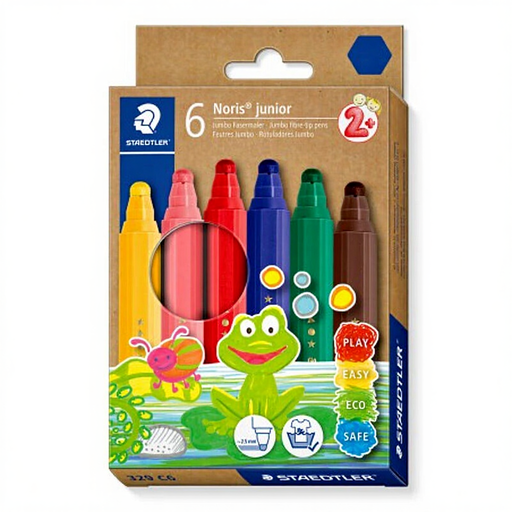
Why this product suits this profile: With a broad, rounded fibre tip and hexagonal barrel, this 6-colour set is designed for younger children’s hands. It is suitable for nursery, school and first art projects.
The robust, pressure-resistant nib is designed for broad areas of colour rather than offering a fine artist’s tip for small children. The ink is described as washable.
6 assorted colours, a broader nib and a ventilated safety cap in accordance with the stated standards.
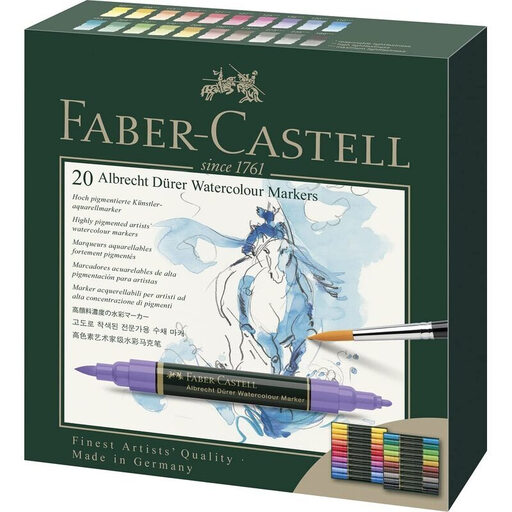
Why this product suits this profile: The 20 artist felt-tip pens combine a soft brush tip with a sturdy fibre writing tip. This single set can be used for sketches, outlines and watercolour gradients.
The ink base is specifically described as water-based and water-soluble. Watercolour paper is explicitly recommended for watercolour effects.
20 colours, two tips per pen, a case and, according to the product information, high lightfastness.
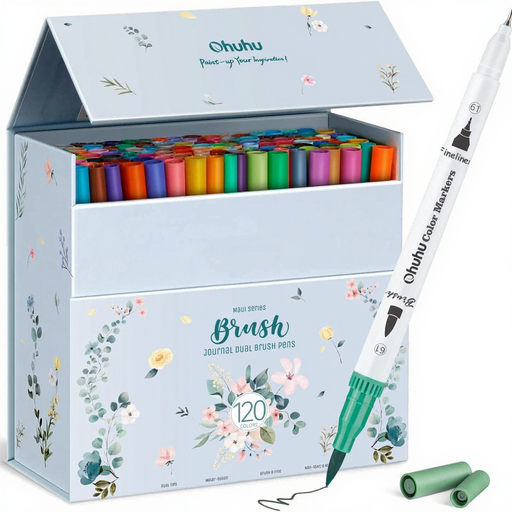
Why this product suits this profile: This extensive set is designed for users who need a wide range of shades and two tips for drawing, colouring, journalling or calligraphy.
The 0.4-mm fine tip and 1–6-mm brush tip are clearly specified. A colour chart template and case make it easier to identify each shade.
120 numbered colours, water-based ink, eight replacement tips and a storage case.
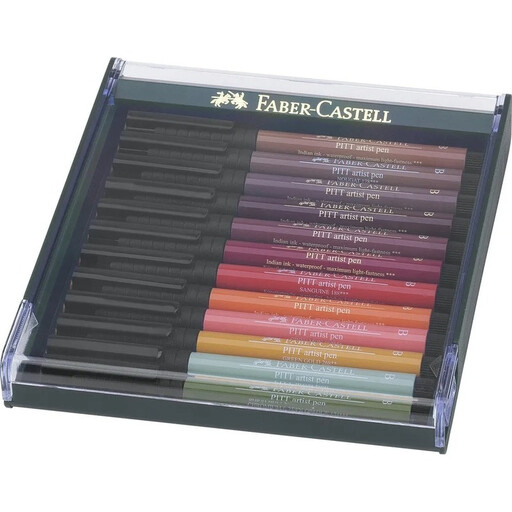
Why this product suits this profile: The twelve earth tones and flexible brush tip are designed for sketches, bullet journalling, calligraphy and hand lettering.
The product information specifies pigmented, waterproof and permanent drawing ink. This clearly distinguishes it from easily washable children’s colouring pens.
Flexible brush tip, 12 earth tones and, according to the product information, waterproof, acid-free ink.
We have put together a complete, regularly updated list of products that fully meet these strict selection criteria and the safety regulations applicable in the EU.
For colouring pictures and schoolwork, washable felt-tip pens with a pressure-resistant nib are a practical choice. For young children, consider broad barrels and large, easy-to-identify caps.
For watercolour painting, watercolour markers with water-soluble ink are worth considering. Test the colour on a scrap or edge of the paper first. Water can cause pigments to bleed or roughen the paper’s surface.
For hand lettering and calligraphy, calligraphy pens or brush pens with a flexible tip are a sensible choice. Consistent pressure control is more important than having a particularly large number of colours.
For sketches and monochrome drawings, charcoal drawing pencils are a good option. According to the product information, the Faber-Castell Pitt Charcoal Set contains different grades, charcoal pencils, charcoal sticks, a kneadable eraser and blending stumps in a metal box. Charcoal dust may be produced, so a well-ventilated workspace is advisable.
Suitable sets have a clearly stated age recommendation, water-based ink, a rounded or pressure-resistant nib and a ventilated safety cap. Pens with small parts that could be swallowed are not suitable for children under three. Washable children’s felt-tip pens should also only be used on suitable surfaces.
Their lifespan depends on how they are used, the nib, the amount of ink and storage conditions. Close the caps fully after every use and store many artist felt-tip pens horizontally. Direct sunlight, heat and storing pens uncapped can shorten their lifespan. Replacement tips are available for some dual-tip marker sets, but not for every product.
The price depends, among other things, on the number of colours, nib design, type of ink, case and accessories. A small children’s set is sufficient for first art projects. For regular drawing or hand lettering, a marker set with two tips may offer better value because it combines several functions. The key is to choose features that match your intended use, rather than spending most of your budget on colours you will not use.