What should you look for when buying?
First decide whether you’d rather take spontaneous close-ups without changing lenses or capture details at greater magnification. Then factor in your luggage, other holiday subjects and the lighting conditions around the fern.
| Priority |
What to check before buying |
Who is it important to? |
| Capture fine fern details |
Check the maximum magnification and working distance; with a zoom lens, also note the focal length at which these apply. |
If I want to capture leaf veins clearly, a short minimum focusing distance alone isn’t enough. Around 33% of consumers in this fern-holiday scenario put detail above all else. |
| Carry less equipment |
Consider the camera, battery, memory card and any lenses you need as a complete kit; check exactly what’s included. |
If I want to travel light on a hike and take photos without changing lenses, the whole kit matters. Around 27% of consumers place the greatest importance on easy carrying. |
| Keep fronds sharp in wind and shade |
Consider how easily you can adjust the shutter speed and aperture, as well as how to keep the camera steady. |
When fronds are moving, I want to choose the right shutter speed rather than rely on a tripod alone. Around 20% of consumers prioritise sharpness in movement and changing light. |
| Photograph whole fronds and holiday subjects |
Compare the wide-angle and telephoto ranges, as well as the minimum focusing distance at your preferred zoom setting. |
If I want to photograph landscapes and other holiday subjects as well as ferns, I need suitable framing for both. Around 20% of consumers prioritise this versatility. |
Joybuy products
The Joybuy offers below feature DJI Osmo Pocket 3 bundles with gimbal accessories for travel and vlogging. If you want to take detailed fern photos, also check whether the specific device can frame your subject as closely as you need; the bundle features listed here don’t, on their own, prove that it’s suitable for macro photography.
 No image available
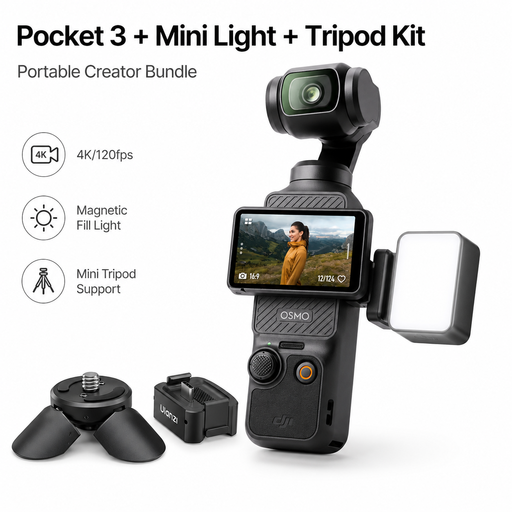
DJI Osmo Pocket 3 Standard Combo with ULANZI LM001 mini light, adapter and mini tripod
For travel and vlogging, the product offer includes a magnetic mini light, a mini tripod and an adapter.
The product name specifies a 1-inch CMOS sensor, 4K/120fps and a 3-axis gimbal.
Joybuy
 No image available
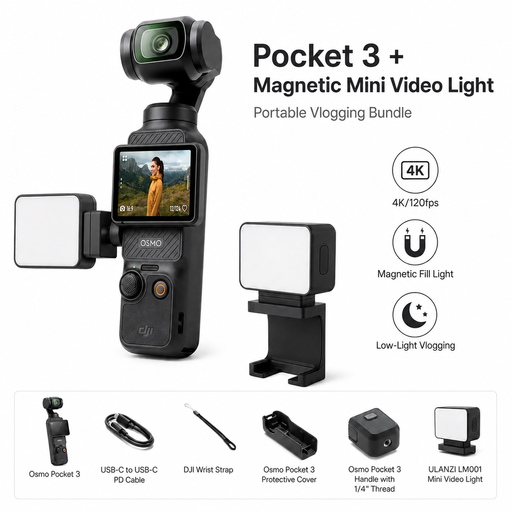
DJI Osmo Pocket 3 Standard Combo with ULANZI LM001 magnetic mini light
For travel photography where extra lighting is useful, the product offer includes a magnetic mini light.
The product name specifies a 1-inch CMOS sensor, 4K/120fps and a 3-axis gimbal.
Joybuy
Frequently asked questions
Is a short minimum focusing distance enough for detailed photos of a fern frond?
No. Also compare the maximum magnification and, with zoom cameras, the zoom setting. The Panasonic LUMIX DC-TZ99 achieves its stated 3 cm at the wide-angle end; Nikon gives the NIKKOR Z DX MC 35mm f/1.7 a maximum magnification of 1:1.5 on a DX sensor.
Can a tripod help when photographing ferns in the wind?
A tripod stabilises the camera, not a fern that’s moving. If a frond is swaying, a faster shutter speed may be more important; stopping down for greater depth of field also means you’ll need more light or a longer exposure.
What extra costs and requirements should I check when buying a camera?
Check the specific offer to see whether it includes a lens, battery, charger and memory card; a mirrorless camera may also need a suitable macro lens. If something goes wrong, your statutory rights are generally against the seller and are separate from any voluntary guarantee.
Can I cut off fern fronds for a photo or take them from a protected area?
Wanting to take a photo doesn’t give you the right to remove a plant. Germany’s Federal Ministry for the Environment explains that the limited rules allowing small amounts of wild plants to be picked for a bunch do not apply to specially protected plants, and most ferns are specially protected. Whether you may enter or take photos in a particular area depends on local conservation rules; without knowing the exact location, it isn’t possible to give a blanket yes or no.


