Shoppers comparing fibre content
You want to assess porridge by its fibre content per 100 g, rather than relying on the name on the front of the pack. The wholegrain content can also help you choose.


When comparing fibre-focused porridge, start by checking the fibre content per 100 g, then look at the ingredients, allergens and serving size. You can add your own extras to a simple oat base, while a ready-made mix may be more convenient on busy mornings. The ingredients and nutritional values vary by product, though. Asparagus season alone doesn’t mean you need a particular type of porridge.
You want to assess porridge by its fibre content per 100 g, rather than relying on the name on the front of the pack. The wholegrain content can also help you choose.
You’re looking for a quick breakfast base and deciding whether a simple oat mix will do, or whether you’d also like to consider the protein content.
For you, details of the oats, spelt, milk, nuts, sugar and possible traces are important. Always check the labelling for the specific variety.
Start with the factor that matters most for your breakfast. Then compare nutritional values using the same basis and check the ingredients of the variety you choose.
| Criteria | What to check when buying | Who it matters most to |
|---|---|---|
| Fibre and wholegrain | Compare the fibre content per 100 g and the stated wholegrain content of the specific variety. | If I want to keep track of fibre content, I need a figure I can compare across products. Around 36% of shoppers would consider this their most important buying criterion. |
| Ingredients and allergens | Read the ingredients list, allergen information and any precautionary ‘may contain’ warnings. | If I have requirements concerning nuts, milk or particular grains, the recipe needs to suit them. For around 29% of shoppers, this check would come first. |
| Preparation and protein | Check the preparation instructions and serving size; compare protein and fibre using the same nutritional basis. | If I’m short on time in the morning or specifically comparing protein content, there’s more to consider than the fibre figure. Approximately 21% of shoppers would see this as their main concern. |
| A customisable breakfast base | Choose a recipe with as few added flavours as possible if you plan to add your own fruit, nuts or other ingredients. | I want to customise the flavour of my breakfast during asparagus season, rather than choose a pre-flavoured mix. For around 14% of shoppers, this flexibility would be the main reason for choosing. |
The nutritional information describes the product, not necessarily your breakfast with all its other ingredients. Vegetables, fruit, pulses and other wholegrain foods can also form part of your diet.
First compare the figures per 100 g, then take your actual portion size and any extras into account.
According to Kölln, Kölln Hafer-Porridge Nuss contains hazelnuts. The manufacturer also states that it may contain traces of other nuts, milk and peanuts. So even if fibre content is a priority, it’s still important to check the ingredients.
Before buying, read the current allergen information and the details on the specific pack.
Seitenbacher states that Protein Porridge Heidelbeere contains 30 g of protein and 6 g of fibre per 100 g. Kölln lists 11 g of fibre per 100 g for Hafer-Porridge Nuss. Protein and fibre content meet different shopping needs.
Decide which nutritional value matters most to you, and check the sugar and ingredient information too.
The German Consumer Advice Centre points out that a sudden switch to a higher-fibre diet can initially cause bloating or a feeling of fullness.
If you’re making a significant change to your diet, consider your portion size and fluid intake.
Kölln offers a range of oat porridges, including Original, Nut and High Protein varieties.
Seitenbacher offers products including Protein Porridge Heidelbeere, which has a different nutritional focus from plain oats.
REWE stocks its own plain and berry porridges, as well as products from other brands.
EDEKA stocks porridge products, including a berry variety.
Alnatura has its own organic porridge range, with products for different age groups and needs.
Brüggen makes oats and porridge, among other products, and also produces own-label goods.
Here you’ll find fine and jumbo oats for making your own porridge, alongside a porridge mix you can customise with your own additions. For each variety, check the latest nutritional and allergen information on the pack.
 No image available
For anyone who wants to make their own porridge using fine oats. Compare the fibre content per 100 g on the pack and, if you need to avoid gluten, check the labelling.
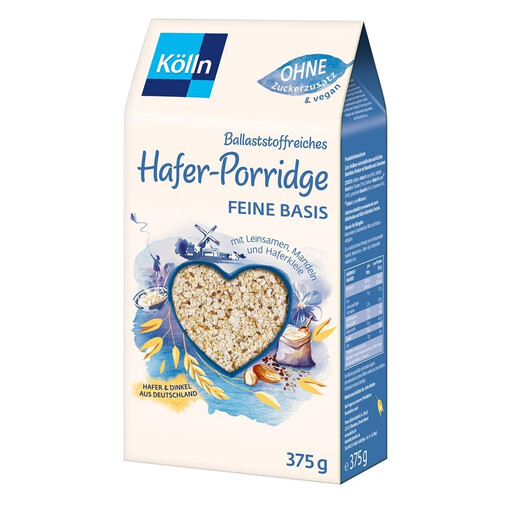 No image available
A porridge base for anyone who wants to choose their own toppings and extras. Before buying, check the fibre content and, in particular, the information on gluten, almonds and any other allergens relevant to you.
 No image available
For making your own porridge when you prefer jumbo oats. Check the nutritional information per 100 g and, if relevant to your needs, the labelling for gluten and possible traces.
Compare the fibre content per 100 g, then take your actual portion size into account. The stated wholegrain content gives you extra information about the recipe, but it doesn’t replace comparing the nutritional information.
No. The term ‘oat porridge’ doesn’t mean that a product is gluten-free. The Federal Ministry of Agriculture, Food and Home Affairs lists oats under cereals containing gluten for allergen labelling. If you specifically need gluten-free products, check that the individual pack is labelled accordingly.
Check the allergens for the specific variety rather than relying on the general product name. The recipes considered here include oats, spelt, milk and nuts, among other relevant allergens. Also check for precautionary ‘may contain’ warnings if they matter to you.
No. Asparagus season alone doesn’t call for a particular type of porridge. If you want to add seasonal ingredients to your breakfast, choose a plain oat base and continue to check the nutritional values, ingredients and suitability of the specific variety.