
Lieferung heute & morgen

Qualitätsgarantie

Willkommens-Angebote freischalten: KOSTENLOSE Lieferung | Bis zu 80 % RABATT | Kostenlose 30-Tage-JoyPlus-Testphase
App herunterladen
A filter coffee maker with a thermal carafe is ideal for anyone who wants to prepare several cups of coffee at once without relying on a permanently switched-on hotplate. The thermal carafe retains the heat after brewing, while keeping the coffee ready to serve.
When choosing a model, however, capacity and brand name are not the only factors that matter. Some models are advertised with long heat-retention times, even though their everyday practicality depends more on the lid, carafe material and fill level. Other appliances offer numerous extra features that are rarely needed in daily use. That is why our selection focuses on clear product data and typical usage scenarios.
A specification such as ‘10 cups’ does not automatically mean ten large mugs. Manufacturers often calculate using smaller standard cups. Buyers should therefore also check the capacity in litres. According to product specifications, a 1-litre filter coffee maker will usually make around 8 cups, while 1.25 litres may provide 8 to 10 or more portions, depending on the cup size.
Insulation performance depends, among other things, on the material and the lid. A double-walled stainless-steel carafe is less prone to breakage than a glass carafe, but depending on the model it may not be dishwasher-safe or suitable for full immersion in water. Preheating it with hot water can also help retain heat. Always follow the care instructions provided by the manufacturer.
A coffee maker with aroma selection, for example, allows you to choose between different brewing profiles. This is practical, but it does not automatically change every type of coffee in the same way. A coffee maker with an integrated grinder delivers freshly ground beans, but requires more space and regular cleaning. If you only use pre-ground coffee, you may not need this feature.
For a small household, a coffee maker with a thermal carafe and a 1-litre capacity may be sufficient. Families, meeting rooms and small catering businesses are more likely to benefit from 1.2 to 1.5 litres. For particularly high demand, a machine with two carafes may be a sensible choice.
Also check the dimensions. A machine with a swing-out filter needs enough space above and to the side so that the filter can be inserted and removed comfortably. An integrated cable compartment makes it easier to position the machine on smaller worktops.
A drip stop interrupts the flow of coffee when the carafe is briefly removed. This reduces drips on the hotplate, but requires the carafe to be positioned correctly. A brew-through lid allows you to brew with the carafe lid closed and can make serving easier.
Look for:
The product specifications are crucial here. For example, hand washing is recommended for several Melitta thermal carafes, while the carafe, lid and filter basket of the Braun PurShine models are stated to be dishwasher-safe.
Many appliances use paper filters in size 1 x 4. A removable swing-out filter makes it easier to insert the filter and clean the machine. Permanent filters can reduce the ongoing cost of paper filters, but they need to be rinsed thoroughly after every use.
A coffee maker with automatic switch-off reduces the risk of the appliance remaining switched on unnecessarily long after brewing. The switch-off time varies by model. It is specified as 15 minutes for the Melitta Enjoy Top Therm and 40 minutes for the Braun PurShine. These figures should not be directly compared, as they relate to different operating systems.
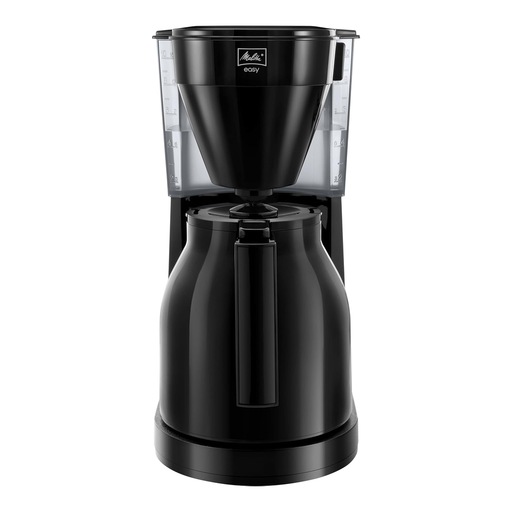
Why this product suits this profile: This compact filter coffee maker has a 1-litre capacity and focuses on everyday brewing without complex programmes. The transparent water tank with cup scale makes it easier to measure the right amount for smaller households.
The features are clearly described: swing-out filter, integrated drip stop and thermal carafe instead of unnecessary extra programmes.
1-litre capacity, 1,050 watts, removable dishwasher-safe swing-out filter and Easy-Click carafe.
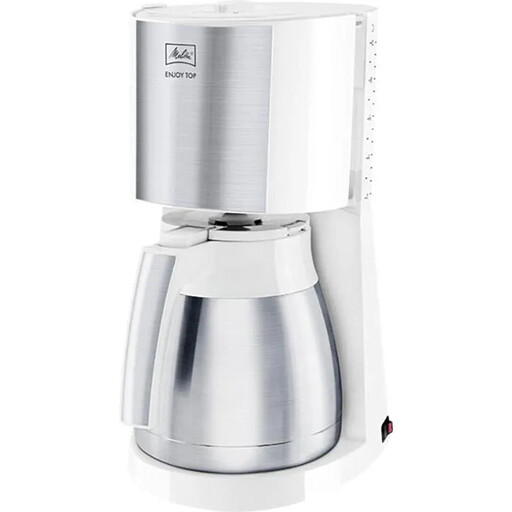
Why this product suits this profile: If you regularly prepare larger quantities, you get 1.25 litres, or up to 10 cups, together with selectable aroma strength.
The aroma selection is described as a specific feature with three control components, rather than simply being presented as a general promise of better flavour.
Stainless-steel thermal carafe, AromSelector, drip stop, swing-out filter and automatic switch-off after the stated brewing process.
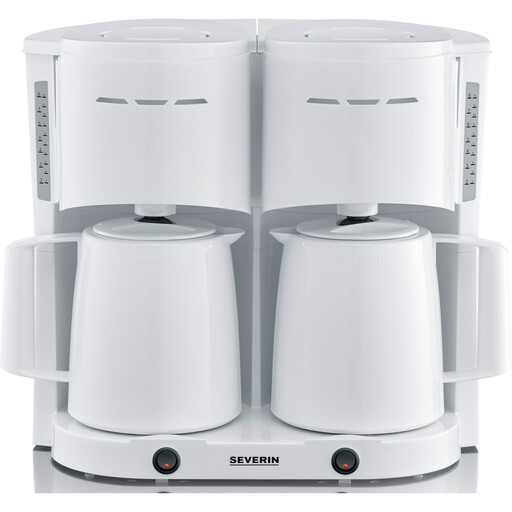
Why this product suits this profile: According to the product description, the appliance brews into two 1-litre thermal carafes at the same time, making it suitable for larger groups and serving two batches in parallel.
The capacity is split between two separately usable thermal carafes, rather than requiring a single carafe to be regularly overfilled.
Two 1-litre insulated carafes, two water-level indicators, drip stop, cable compartment and automatic switch-off.
We have put together a complete, regularly updated list of products that fully meet these strict selection criteria and the safety regulations applicable in the EU.
Descale the machine regularly, according to the water hardness in your area and the manufacturer’s instructions. Limescale can affect the water flow and brewing performance. Coffee residue should be removed from the filter basket and lid after every use. In many cases, a stainless-steel thermal carafe should be cleaned by hand; use warm water and a mild cleaning product.
The main ongoing costs include:
An appliance without a hotplate can limit electricity consumption after brewing. However, this does not mean that every thermal carafe will maintain the temperature for the same length of time. The fill level, lid design and opening the carafe to serve the coffee all affect heat loss.
That depends on the manufacturer’s definition of a cup. Appliances with a 1-litre capacity are often specified as making around 8 cups. Depending on portion size, models with 1.25 litres are suitable for approximately 8 to 10 cups or more. For offices and larger groups, two carafes or a 1.5-litre appliance may be the more practical choice.
Both systems have different characteristics. A thermal carafe allows you to serve the coffee away from the machine and does not require a permanently active heating surface after brewing. A hotplate makes it easier to pour another cup directly from a glass carafe, but it may continue heating the coffee if it is left standing for a long time. The right option depends on how long the coffee will be kept, where it will be served and your cleaning preferences.
Its lifespan depends on how often it is used, descaling, cleaning and how well the carafe and filter are cared for. Look for solid construction, replacement carafes that are available separately and clear manufacturer information. If the cable is damaged, the carafe is leaking or the automatic switch-off is not working correctly, stop using the appliance.