
Lieferung heute & morgen

Qualitätsgarantie

Willkommens-Angebote freischalten: KOSTENLOSE Lieferung | Bis zu 80 % RABATT | Kostenlose 30-Tage-JoyPlus-Testphase
App herunterladen
A filter coffee machine with a glass jug is a straightforward solution for many households: fill the water tank, insert a paper filter, measure out the ground coffee and start the brewing process. However, unclear capacity specifications, filter holders that are difficult to clean or an impractical keep-warm function can quickly lead to disappointing purchases.
Your choice should therefore not be based solely on the colour of the casing or advertised aroma programmes. Clear information on capacity, operation, cleaning and safety features is what really matters.
A specification such as “10 cups” often refers to smaller standard portions when used for filter coffee machines. A model with a capacity of 1.25 litres may therefore be designed for up to 10 cups, but it will not automatically produce 10 large breakfast mugs. Families and offices should check the water tank’s actual capacity.
A coffee machine with a keep-warm plate keeps the glass jug at temperature after brewing. However, the coffee may continue to lose heat and flavour. An automatic switch-off is practical, as it ends the heating function after a set period. Buyers should check that automatic switch-off is explicitly listed in the product specifications.
A coffee machine with a drip-stop function allows you to remove the jug while the coffee is still brewing without the filter holder dripping excessively. This is useful in everyday use, but it does not prevent every spill or build-up of residue. Removable filter holders, easy-to-read water-level indicators and a glass coffee jug that is easy to rinse make regular cleaning much simpler.
For individuals or small households, a compact filter coffee machine with a capacity of around 0.6 to 1 litre may be sufficient. Families, shared households and offices often benefit from capacities of 1.25 to 1.5 litres. Also check the required footprint and the height with the glass jug in place, particularly if you plan to position the machine beneath wall cupboards.
For models designed for 10 to 14 cups, the water tank capacity should be compared with the jug’s filling capacity. Portion sizes may be defined differently by each manufacturer. A water-level indicator on both sides is useful when several people use the machine.
Important practical features include:
A programmable timer can be useful in an office or for a fixed morning routine. However, it is not an essential feature for every coffee machine.
A glass jug lets you see how much coffee remains and can be placed on a keep-warm plate. Glass is nevertheless susceptible to breakage. Hot jugs should not be placed on cold or wet surfaces. Sudden changes in temperature can also create stress in the glass.
It is worth checking the cleaning instructions before buying. Not every component is dishwasher-safe. The main housing of an electric filter coffee machine must never be immersed in water. For use in Germany, the specifications for 220–240 volts and a mains frequency of 50/60 hertz are relevant.
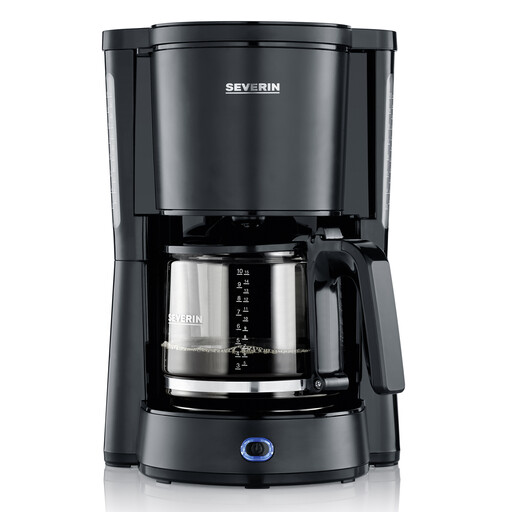
Why this product suits this profile: According to the product specifications, this model brews up to 10 cups using a 1.25-litre water tank, making it suitable for everyday use without complex programmes.
The removable filter holder makes cleaning easier. The drip-stop function and automatic switch-off are explicitly listed.
1000 watts, 1.25-litre capacity, glass jug and swing-out filter with removable filter holder.
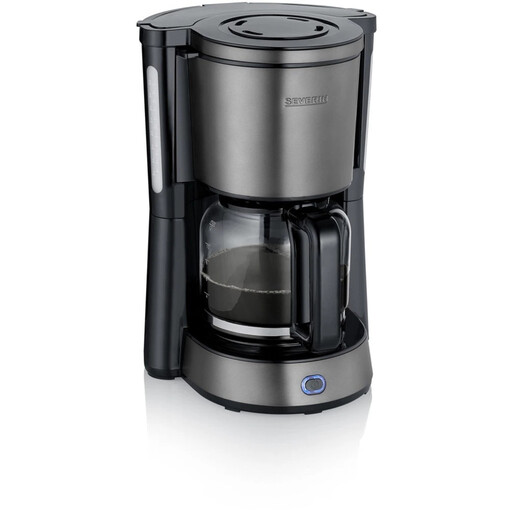
Why this product suits this profile: The combination of a 1.25-litre capacity, brew-through lid, water-level indicator on both sides and stainless-steel finish is ideal for users who value attention to detail in their daily routine.
The swing-out filter has a removable filter holder. The drip-stop function and automatic switch-off are included in the listed features.
1000 watts, glass jug with brew-through lid, filter size 1x4 and integrated cable compartment.
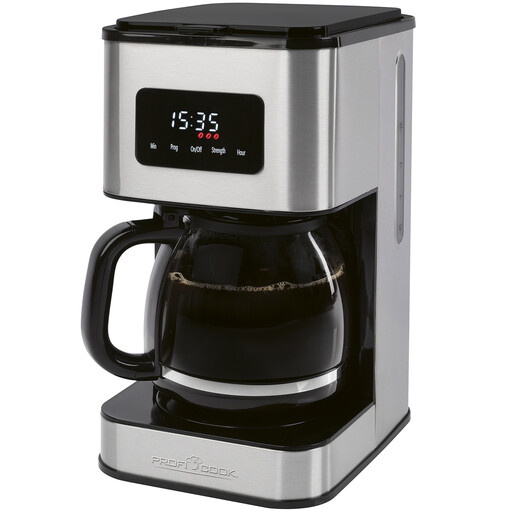
Why this product suits this profile: With a capacity of around 1.5 litres, this model is designed for larger quantities and may be a good choice for families, meetings or shared kitchens.
The product specifications state 12 to 14 cups, a drip-stop function, a removable filter holder and a keep-warm plate with automatic switch-off.
Stainless-steel housing, 24-hour timer, three-stage aroma selection and a capacity of around 1.5 litres.
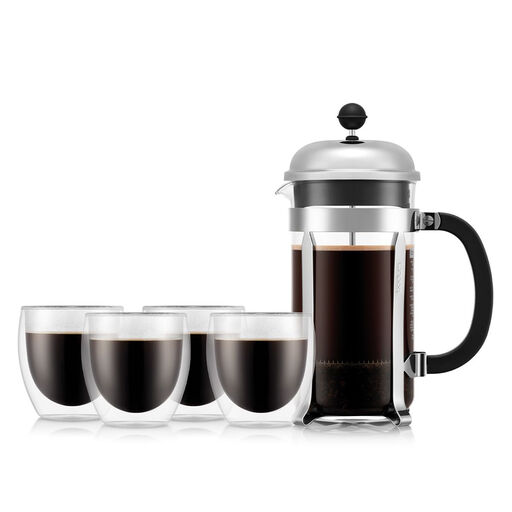
Why this product suits this profile: A French press does not require electricity, making it ideal for users who prefer to pour over their coffee manually and control the brewing time themselves.
There is no electric heating plate, so it uses no electricity to keep the coffee warm. Coffee can be prepared independently of a power socket.
1-litre capacity, three-part stainless-steel filter and four PAVINA glasses, each holding 250 millilitres, included in the set.
We have put together a complete, regularly updated list of products that fully meet these strict selection criteria and the safety regulations applicable in the EU.
A filter coffee machine with a glass jug is a good choice when you want to prepare several portions regularly with minimal hands-on effort. A French press is more compact and does not require paper filters, but it does involve manual brewing time followed by pressing down the filter.
For smaller portions, a pour-over coffee maker may be worth considering. Options include a filter holder such as the TIMEMORE Glass Crystal Eye and a gooseneck kettle such as the TIMEMORE Fish Pure Coffee Kettle. This combination gives you greater control over pouring, but is less automated. If you would also like to serve tea, you can find suitable glass models with capacities of around 1.1 to 1.3 litres.
This depends on the stated capacity and the manufacturer’s definition. Models with a capacity of 1.25 litres are often advertised as making up to 10 cups, while machines with around 1.5 litres are frequently labelled as making 12 to 14 cups. Large mugs are generally bigger than the standard portions used for these specifications.
Its service life depends on usage, cleaning and descaling. Limescale deposits can affect the water flow and heating performance. The glass jug should be handled carefully and must not be used if it has cracks or chips. The care instructions provided by the relevant manufacturer are also important.
Consumption depends on the power rating and the length of time the keep-warm function is active. A 1000-watt rating describes the electrical power used during operation; it does not automatically indicate the total consumption for one brewing cycle. An automatic switch-off limits how long the keep-warm plate remains on. If you only drink coffee a portion at a time, you can transfer it to a suitable thermal flask after brewing.