
Lieferung heute & morgen

Qualitätsgarantie

Willkommens-Angebote freischalten: KOSTENLOSE Lieferung | Bis zu 80 % RABATT | Kostenlose 30-Tage-JoyPlus-Testphase
App herunterladen
A filtered shower head can be a practical addition for households with limescale-rich water. However, filter materials, spray patterns, connections and maintenance requirements vary considerably. If you only look for terms such as “high pressure” or “20-layer filtration system”, it is easy to overlook ongoing costs and technical limitations.
This selection by the Joybuy Product Recommendation Officers explains which details are relevant before buying a filtered shower head and which models are suitable for different usage scenarios.
Many products are marketed as a shower head for hard water or a shower head against limescale and chlorine. Depending on the filter medium, a filter can reduce certain substances. However, simple filter cartridges do not always completely remove dissolved hardness-forming minerals such as calcium and magnesium. Actual water softening normally requires a suitably designed water-softening system.
You should therefore check:
Claims about reducing chlorine or other substances should be treated as manufacturer’s information. They do not constitute evidence of any medical or therapeutic effect.
A high-pressure shower head does not automatically produce a greater volume of water. Smaller nozzles can direct the water jet more effectively at the same or a lower flow rate. This can be useful with a hand shower for low water pressure, but depends on the existing water pressure and the property’s plumbing system.
A flow restrictor can reduce water consumption, but it may also change how the spray feels. Some models include one as an optional accessory. You should therefore check whether the stated water-saving effect is a manufacturer’s claim and the conditions under which it applies.
A filter element is a consumable component. With very hard water, the flow rate may decrease sooner. Silicone nozzles also require regular cleaning, even if a product is described as an anti-limescale shower head. A low purchase price can be offset by the cost of frequent replacement filters.
For many bathrooms in Germany, a G1/2 connection is relevant. A shower head with a hose should therefore connect to a standard shower hose. Even so, it is advisable to check the existing thread and the supplied seal. “Tool-free installation” usually means that the shower head is screwed onto the hose by hand; an additional seal may be needed if there are drips.
Hoses supplied with some models can make installation easier. A length of 150 cm is sufficient for many showers, while 200 cm provides greater freedom of movement. The hose should not be left sharply kinked or twisted.
A shower head with a water filter should provide clear information about the filter type and maintenance. According to the manufacturer, the Cobbe model with a 20-layer filtration system incorporates KDF, calcium sulphite, activated carbon and mineral beads, among other materials. For this model, the manufacturer recommends changing the filter after three to four months or when the water pressure drops. The actual service life depends on water quality, household size and how often the shower is used.
A shower head with multiple spray settings can offer greater flexibility in everyday use. Rain, massage, jet and combination sprays suit different preferences. Look for an easy-to-reach selector and soft silicone nozzles that can be rubbed clean to remove surface limescale deposits.
However, more spray settings also mean more components. For straightforward use, a model with three clearly distinguishable settings may be more practical than one with a complex selector.
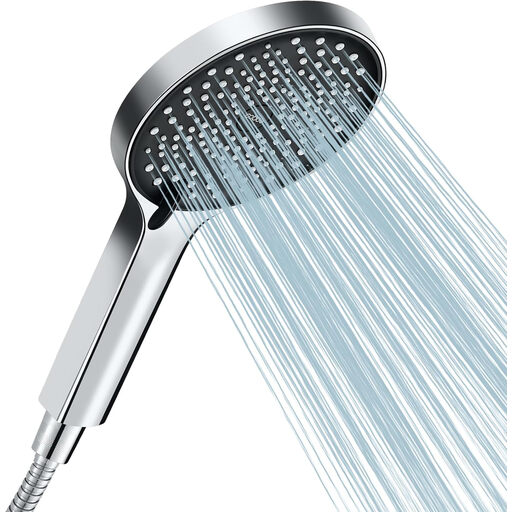
Why this product suits this profile: The set combines a shower head with hose, three spray settings and tool-free installation for an easy, affordable introduction.
The specifications list specific spray settings and standard installation rather than making only general comfort claims. The water saving of up to 30 per cent is a guideline according to the manufacturer.
13.1 cm shower head, 150 cm hose and selector for rain, pulse and massage sprays.
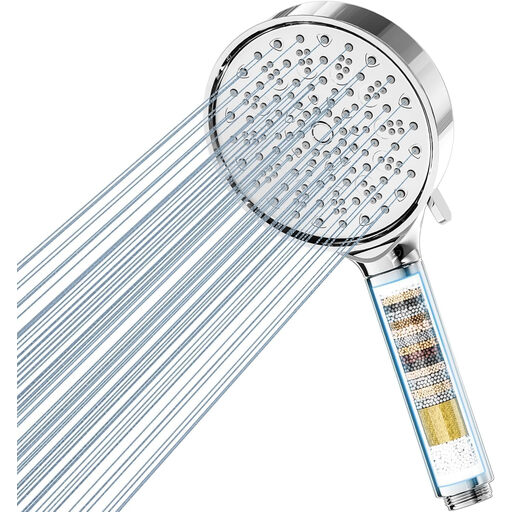
Why this product suits this profile: This model is designed for households looking to combine a filtration system, several spray options and a larger shower surface.
According to the product details, the filter element is pre-installed. The recommended replacement after three to four months or when the pressure drops makes the maintenance requirements clear.
20-layer filtration system according to the manufacturer, six modes and a 124 × 124 mm shower surface.
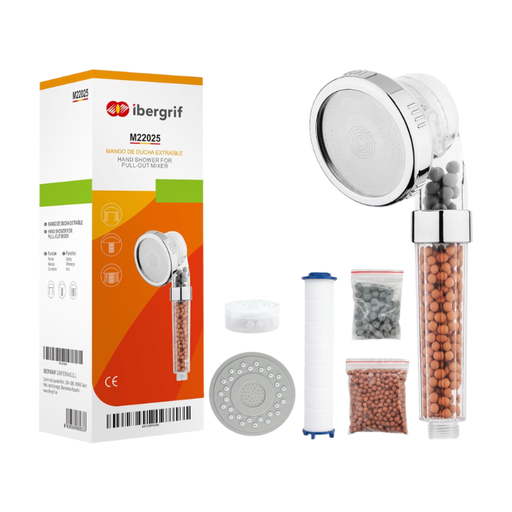
Why this product suits this profile: The removable filter components and supplied spare parts are practical if the shower head is used regularly or cleaned more frequently.
The filter can be removed and, according to the product details, cleaned under running water. The permitted water temperature is specified as a maximum of 60 °C.
Three-layer filtration system according to the manufacturer, three spray settings, replacement filter, mineral beads and replacement seal included.
We have put together a complete, regularly updated list of products that fully meet these strict selection criteria and the safety regulations applicable in the EU.
Before installation, turn off the water supply or shut off the shower tap. Remove the old hand shower, check the seal and screw the new shower head hand-tight onto the existing hose. Turn on the water slowly and check the connection for leaks.
You should also bear the following in mind:
If you only need a new hose, you can choose a separate shower head with hose. According to the product details, a 200 cm stainless-steel hose from 5Five has universal connections and offers greater reach, but does not include a water filter.
Most models are attached directly to the existing shower hose via a G1/2 thread. No tools are usually required. Before buying, you should check the thread, seal and, where applicable, whether the product is suitable for use with an electric shower.
This depends on water hardness, flow rate and frequency of use. For one Cobbe model, the manufacturer specifies three to four months or replacement when the water pressure decreases. This is not a general value that applies to all filtered showers.
A water-saving shower head can reduce the flow rate through smaller nozzles or a restrictor. The actual saving depends on shower duration, water pressure and your usage habits. Claims such as “up to 30 per cent” should be understood as manufacturer’s information and should not be treated as a guaranteed saving in your own household.