
Lieferung heute & morgen

Qualitätsgarantie

Willkommens-Angebote freischalten: KOSTENLOSE Lieferung | Bis zu 80 % RABATT | Kostenlose 30-Tage-JoyPlus-Testphase
App herunterladen
A fine-mesh stainless steel kitchen strainer is one of the most versatile kitchen tools. It can sift flour and icing sugar, drain cooked pasta, wash fruit or filter liquids. In practice, however, it is easy to make the wrong choice because product images and marketing claims often fail to show important details such as mesh size, material thickness or cleaning suitability.
The term fine-mesh kitchen strainer is not uniformly protected. It may refer to a strainer for coarse foods as well as one for fine flour. If you bake regularly or are looking for a strainer for soya milk, you should therefore check for a specific mesh or opening size.
As a guide, the Leifheit ProLine kitchen strainer is listed with a 1.5 mm mesh opening. According to the product description, this size is suitable for sifting flour and other dry ingredients. For very fine liquids, however, a model designed specifically for this purpose may still be required.
“Stainless steel” initially describes only the material group. More informative specifications include 304 stainless steel or 316 stainless steel, provided the supplier explicitly states them. The BJ strainer is listed as being made from 304 Stainless Steel, while the stainless steel and plastic strainer specifies a 316 stainless steel mesh.
The connection between the straining surface, frame and handle is also important. A thin or poorly secured rim may deform under pressure. Sharp wire ends can also pose a risk of injury. You should therefore check the product images, safety information and details of what is included.
Buying a dishwasher-safe stainless steel strainer can make cleaning easier. However, for models with a plastic frame, this property does not automatically apply to every temperature exposure. For example, the stainless steel and plastic strainer states that the plastic frame should not be exposed to temperatures above 70 °C, and that boiling liquids should not be poured directly into it.
With a stainless steel strainer made entirely from metal, temperature is usually less of a concern. Nevertheless, you should follow the manufacturer’s instructions and dry the strainer thoroughly after cleaning.
The following details are particularly useful for everyday use:
A strainer with plastic components may be lighter and more comfortable to hold. A stainless steel strainer made entirely from metal, on the other hand, makes it easier to assess the material. What matters is the specific product information, not just the wording in the title.
The right opening size depends on how you plan to use it:
A small flour sieve is not automatically suitable for a large pot of pasta. Conversely, a spacious colander may be awkward when precisely sifting small quantities.
Before buying, measure the sink, bowls or saucepans over which you intend to use the strainer. An extendable model can be practical for sinks of different widths. According to the product description, the 3.6-litre strainer, measuring 53.5 × 24.7 × 10.5 cm, is designed for rinsing and draining larger quantities.
A hanging loop or resting rim saves space in smaller kitchens. For baking ingredients, a diameter of around 16 cm is often sufficient, while pasta and vegetables require greater capacity.
The following selection groups specific models according to typical usage scenarios. Technical details are based on the product information provided for each item.
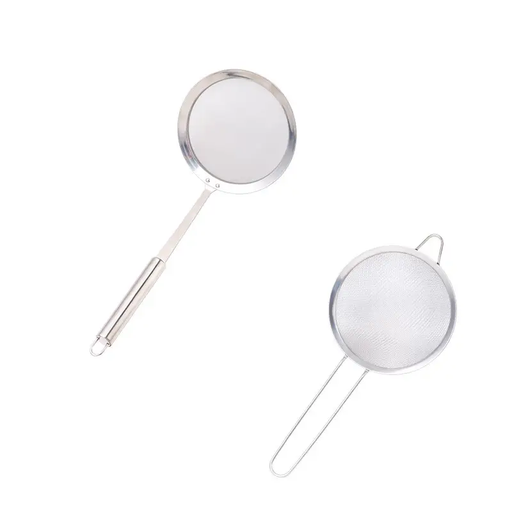
Why this product suits this profile: The two-piece set covers several everyday tasks and, according to its product name, is intended for soya milk and flour. It is aimed at households looking for a fine-mesh strainer without additional specialist equipment.
The 304 stainless steel specification is more precise than the general term “metal strainer”. The contents also explicitly state that two pieces are included.
304 stainless steel according to the product information; two-piece set for flour and liquid applications.
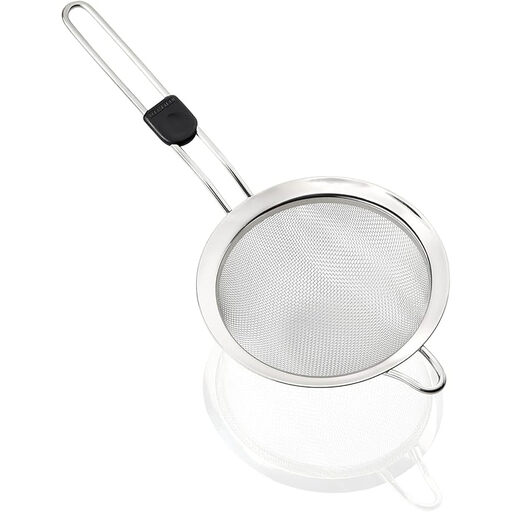
Why this product suits this profile: The 16 cm strainer combines defined technical specifications with a hanging loop and thumb rest on the handle. It is well suited to baking and kitchen tasks involving small to medium quantities.
The product data states a 1.5 mm mesh opening and dishwasher suitability. This makes it easier to assess the mesh fineness and cleaning requirements before buying.
16 cm diameter; 1.5 mm opening; dishwasher suitability according to the product description.

Why this product suits this profile: The extendable design is intended for sinks of different sizes. With a capacity of 3.6 litres, this colander is suitable for pasta, vegetables and larger portions.
The dimensions and capacity are clearly specified. The extendable design reduces the risk of the colander not fitting securely over the sink.
3.6-litre capacity; extendable dimensions of 53.5 × 24.7 × 10.5 cm; stainless steel and food-contact construction according to the product data.
We have put together a complete, regularly updated list of products that fully meet these strict selection criteria and the safety regulations applicable in the EU.
Wash a new strainer with warm water and a little washing-up liquid before using it for the first time. Fine wire meshes should not be treated with steel wool or abrasive cleaners. These can scratch the surface or deform the mesh.
When handling hot liquids, the construction is crucial. A strainer made entirely from stainless steel may be more suitable than a model with a plastic frame. If the strainer has plastic components, allow liquids to cool briefly where necessary and use heat-resistant gloves if required. Check the mesh regularly for bent sections and sharp edges.
A fine opening is ideal for flour, icing sugar and cocoa. A specific measurement such as 1.5 mm makes comparison easier. For particularly fine powders, an even finer specialist model may be required.
Yes, provided the diameter, capacity and stability are suitable for the quantity. A small flour sieve is unsuitable for a large saucepan. For pasta, a spacious colander or extendable pasta strainer that sits securely over the sink is recommended.
Its service life depends on the material, construction, load and care. A strainer will remain functional for longer if you do not overload it with heavy foods, force sharp objects through the mesh or expose plastic components to unnecessarily high temperatures.