
Lieferung heute & morgen

Qualitätsgarantie

Willkommens-Angebote freischalten: KOSTENLOSE Lieferung | Bis zu 80 % RABATT | Kostenlose 30-Tage-JoyPlus-Testphase
App herunterladen
A fingerprint padlock can provide access to a locker, garden gate, tool box or cupboard without a key or combination code. This is practical for families, athletes, tradespeople, offices and shared households – provided the padlock is suitable for its intended location and properly maintained.
Before buying, however, you should avoid common marketing pitfalls. A biometric padlock is not automatically suitable for every environment. The decisive factors are the technical specifications that are often overlooked in everyday use.
The designations IP66 and IP68 describe protection against dust and water under the relevant test conditions. However, they do not automatically mean that a padlock can withstand every type of mechanical stress, prolonged frost or aggressive cleaning products. For outdoor use, buyers should also pay attention to the materials, shackle design and care instructions.
Damp, dirty or very dry fingers can make recognition more difficult. Even a sensor with 360-degree recognition needs a clean surface and correct set-up. If you plan to use the padlock in winter, while exercising or in a workshop, you should therefore check the emergency access and battery information.
A padlock must fit through the opening of a gate, locker, chain or latch. At the same time, the shackle must not be too short or too thin for the intended application. Specifications such as 45 mm or 50 mm often refer to the width of the body, not the shackle opening. Before buying, you should therefore compare the body dimensions, shackle height, shackle diameter and clearance.
For use in the garden, on a bicycle shed or on an exterior door, a weatherproof padlock is a sensible choice. For products with an IP66 or IP68 rating, check whether the protection rating explicitly applies to the entire padlock and what restrictions the manufacturer specifies.
Indoors, for example on a gym locker or office cupboard, water and dust are usually less important. Here, ease of use, size and the number of fingerprints that can be stored may carry more weight.
A fingerprint padlock should ideally support multiple user profiles. According to ABUS product information, the Touch models can store up to 20 fingerprints. This is practical for families, clubs, offices or shared households, as not every user needs their own key.
The battery is equally important. Look out for:
Although a keyless padlock removes the risk of losing a key, it still requires a reliable power supply and regular checks to ensure it is working properly.
The sensor and electronics do not replace the basic mechanical construction. Check whether the shackle is made of hardened steel, how the locking mechanism is designed and whether information is provided about resistance to pulling or twisting. These features should be understood as technical characteristics, not as a guarantee against every attempted break-in.
For particularly exposed areas, a traditional padlock with an additional protective housing or a combination lock key safe may be the more suitable solution.

Why this product suits this profile: An alternative for people who want to store keys or access cards and do not need a fingerprint sensor.
The four-digit code avoids reliance on a battery or fingerprint recognition. The code should be kept confidential and checked regularly.
According to the product description: four-digit resettable combination code, weather- and frost-resistant construction, plus space for up to five keys and one card.
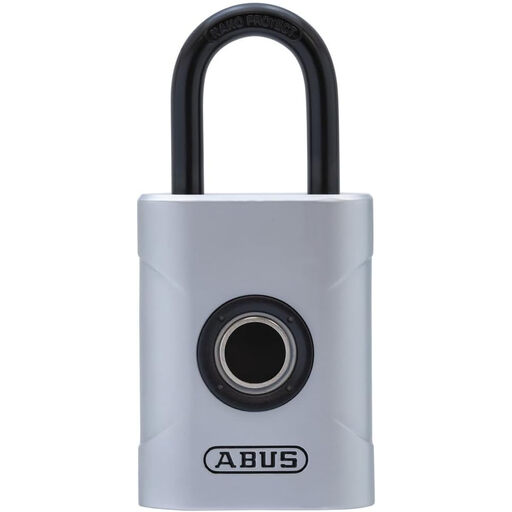
Why this product suits this profile: Suitable for users who prefer keyless access to their home, office, gym or garden.
The stated IP66 and IP68 protection ratings address the outdoor conditions that are so often overlooked. The sensor and finger should be kept clean and dry.
According to ABUS product information: 360-degree sensor, storage for up to 20 fingerprints, hardened steel shackle and automatic spring-assisted opening.
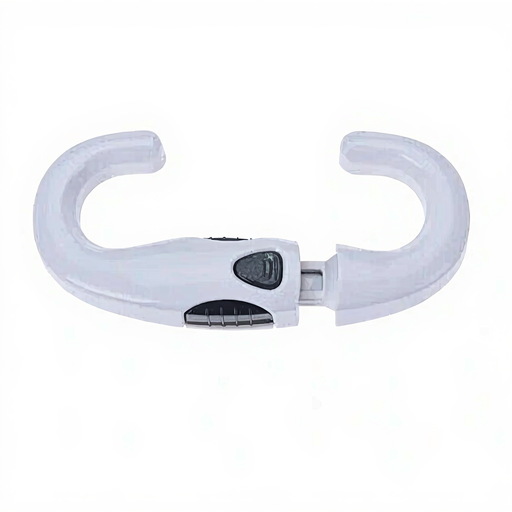
Why this product suits this profile: For households with young children who want to restrict access to cupboards, doors or drawers indoors.
It should not be confused with an outdoor padlock, as it is designed for a different purpose: childproofing cupboards and drawers.
According to the product description: installation without adhesive, screws or tools, one-button operation and an ABS plastic housing.
We have put together a complete, regularly updated list of products that fully meet these strict selection criteria and the safety regulations applicable in the EU.
This depends on the model. According to ABUS product information, the Touch models mentioned can store up to 20 fingerprints. Before buying, check whether this capacity is sufficient for your family, club, office or business.
Battery life depends on usage, temperature and the model. According to the available product information, ABUS Touch padlocks can provide several thousand opening and closing cycles. A warning indicator or signal shows when the battery is low. The exact service life is therefore not a fixed period.
Models with stated weather resistance and IP66/IP68 are generally designed for indoor and outdoor use. Nevertheless, buyers should consider the installation position, extreme weather, dirt and mechanical stress. The shackle dimensions and the suitable mounting point on the gate, locker or latch are also crucial to making the final choice.