
Lieferung heute & morgen

Qualitätsgarantie

Willkommens-Angebote freischalten: KOSTENLOSE Lieferung | Bis zu 80 % RABATT | Kostenlose 30-Tage-JoyPlus-Testphase
App herunterladen
A fire engine toy combines vehicle play, building and imaginative rescue missions. However, choosing the right one is not always easy for parents, grandparents and gift buyers. A model with lots of features is not automatically suitable for the child’s age, while a large amount of accessories can even be impractical in everyday use.
A fire engine with lights and sounds quickly stands out on the shelf. What matters, however, is whether the features suit the intended setting. In a flat, frequent siren sounds can become disruptive. Electronic models also require batteries, which need to be replaced regularly. So check the following:
A manually operated vehicle without electronics may be the more suitable choice for younger children or quieter play situations.
A fire ladder truck with an extendable or rotating ladder can enable exciting high-rise rescue missions. For younger children, however, long, delicate components can be more difficult to operate. A large vehicle also needs sufficient space on the floor and on the shelf. Look for a sturdy construction, smooth-moving joints and whether stabilising feet need to be folded out.
A fire engine playset with figures, tools, hoses and accessories offers a variety of scenarios. However, small parts increase the risk of something being lost or being unsuitable for younger children. The manufacturer’s age recommendation is the key consideration, not just the child’s interests. For products from age 4, manufacturers often explicitly warn about small parts and the need for supervision.
For a fire engine for children aged 2 and over, large, easy-to-grip components and simple functions are a sensible choice. LEGO DUPLO and PLAYMOBIL JUNIOR, for example, use larger elements or a simplified range of features. For children aged 4 and over, more detailed models with figures, tools and moving vehicle parts may be suitable.
The age recommendation does not replace the duty to supervise. Check the toy before every use for damaged parts, loose wheels or sharp broken edges. Products containing small parts that could be swallowed should not be used by children under 3.
For plastic vehicles, sturdy ABS or comparable plastic components, smoothly finished edges and securely closing battery compartments are practical points to check. The CE marking should be displayed on the packaging or product. It indicates that the manufacturer has taken the relevant EU requirements into account; it is not, however, a quality ranking.
Also look for:
A small vehicle is suitable for taking on trips and requires little storage space. Larger models, such as a Bruder fire engine, often feature doors, storage compartments, a water function or a ladder. Measure the available play area and compare it with the product dimensions. For water functions, it should also be clear whether the tank can be emptied after play and the vehicle dried.
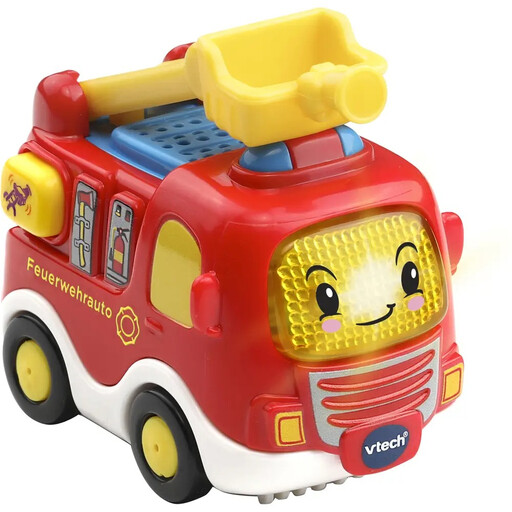
Why this product suits the profile: According to the product details, this compact vehicle is designed for children aged 1 and over, making it a suitable introduction to the world of firefighting.
The functions are straightforward: the focus is on a movable ladder, control buttons and sensors, rather than supplying lots of loose small parts.
Lights, sounds, three songs and six melodies; according to the product details, two AAA batteries are included.
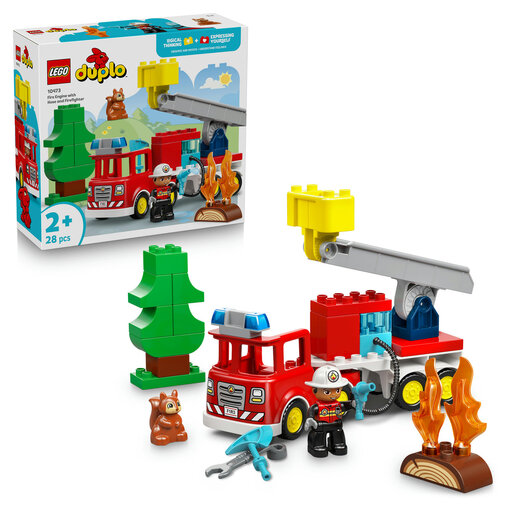
Why this product suits the profile: This fire engine toy for children aged 2 and over combines a larger vehicle with building bricks and a manageable selection of features for little hands.
Large DUPLO elements reduce the issue of small parts. The set comes without an electronic sound unit, so no batteries are required.
28 components, a flexible hose, a rotating ladder with basket and a transparent water tank, according to the product description.

Why this product suits the profile: This model for children aged 4 and over is aimed at those who enjoy realistic vehicle details and repeated role play indoors and outdoors.
The water spray is designed as a hands-on play feature, while the doors and storage compartments allow the accessories to be stored neatly.
1:16 scale, rotating water cannon, refillable tank, removable water hoses, plus a light and sound module.
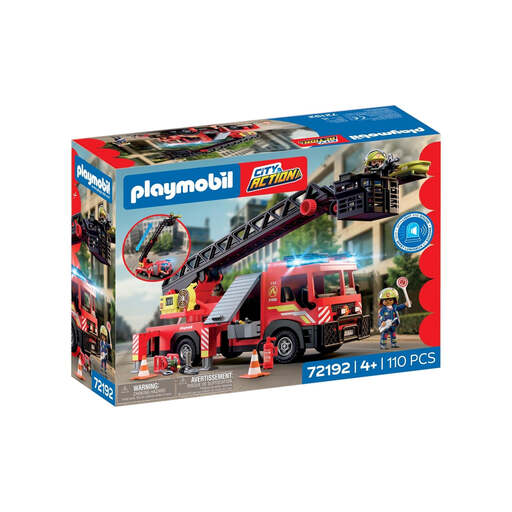
Why this product suits the profile: Two figures and an extensive range of accessories support longer rescue stories created and acted out together.
The extendable stabilising feet keep the vehicle steady during ladder scenarios, while the age recommendation of 4 and over makes the small-parts issue clear.
Rotating and extendable ladder reaching approximately 63 cm, two firefighter figures, 110 parts, plus a light and sound module according to the product details.
We have put together a complete, regularly updated list of products that fully meet these strict selection criteria and the safety regulations applicable in the EU.
For children aged 2 and over, models with larger components, few individual parts and easy-to-move features are suitable. A LEGO DUPLO fire engine or a suitably labelled vehicle without small parts may be a good choice. The specific age recommendation, safety warnings and adult supervision remain essential.
That depends on the child and where the toy will be used. Lights and sounds can make rescue scenarios more vivid, but they also result in ongoing battery costs and noise. Before buying, check the volume, automatic shut-off and whether individual functions can be operated separately.
Its lifespan depends on the materials, how intensively it is played with and how well it is cared for. Vehicles with sturdy wheels and fewer delicate joints are often easier to maintain for regular play. For water functions, the tank should be emptied after play. Remove the batteries if the vehicle will not be used for an extended period. Damaged or loose parts should no longer be used.