
Lieferung heute & morgen

Qualitätsgarantie

Willkommens-Angebote freischalten: KOSTENLOSE Lieferung | Bis zu 80 % RABATT | Kostenlose 30-Tage-JoyPlus-Testphase
App herunterladen
Fire engine toys combine role play with vehicles, figures and technical features. However, choosing the right one is not always easy for parents, grandparents and other family members: a large fire engine toy may take up too much space in a child’s bedroom, small accessories may be unsuitable for younger children, and lights and sound effects often require batteries.
By comparing products carefully, you can avoid common buying mistakes. The key is not having as many features as possible, but finding the right combination of age recommendation, material, size, play concept and care requirements.
A fire engine playset with small figures, tools or connecting pieces is not automatically suitable for every child. Recommendations such as “from 3 years” or “from 4 years” should be considered alongside the child’s developmental stage. For products containing small parts, the choking hazard warning is particularly important.
A fire engine vehicle for children aged 3 and over should be easy to hold and require little or no complicated assembly. For children aged 4 and over, movable ladders, figures and accessories can expand the play possibilities. Construction sets such as a LEGO fire engine are often aimed at older children, as assembling the pieces requires additional concentration and fine motor skills.
A fire engine with lights and sound can enhance role play. However, it does not automatically mean that the vehicle is especially versatile. Therefore, check the following:
For quieter areas of the home or longer play sessions, a manual model without sound may be more suitable. With electronic products, the battery cover, polarity and storage instructions should also form part of your buying decision.
A fire ladder truck in 1:16 scale can be considerably larger than a small metal model in 1:87 scale. Before buying, compare the actual dimensions with your available storage space and play area. A vehicle with an extendable ladder also needs additional clearance above and to the sides.
Weight is another consideration. A model weighing around 1.8 to 2 kilograms is less manageable for small children’s hands than a compact SIKU vehicle. Larger models do, however, often offer more usable features.
European toy safety includes requirements such as those set out in EN 71. The CE marking indicates that the manufacturer has declared the product complies with the applicable EU requirements. It does not replace checking the specific age recommendation and safety warnings.
For fire fighter toys with figures, helmets, hoses or tools, pay particular attention to the following:
Metal bodies with plastic parts, as found on selected SIKU models, are compact and also suitable for collectors. Larger fire engines made from ABS plastic, on the other hand, often feature opening doors, water tanks, ladders or folding supports.
Look for neat workmanship without sharp edges, freely rotating wheels and durable joints. For play functions involving water, the tank should be emptied after play. Electronic components must not come into contact with water.
A small fire engine is easy to transport and combine with other model vehicles. A large fire engine playset is better suited to a permanent play area. For outdoor use, sturdy wheels and easy cleaning are practical features.
When choosing features, it is useful to distinguish between the following:
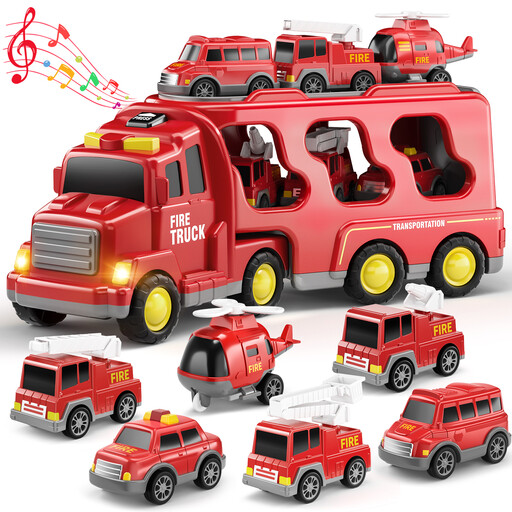
Why this product suits this profile: According to the product information, the 7-in-1 set combines a carrier vehicle with several smaller vehicles and is suitable for children aged 3 and over. The friction-powered vehicles do not require batteries.
The product description gives dimensions of 12.9 × 3.9 × 5.3 inches and explains that the smaller vehicles can be stored inside the carrier. This makes storage part of the play concept.
Several vehicles, lights and music on the large truck, plus indoor and outdoor use according to the product information.
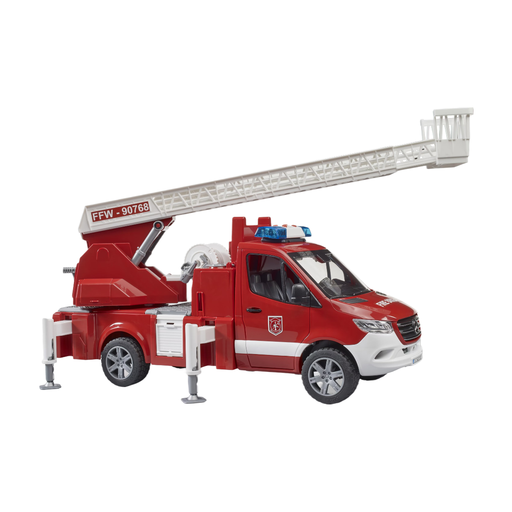
Why this product suits this profile: This fire engine for children aged 4 and over is in 1:16 scale and features an extendable ladder, water spray function, support legs, and a light and sound module.
The age recommendation of 4 and over and the warning about small parts make the usage requirements clear. The module’s batteries must be purchased separately.
Opening doors and storage compartments, a rescue basket and functional support legs encourage varied role play.
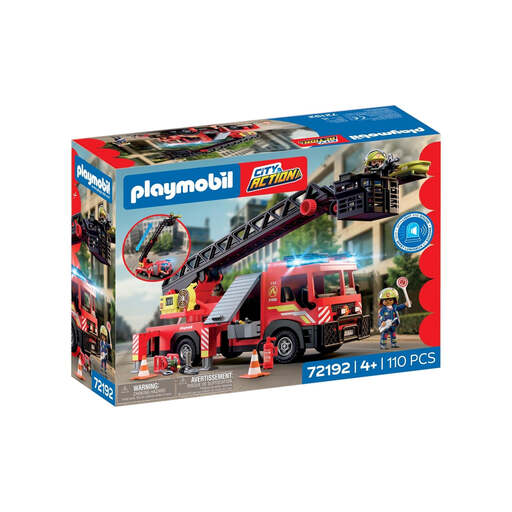
Why this product suits this profile: The set is designed for children aged 4 and over and includes two firefighter figures, a rotating and extendable ladder with rescue basket, and a wide range of accessories.
The product details specify a maximum ladder height of around 63 cm, a footprint of 29.3 × 26.1 × 40 cm, and the batteries required for the lights and sound.
With 110 pieces, two figures, rescue accessories and fold-out supports, the set offers several play scenarios for solo and shared play.
We have put together a complete, regularly updated list of products that fully meet these strict selection criteria and the safety regulations applicable in the EU.
Their lifespan depends largely on how they are used and stored. Wheels, ladder joints, water pumps and small accessories should be checked regularly for loose connections. Models with electronic components should only be cleaned on the surface with a dry or slightly damp cloth. Vehicles that use water should be emptied and dried thoroughly after play.
If the toy is not going to be used for an extended period, it is advisable to remove the batteries in accordance with the manufacturer’s instructions. Damaged parts, loose small components or a battery compartment that no longer closes securely are all reasons to stop using the toy.
For fire engine toys suitable from the age of 3, consider compact vehicles, simple playsets and models without lots of small parts. The manufacturer’s specific age recommendation remains decisive. With sets containing small figures or accessories, an adult should supervise play.
In addition to the purchase price, battery costs depend on the model. Check the battery type and quantity before buying. Some vehicles require AAA batteries, while others use LR44 button cells. A model with manual features does not incur battery costs during play.
This depends on the scale and ladder design. A small model can usually be used on tables or shelves. Large vehicles in 1:16 scale also need room for extended ladders and supports. Therefore, measure not only the vehicle’s length, but also the maximum height and reach of its moving parts.