Hosts with a large pie dish
If you’re making a fish pie for several people in one dish, first check that the dish, including its handles, will fit in the usable oven space.


Start by considering the dish you’ll use and the space available. A built-in oven could be right for you if you have a suitable recess and need enough room for your dish. If you don’t have a built-in recess, a compact fan oven is an option, provided the dish fits and you have a suitable place for it. The heating function and browning won’t tell you whether the fish filling has been heated thoroughly, so check that separately.
If you’re making a fish pie for several people in one dish, first check that the dish, including its handles, will fit in the usable oven space.
If you’re looking for a freestanding oven, compare your dish’s dimensions with the oven’s interior and allow for the recommended clearances around its position.
If a golden-brown finish matters to you, check the oven’s heating functions. Assess whether the fish filling is cooked separately.
First, make sure your dish will fit in the oven and that you have a suitable place for it. Then compare the heating functions, how you’ll check that the food is cooked, and the features that matter if you’ll use the oven regularly.
| What matters | What to check before buying | Who should pay particular attention? |
|---|---|---|
| Will the pie dish fit? | Measure the dish, including its handles, and compare it with the usable internal dimensions. The stated capacity in litres alone won’t tell you whether it fits. | If I’m making a pie for several people in a large dish, the usable space is crucial. Around 36 % of consumers put fit first for this reason. |
| Will the oven fit in the space? | For a built-in oven, check the recess dimensions and connection requirements. For a countertop oven, consider the space it needs, the door opening and the clearances specified for that model. | If you don’t have a suitable recess, you’ll need to find a safe place for a countertop oven or check your plans for a built-in model. Around 29 % of consumers prioritise the space available. |
| Which heating functions do I need? | Check whether the model offers fan-assisted or convection heating, as well as a suitable top-heat or grill function. Assess whether the fish filling is cooked separately. | If I want a browned topping, I look for suitable heating functions, but check the filling separately. Around 21 % of consumers prioritise the heating function and checking that food is cooked. |
| Energy use and cleaning | When comparing similar built-in ovens, compare energy use per standard cycle and the cleaning options available. Don’t assume small countertop ovens are directly comparable with built-in models. | If you use your oven often, weigh up running costs and cleaning effort over time. Around 14 % of consumers put these considerations first. |
The stated capacity doesn’t tell you whether a dish will fit with its handles and filling in place.
Measure your dish and compare its outside dimensions with the usable interior dimensions of the specific oven.
The appliance’s external dimensions don’t automatically include the clearance it needs during use.
Check the setup instructions for your chosen model and make sure you allow enough space.
A browned surface doesn’t show whether the fish filling has been heated thoroughly.
The Federal Institute for Risk Assessment recommends heating fish until the flesh no longer looks translucent and can be easily flaked with a fork. If in doubt, you can check the temperature.
Automatic cleaning heats the oven cavity, so the programme uses energy too.
Weigh up the cleaning method against your actual cleaning needs rather than choosing based on the feature name alone.
A pyrolytic cleaning cycle uses additional energy.
Built-in ovens for suitable recesses; the HBA571BB4 is one example, with a 71 l oven capacity.
Countertop ovens can be an option if you don’t have a suitable built-in recess. The TO 2068 is one example of a fan-assisted model.
Built-in ovens with a range of heating and cleaning functions; the BAR2 KP8V2 IN is one hot-air model.
This selection includes built-in and countertop ovens with baking, hot-air or fan-assisted functions. For a built-in model, check the recess; for a countertop oven, make sure your dish fits and you have a suitable place for it.
 No image available
For a larger pie dish in a suitable built-in recess; check the internal dimensions against your dish.
Listed in the product name: 71 l oven capacity, 3D hot-air cooking and pyrolytic cleaning.
 No image available
A built-in option if you have a suitable recess and your dish fits in the oven.
Listed in the product name: 3 kW, grill, pizza function and AquaClean steam cleaning.
 No image available
For a pie in a suitable built-in recess; compare the appliance dimensions with the space available.
Listed in the product name: 3D hot-air cooking, AirFry and pyrolytic cleaning.
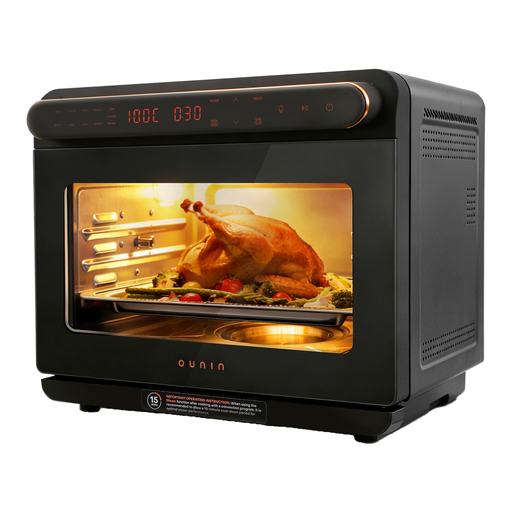 No image available
A countertop option if your dish fits and you have a suitable place for the oven.
Listed in the product name: Steam Bake, Steam Roast, rotisserie, 1-l water tank and 304 stainless steel interior.
 No image available
A countertop oven for a pie, provided your dish and the space available are suitable for the model.
Listed in the product name: 1,600 W, timer and crumb tray.
No. The Federal Institute for Risk Assessment recommends heating fish until the flesh no longer looks translucent and can be easily flaked with a fork. If in doubt, the institute recommends reaching at least 70 °C throughout for two minutes.
Follow your recipe and the appliance instructions. The consumer advice centre notes that many dishes can be cooked without preheating, although doughs may need a high temperature from the start. The European Commission recommends preheating when the recipe or instructions call for it.
For a built-in oven, check the appliance and recess dimensions, as well as the connection requirements for the specific model. For a countertop oven, follow the setup instructions; having a clear worktop doesn’t necessarily mean it’s a suitable place to use the oven.
For household ovens covered by the scheme, the EU energy label shows, among other things, energy use per standard cycle for conventional and fan-assisted cooking. Small and portable ovens are excluded from the scope shown, so the absence of a corresponding label doesn’t automatically mean that regulations have been breached.
Measure the dish’s width, depth and height, including its handles, and compare the dimensions with the usable interior of the specific oven. The stated capacity in litres doesn’t replace this check.