
Lieferung heute & morgen

Qualitätsgarantie

Willkommens-Angebote freischalten: KOSTENLOSE Lieferung | Bis zu 80 % RABATT | Kostenlose 30-Tage-JoyPlus-Testphase
App herunterladen
Choosing the right fishing line is a fundamental decision that can significantly influence your success on the water. The market offers a vast array of materials and specifications, making the selection process complex for both ambitious hobbyists and experienced anglers. This article serves as a guide. It explains the key differences between common line types and presents a selection of products that are relevant based on their material properties and applications. The goal is to provide you with an objective basis for your decision when you want to buy a high-quality fishing line.
Before making a decision, you should consider several technical parameters. The line's properties must match the fishing method, the target fish, and the conditions of the body of water.
The two most popular materials for modern fishing methods like spin fishing are PE braid (polyethylene) and fluorocarbon. Both offer specific advantages and disadvantages.
The choice of line is directly dependent on your preferred technique. For spin fishing with artificial lures for pike, zander, or perch, a braided fishing line is often the first choice as it enables long casts and precise lure control. For finesse techniques or fishing in snag-heavy waters, a full fluorocarbon fishing line or at least a long fluorocarbon leader can be beneficial to take advantage of its high abrasion resistance and low visibility.
Based on the criteria mentioned, we have compiled a selection of products that cover different requirements.
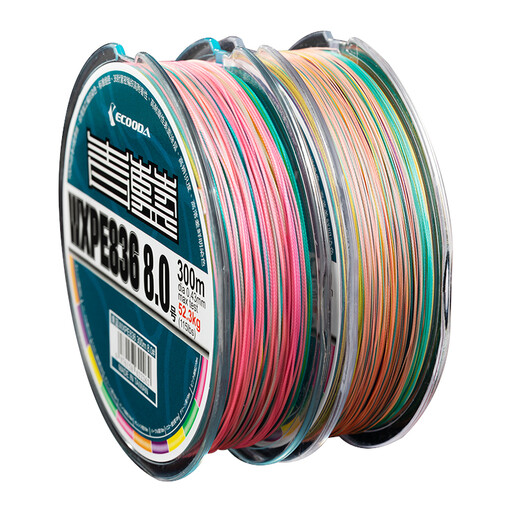
ECOODA Cyan blue PE fishing line WXPE836 high quality
Why it stands out: This is an 8-strand braided PE line. The designation WXPE836 indicates a construction of eight individual strands, which typically results in a rounder and smoother line profile. A smooth surface reduces friction in the rod guides, thus enabling longer casting distances.
Advantages:
Who is it for?: For anglers looking for a reliable main line for spin fishing for predators like zander, perch, and pike. Its properties are particularly beneficial when maximum casting distance and sensitive bite detection are top priorities.

ECOODA Cyan blue Carbon fluorine lure fishing line high quality
Why it stands out: This line is described as a "Carbon fluorine" line, which indicates a fluorocarbon fishing line. Its key feature is its low visibility underwater, making it a strategic choice in clear waters.
Advantages:
Who is it for?: Ideal as a leader material in combination with a braided main line to combine the benefits of both materials. It can also be used as a main line for finesse applications or when fishing for particularly wary fish.

JU7CER 2-piece fishnet burlap roll with yellow linen cord
Why it stands out: This product is not a fishing line, but a practical accessory for organisation and customisation. It is a decorative ribbon that can be used to wrap or label fishing line spools.
Advantages:
Who is it for?: For anglers who value well-organised gear or are looking for a creative idea for packaging fishing accessories.
If the products presented here do not exactly meet your requirements or if you would like a broader overview, you can find a more extensive selection in our Fishing Line category. There, you can filter specifically by material, breaking strength, and other specifications to find the right product for your next trip.
A tear-resistant fishing line is characterised by high linear strength and high knot strength. These properties are the result of the material used (e.g., PE fibres, fluorocarbon polymers), the quality of manufacturing (e.g., the tightness of the weave in a braided fishing line), and the line diameter. A higher breaking strength for the same diameter is often an indicator of a high-quality material.
A proven combination for spin fishing for zander is a thin braided fishing line with a diameter of about 0.10 mm to 0.14 mm as the main line. This provides excellent bite detection over long distances. A leader made of fluorocarbon fishing line (approx. 0.25 mm to 0.35 mm) is attached in front of it to minimise visibility near the lure and to create a buffer against abrasion on rocks or mussels.
The lifespan of a braided line depends heavily on the intensity of use, water conditions (e.g., saltwater or snag-filled water), and maintenance. It is recommended to regularly inspect the line, especially the first few metres, for visible signs of wear such as fraying, colour loss, or a rough surface. With intensive use, an annual change may be advisable. Often, it is also sufficient to remove the first 10 to 15 metres and re-tie the line.