
Lieferung heute & morgen

Qualitätsgarantie

Willkommens-Angebote freischalten: KOSTENLOSE Lieferung | Bis zu 80 % RABATT | Kostenlose 30-Tage-JoyPlus-Testphase
App herunterladen
A fitted sheet should sit securely on the mattress, feel comfortable and retain its shape even after many washes. However, online purchases often lead to unnecessary costs: the stated size does not match the mattress, the pocket depth is insufficient or the material is advertised with properties that are not particularly important in everyday use.
This buying guide explains which details really matter and which options suit different sleeping and usage situations.
The stated dimensions of 90 × 200 cm or 180 × 200 cm generally refer to the mattress surface. To ensure a secure fit, you must also take the mattress height, including any topper, into account. For example, a fitted sheet with a 30 cm pocket depth is suitable for mattresses up to around 30 cm deep, provided this is confirmed by the manufacturer.
If the pocket is too shallow, the sheet may ride up at the corners. If it is significantly too large, creases and excess fabric can form.
Cotton fitted sheets, jersey and cotton sateen differ in their weave, weight and surface texture. A jersey fitted sheet is stretchy and can usually be put on with little effort. Cotton sateen has a smoother surface. The fibre content alone, however, does not provide complete information about the feel, weight or care requirements.
Microfibre fitted sheets are often made from polyester. They can be easy to care for and retain their shape well, but feel different from pure cotton. The material information and care instructions should therefore always be considered together.
A sheet with an all-round elasticated edge can improve the fit, but it does not replace choosing the correct size and pocket depth. What matters is whether the elastic is wide enough and properly finished. For high mattresses or an additional topper, the maximum mattress height should be clearly stated in the product description.
For single beds, a 90x200 fitted sheet is a common size. Depending on the mattress, double beds often require a 140x200 fitted sheet, 150x200 fitted sheet, 160x200 fitted sheet, 180x200 fitted sheet or 200x200 fitted sheet.
Before buying, you should measure:
If a double bed has separate mattresses, two individual sheets may be more practical than one large model.
An easy-care sheet cannot be identified by its material alone. Look for information on machine washing, the permitted temperature, tumble-drying suitability and possible restrictions such as a ban on bleaching. Light and dark colours may have different care requirements.
An ar breathable fitted sheet is often associated in product descriptions with cotton or breathable fabrics. Such claims should always be checked against the actual material composition.
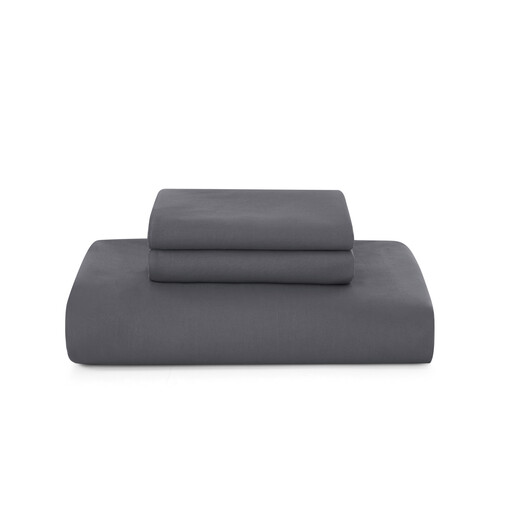
Why this product suits this profile: According to the product description, the set contains two duvet covers measuring 135 × 200 cm and two pillowcases measuring 80 × 80 cm. It may be a useful option for families, guest rooms or keeping a spare set.
The contents are listed clearly, helping you avoid accidentally buying just a single cover instead of a bed linen set.
90% cotton according to the product information, zips and four pieces in the set.
For particularly wide beds, 200x200 fitted sheets or models in 180x200 cm are available. For a 160 × 200 cm mattress, a cotton jersey model such as the specified vidaXL Jersey Fitted Sheet may be a suitable option. For an oversized duvet, a 155x220 bed linen set could be considered. According to the product data, the corresponding 3-piece set includes a cover measuring 155 × 220 cm and two pillowcases measuring 80 × 80 cm.
Before buying, you should also check whether you actually need a single fitted sheet or a complete set. Product images may show several components that are not always all included in the delivery.
We have put together a complete, regularly updated list of products that fully meet these strict selection criteria and the safety regulations applicable in the EU.
Measure the mattress height and add the height of any topper. A fitted sheet with a 30 cm pocket depth is intended for mattresses up to approximately 30 cm deep, provided this is confirmed in the product information. If the measurement is particularly close, a model with some additional capacity may be a sensible choice.
Its lifespan depends on the material, frequency of use, washing temperature, drying method and construction quality. A good fit reduces stress on the corners. Follow the care instructions, avoid unnecessarily high temperatures and change the sheet regularly so that wear is distributed more evenly.
Polyester microfibre is often described as retaining its shape and colour well, and it can be washed at low temperatures. Many people value cotton for its natural fibre structure, although it may shrink more depending on how it is made. The specific material composition and the care label are always the deciding factors.