
Lieferung heute & morgen

Qualitätsgarantie

Willkommens-Angebote freischalten: KOSTENLOSE Lieferung | Bis zu 80 % RABATT | Kostenlose 30-Tage-JoyPlus-Testphase
App herunterladen
A fitted sheet for a double bed needs to do more than just cover the sleeping surface. With a mattress that’s 25 to 30 cm deep, the pocket depth determines whether the sheet stays securely in place or slips off at the corners. If you’re looking for a 180x200 cm fitted sheet with a 30 cm deep pocket, check the measurements, material and fit carefully before you buy.
The 180x200 cm measurement refers primarily to the size of the mattress. It doesn’t tell you whether the sheet is suitable for a deep mattress. A standard fitted sheet may be too small for a 30 cm-deep mattress. The corners can pop off, the fabric may pull across the surface or the sheet may crease.
So, check the pocket depth as well. For a fitted sheet with a 30 cm pocket, the product’s maximum mattress depth should suit the actual depth of your mattress.
Terms such as ‘soft’ or ‘breathable’ only tell you so much without specific material details. Cotton and polyester or microfibre have different properties:
For an informed choice, details such as ‘100% cotton’, ‘100% polyester’, washing instructions and recommended drying methods are more useful than general marketing claims.
An all-round elasticated edge can make a sheet easier to put on, but it won’t make up for the wrong size. Check that the sheet has enough fabric at all four corners and whether the product description specifies a deep pocket or maximum mattress depth. In practice, a non-slip fitted sheet is mainly the result of the right pocket depth, an elasticated edge and putting it on correctly.
Measure the length, width and depth of your mattress. If you have a mattress topper, include the depth of both layers if you want the sheet to cover them. For a standard 180x200 cm mattress, a fitted sheet measuring 180x200 cm with a pocket depth of up to 30 cm is a good guide.
The term fitted sheet for deep mattresses doesn’t automatically mean that every mattress depth will be covered. The specific manufacturer’s measurements are what matter.
A cotton fitted sheet may appeal if you prefer a breathable, natural-feel surface. A microfibre fitted sheet may be a better choice for households where quick washing and easy care are priorities. Always check the care instructions, especially the washing temperature, spin cycle and whether it’s suitable for tumble drying.
Check whether you’re buying a single fitted sheet or a set. Each of the products listed here is described as a single sheet. Colour is also important, whether you’re looking for grey, dark grey or white, as are the care instructions. A machine-washable fitted sheet should be cared for according to the manufacturer’s instructions to help preserve its shape and elastic.
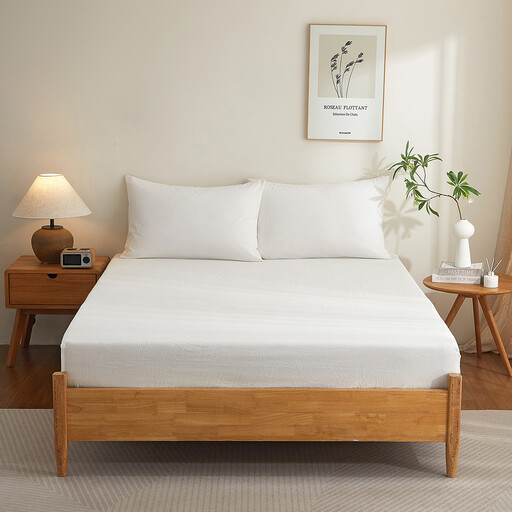
Why it suits this profile: The white option complements a light-coloured bed, and its product name specifies a 180x200 cm size with a 30 cm depth.
The stated measurements make it easier to check whether the sheet will fit a deep 180x200 cm mattress. Before buying, check the full care and material details on the product page.
100% cotton according to the product name, size 180x200 cm plus 30 cm and a white colour.
We’ve put together a complete, regularly updated list of products that meet these strict selection criteria and fully comply with the safety regulations in force in the EU.
First, position the sheet correctly on the mattress. Then pull each of the four corners over the mattress edges in turn. On a deep mattress, the elasticated edge should sit fully underneath it. If you’re using a topper, check that the pocket depth is sufficient to cover the whole mattress setup.
Follow the care instructions provided by the manufacturer. Don’t assume that cotton and microfibre can be washed on the same programme. Bleach can damage colours and fibres. Washing and drying your sheet gently may help it keep its fit for longer.
Not necessarily. As well as the sleeping surface, you’ll need to consider the mattress depth and, where relevant, the depth of a topper. A deep fitted sheet with a pocket depth of up to 30 cm is designed for deeper mattresses.
Its lifespan depends on factors including the material, how often it’s washed, the wash programme and how it’s dried. The elasticated edge may lose its stretch over time. Following the manufacturer’s care instructions and taking turns with several sheets can help reduce wear on each one.
It depends on what matters most to you. Cotton is often chosen for its natural fibres and fabric feel. Microfibre or polyester may be a good option if you want easy care and quick drying. Compare the material composition, pocket depth and care instructions using the specific product details.