
Lieferung heute & morgen

Qualitätsgarantie

Willkommens-Angebote freischalten: KOSTENLOSE Lieferung | Bis zu 80 % RABATT | Kostenlose 30-Tage-JoyPlus-Testphase
App herunterladen
A flex-head ratchet spanner set 8–19 mm can save a lot of space when carrying out repairs on vehicles, machinery or around the home. A flexible head is especially useful for fastenings in hard-to-reach places, where a fixed ring spanner may be awkward to use. However, ratchet spanner sets can vary considerably in their tooth count, materials, size range and storage options.
If you focus only on a shiny finish or a high tooth count, you could miss some important details. The points below will help you choose a flexible spanner set that suits the jobs you have in mind.
According to the product details, a 72-tooth ratchet has a small swing arc of around 5°. This is particularly useful in confined spaces where you can only move the spanner a few millimetres. However, the tooth count shouldn’t be considered in isolation.
You should also look for:
A small swing arc makes the job easier, but it doesn’t replace choosing the right socket or spanner size.
A 180° flex head can reach many positions that are difficult to access with a fixed spanner. At the same time, the joint adds another moving part. If you’re dealing with particularly stubborn fasteners, check whether the manufacturer specifies load limits.
A flexible ratchet spanner is particularly useful for quickly loosening and tightening fasteners with controlled force. Severely corroded or extremely tight fasteners may require a sturdy fixed ring spanner or a suitable torque wrench. Never exceed the maximum load.
A polished or chrome-plated finish makes cleaning easier and can help protect against corrosion. However, the material itself is what matters most. If you’ll be using the spanners frequently, details such as chrome vanadium steel, heat treatment and a forged construction are more relevant than appearance alone.
Care matters too: clean the spanners and store them somewhere dry after working in damp conditions. A tool roll protects them when you’re carrying them loose, but it doesn’t replace regular checks for wear or damage.
A 12-piece ratchet spanner set covering 8, 9, 10, 11, 12, 13, 14, 15, 16, 17, 18 and 19 mm handles many metric fasteners on bicycles, vehicles, household appliances and machinery. The complete size range means you’re less likely to find a commonly used size missing.
If you’re buying a set for car repairs, also check whether the spanner sizes are marked on both sides of the handle. This makes them easier to identify in poor light or under the bonnet.
A 12-point ring can be positioned on many bolt heads without needing to turn the spanner as far as you might with fewer engagement positions. The key is to choose a spanner size that fits as closely as possible. A ring that’s too large can increase the risk of damaging the edges of the bolt head.
Make sure the ring sits fully on the nut or bolt head before turning it. For damaged, badly rounded or dirty fasteners, a suitable specialist tool may be a better choice.
When choosing a flexible spanner set, these details are particularly useful:
Don’t take claims such as “durable” at face value. How long a tool lasts depends on factors including the force applied, exposure to moisture, cleaning and whether it’s used for the right job.
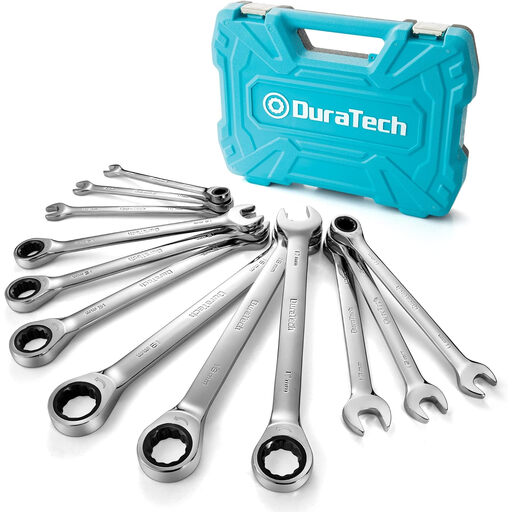
Why this product suits this profile: The set covers every metric size from 8 to 19 mm, making it a straightforward starter kit for home DIY, projects and occasional vehicle repairs.
The sizes are marked on both sides of the handle. The product description specifically identifies the 180° flex head and 72-tooth ratchet, rather than relying on a vague claim of flexibility.
Chrome vanadium steel, a 12-point ring, a 5° swing arc according to the product details, and a tool roll for storage.
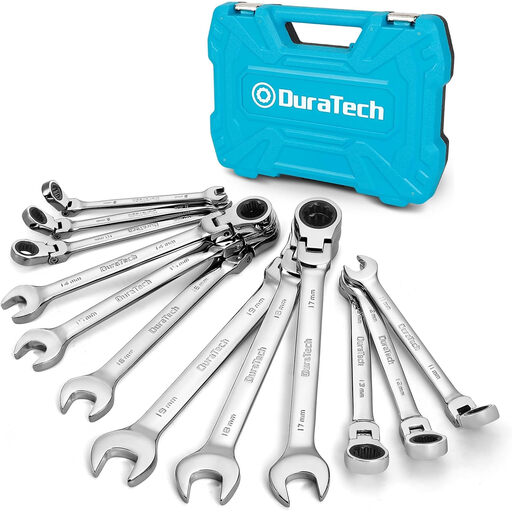
Why this product suits this profile: The version with a case is ideal if you regularly transport your tools or want to keep them neatly organised in your workshop.
The product description lists the complete size range, 72-tooth ratchet, 180° flex head and 12-point ring. This makes it easier to check the key buying criteria before placing your order.
Manufacturer specifications include chrome vanadium steel, heat treatment and forged construction, plus a case for carrying and organising the tools.
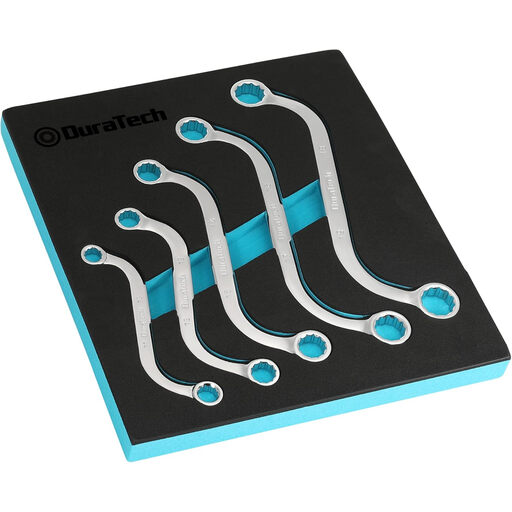
Why this product suits this profile: The S-shape is useful if you work on engines, machinery or other confined spaces with offset fasteners.
The S-shape and double ring offer an alternative when a standard straight spanner catches on a component. The sizes included are clearly listed.
Five spanners with two sizes each, 12-point rings, chrome vanadium steel and an EVA foam insert to keep them organised.
A tool roll is handy for the boot or for taking your tools on the go. A case offers extra protection and helps prevent the tools from moving around. For a permanent workshop setup, a foam insert can be useful because it makes missing spanners easier to spot.
After use, clean any dirt and moisture from your metric ratchet ring spanners. Don’t use an extension pipe unless the manufacturer allows it. If the flex head feels unusually loose, the teeth are damaged or you can see cracks, don’t continue using the tool under load.
We’ve put together a complete, regularly updated list of products that meet these strict selection criteria and fully comply with the safety regulations in force in the EU.
Yes. According to the product details mentioned above, a 72-tooth mechanism needs a swing arc of only around 5°. This can be useful when you have limited room to move the tool. Actual access also depends on the thickness of the spanner, the position of the joint and the shape of the surrounding components.
The complete size range provides a useful starter set for many metric fasteners in home car maintenance and workshop tasks. However, it won’t replace a complete tool kit. Some vehicle systems may require larger spanner sizes, sockets, Torx profiles or torque wrenches.
Avoid overloading the tool, clean the spanners after use and store them somewhere dry. Check the joint regularly for any unusual looseness. When finally tightening safety-critical fasteners, always follow the vehicle or machinery manufacturer’s instructions.