Teams with changing picking tasks
If parts need to be picked up, sorted or supplied at different stations, the key considerations are the specific picking sequence, payload and required cycle time – not simply the robot’s humanoid form.


If parts need to be actively picked up and moved at changing stations, compare a suitable mobile manipulator or humanoid robot with a transport AMR; an AMR may be enough for moving containers alone. Manufacturer data and individual pilot projects prove neither performance nor safe suitability for your specific process. The German Federal Institute for Occupational Safety and Health (BAuA) recommends starting the risk assessment before selecting and purchasing equipment.
If parts need to be picked up, sorted or supplied at different stations, the key considerations are the specific picking sequence, payload and required cycle time – not simply the robot’s humanoid form.
If you need to move materials between stations, establish whether the robot will only transport containers or also pick up parts along the way. This distinction helps you compare an AMR with a mobile manipulator.
If the robot will operate alongside employees, workstations and existing IT processes, define its intended use and carry out a risk assessment at the start of the purchasing process. The BAuA recommends starting this before selecting and purchasing work equipment.
Suitable when: you are trialling changing picking locations and a development team can test the specific hand configuration.
Consider: A humanoid form does not prove that the robot can meet the required cycle time or operate safely at your site.
Suitable when: picking and moving around on a driveable factory floor go hand in hand, and integration with the existing control system is possible.
Consider: A stated payload alone tells you nothing about the weight of the part and gripper combined, the cycle time or safe operation.
Suitable when: an AMR mainly moves containers between points, or a reliable picking task takes place at a fixed station.
Consider: An AMR needs a suitable attachment for active picking; a fixed alternative must be assessed separately for the specific task.
| Consideration | What to check before buying | Who should pay particular attention |
|---|---|---|
| Picking, payload and cycle time | Include the part and gripper, centre of gravity, variations in part position and required cycles in the acceptance test. | If parts and picking positions vary, the handling process must work in your own workflow. For around 27 % of consumers, changing picking tasks are the most important purchasing consideration. |
| Safe operation | Start the risk assessment before selecting the equipment, taking account of travel and picking zones, people moving through the area and potential faults. | If you plan to use the robot in a work area with employees, you need to assess its intended use. For around 20 % of consumers, safe operation at the site comes first. |
| Route and handovers | Check the floor, narrow passages, handovers, crossings with people and parking areas along the actual route. | If containers need to move between stations, route suitability and handovers will determine the right equipment class. Around 20 % of consumers consider the route their most important selection criterion. |
| Software and operation | Clarify interfaces, operation, fleet requirements, charging windows and responsibility for maintenance. | If you need to integrate changing stations with existing orders and workflows, you need a suitable integration plan. For around 20 % of consumers, integration is their main purchasing consideration. |
| Total cost and performance | Compare attachments, integration, charging, maintenance and support with measured throughput and downtime. | If your purchasing decision requires a reliable cost-performance comparison, compare the same scope of work. Around 13 % of consumers put this evidence first. |
A figure on a data sheet may refer to a particular arm position and exclude the end effector. PAL Robotics lists 3 kg per extended arm for the TIAGo Pro, without an end effector; Unitree gives different stated maximum arm payloads for the G1 and G1 EDU.
Check the specific variant and test the part, gripper and movement sequence under your process conditions.
You may need a different gripper, fixtures and additional testing.
igus describes the ReBeLMove Pro as a mobile platform. A transport base alone does not automatically pick up or hand over parts.
Specify transport and active part handling as separate functions, and define where parts should be picked up and handed over.
For independent picking, you may need additional system components such as an arm, gripper, handover equipment and integration.
The German listing for the Unitree G1 Basic EDU is aimed at research and development. NEURA Robotics describes the 4NE1 reservation as an early-access opportunity, not confirmation of short-term availability.
Get written confirmation of the delivery contents, lead time, documentation and acceptance criteria for the exact variant on offer.
Development and integration work, as well as possible waiting times, can affect your purchasing plans.
The BAuA points out that CE marking is not the same as a safety test mark. A deployment at another site does not automatically assess your intended use.
Start the risk assessment before selecting the equipment and assess your own process against measurable acceptance criteria.
You may need to introduce additional protective measures or change your process afterwards.
The TIAGo Pro is offered as a mobile manipulator for picking and navigation.
The G1 and G1 EDU are humanoid platforms; a G1 Basic EDU listing on the German marketplace is aimed at research and development.
The ReBeLMove Pro is a mobile option to compare for transport and material supply.
The manufacturer describes the 4NE1 as a humanoid approach to industrial workflows.
Agile Robots describes Agile ONE as a humanoid robot for industrial applications and moving between workstations.
The following Joybuy listings are for humanoid platforms. Product details alone do not prove suitability for material flow or safe operation in a workplace.
 No image available
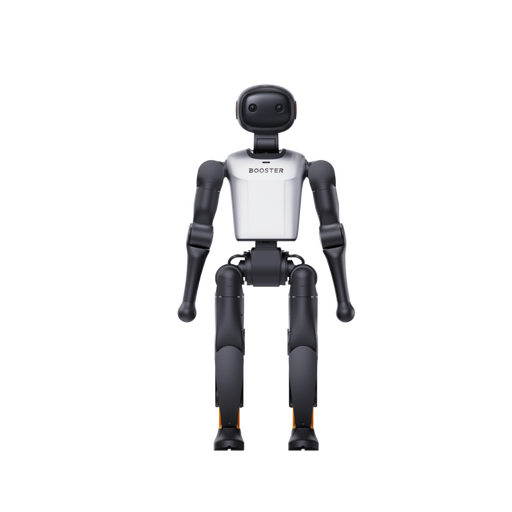
The product title describes the K1 as a development platform for embodied AI; check whether the specific configuration suits your testing project.
Listed in the product title: 48 TOPS AI and 22-DoF.
 No image available
The product title lists force-controlled, dexterous hands for manipulation; check the specific picking task and available integration before planning to use this model in a process.
The product title does not list an available SDK/API for this version.
First, describe each picking and handover step, including part weights and variants. Then compare a mobile manipulator with an AMR that mainly transports items and needs a suitable attachment for independent picking.
Not in all the configurations described here: PAL Robotics lists a dock charging station as an additional option, while igus describes fleet management for the ReBeLMove Pro as optional. Make sure the actual delivery and integration scope is set out in the quotation.
For the specific offering, factor in grippers and attachments, integration, charging equipment, software, support and maintenance. PAL Robotics lists additional batteries and premium maintenance and service plans as options; compare the terms for your use case.
No. The BAuA makes clear that CE marking is not the same as a safety test mark. The risk assessment for the work equipment and its intended use should begin before selection and purchase.
No. According to the BAuA, Regulation (EU) 2023/1230 applies to products placed on the market from 20 January 2027; until 19 January 2027, Machinery Directive 2006/42/EC continues to apply. The requirements for the specific system and any modifications must be checked separately.