
Lieferung heute & morgen

Qualitätsgarantie

Willkommens-Angebote freischalten: KOSTENLOSE Lieferung | Bis zu 80 % RABATT | Kostenlose 30-Tage-JoyPlus-Testphase
App herunterladen
A flexible mini tripod with a selfie stick needs to do several jobs when you’re out and about: hold a smartphone or camera, let you take selfies from further away and stay stable even in unusual positions. In practice, though, models vary considerably. Some are only suitable for smooth tabletop surfaces, while others can be attached to railings, branches or poles.
Before you buy, it’s worth looking at the design, load capacity and compatibility rather than relying on marketing claims alone.
A tripod with flexible legs needs to do more than simply bend. What matters is whether the legs provide enough grip once wrapped around something. Smooth plastic surfaces can slip on painted poles or damp surfaces. For a secure fit, wrap the legs tightly around the structure before letting go of the camera.
On uneven ground or in windy conditions, a flexible phone tripod is still a portable solution, not a replacement for a firmly anchored mount.
A mini tripod for smartphones and cameras may accommodate different devices without being suitable for every weight. The smartphone, mount, microphone and LED light all add up. So check the tripod’s maximum load against the combined weight of the accessories you plan to use.
The stated load limit is particularly important with cameras that have interchangeable lenses. A 1/4-inch standard screw describes the connection, but it doesn’t automatically mean the whole tripod is stable.
A selfie stick with a Bluetooth remote needs to connect to your smartphone. Before ordering, check the operating system, pairing method and range. The remote doesn’t replace a stable setup, either: for group photos, make sure the tripod is secure before triggering the shutter remotely.
Thermoplastic elastomers, or TPE, are often used for flexible tripod legs. The material should bend easily without quickly losing its shape during normal use. The stated operating temperature range may also matter for travel and outdoor photography.
Also check:
A 360° ball head makes it easier to position your camera for portrait or landscape shots, as well as overhead or low-angle photography. A reliable locking mechanism is essential. A freely moving head without a secure clamp may give way under the weight of heavier accessories.
A camera tripod with a cold shoe may also be useful for vloggers. The accessory shoe lets you attach a compatible microphone or video light directly to the head. The maximum combined load of the camera and accessories still matters, though.
A vlogging tripod with a built-in telescopic pole can double as a tabletop tripod and a selfie stick. Check the:
For a portable smartphone tripod, a weight of 300 to 500 grams is often a practical compromise between portability and stability. However, the right choice depends on how you plan to use it.
The recommendations below group products by typical needs. The technical details are based on the information provided for each product.
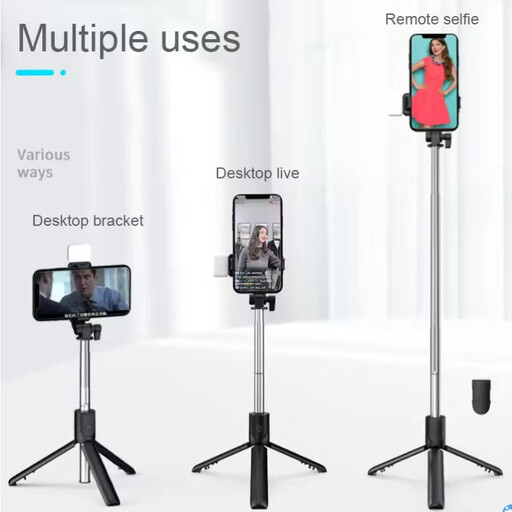
Why this product suits this profile: Combining an extendable selfie stick, a smartphone holder and tripod functionality, this model is ideal for casual selfies, group photos and occasional social media shots.
The remote’s stated range is less than 10 metres, giving you a clearer idea of the practical distance before you buy.
Bluetooth connectivity for iOS and Android, extends to 100 cm and has a stated tripod function.
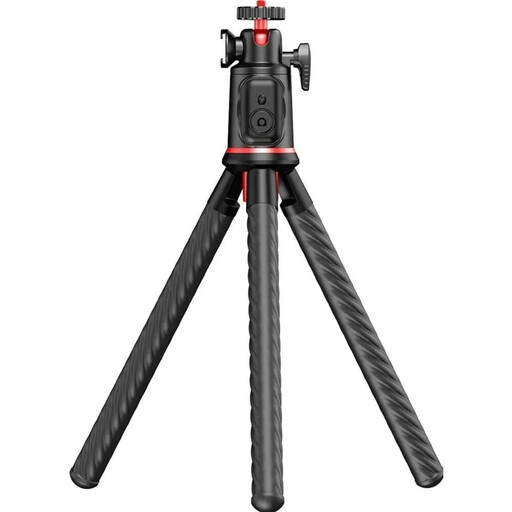
Why this product suits this profile: This model combines flexible legs, a telescopic pole, a 360° ball head and a cold shoe. It’s designed for vlogging, travel and a range of mounting positions.
The product details specify three flexible TPE legs, a maximum load of 2 kg and a lockable 360° ball head.
Height range of 25 to 46 cm, Bluetooth 5.4 with a stated range of up to 10 m, and a detachable smartphone holder.
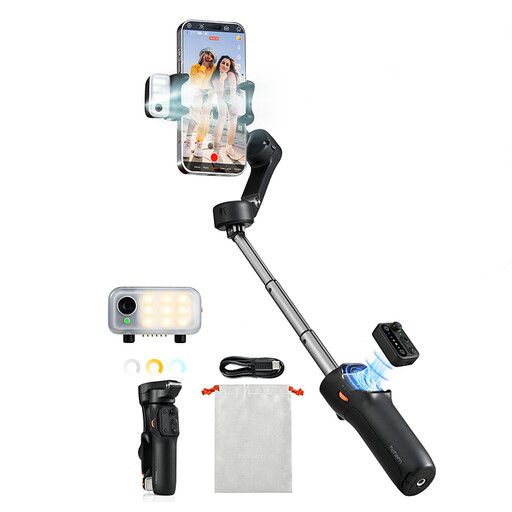
Why this product suits this profile: For anyone who moves around while filming, a gimbal is an alternative to a flexible tripod. It combines 3-axis stabilisation, a detachable remote and a built-in extension pole.
The product description notes that it isn’t waterproof and that the smartphone’s weight must not exceed the permitted limit.
3-axis system, detachable remote and a stated battery life of up to 13 hours.
We’ve put together a complete, regularly updated list of products that meet these strict selection criteria and the safety regulations in force in the EU.
Before each shoot, check that your smartphone or camera is firmly secured in the mount. With a flexible model, wrap the legs tightly around the chosen structure. Only let go of the camera once you’ve checked that the setup won’t tip over or slip.
Also remember to:
Switch on Bluetooth on your smartphone, turn on the remote and select the device shown in your Bluetooth settings. Then open the camera app. Depending on your smartphone, you may be able to set the volume button as the shutter release if pressing the remote doesn’t work straight away.
Its lifespan depends on the load, UV exposure, moisture and how often the legs are bent. Replace the tripod or stop using it with heavy devices if the legs become brittle, develop cracks or can no longer hold their position.
Yes, provided the model has a suitable 1/4-inch thread and can support the weight. Check the combined weight of the camera, lens and accessories. An additional adapter may be needed for action cameras.