For simulated frequency changes, a radio panel with dedicated COM controls is a better fit than a throttle quadrant: Logitech G lists COM1/2 knobs on its Flight Sim Radio Panel, while Octavi offers COM context modes on the IFR-1. If you also want to manage the throttle while making radio calls, add a suitable quadrant to your setup. For voice communications on VATSIM, you’ll also need a pilot client, a configured microphone and a push-to-talk button, as Audio for VATSIM explains.
Which controls are right for you?
Learning radio procedures
You mainly want to practise simulated frequency changes, calls and readbacks, and are wondering whether you need additional throttle axes at all. Logitech G describes the COM1/2 functions on its Radio Panel, while Octavi lists COM context modes on the IFR-1.
Pilots with existing flight controls
You already own a stick or yoke and want to operate the throttle or other aircraft functions using physical levers while handling radio procedures. Logitech G describes three levers on its Flight Sim Throttle Quadrant, while VKB lists three analogue axes on the GNX THQ.
Home cockpit builders
You’re setting up a dedicated control station and comparing aircraft layouts, mounting options and platform requirements. Thrustmaster describes different throttle controls for its models, while Honeycomb Aeronautical lists additional hardware needed to use the Bravo with Xbox.
What should you consider when buying?
First decide whether you want to set frequencies physically, communicate by voice or control the throttle as well. A throttle quadrant won’t automatically handle radio controls.
| What matters to you |
What to check before buying |
Who should pay particular attention? |
| Suitable radio controls |
Check COM1/2 inputs, rotary knobs and compatibility with your specific simulator and simulated aircraft. For VATSIM, also set up audio and push-to-talk. |
If I want to control simulated frequencies directly, suitable radio controls matter more than an additional throttle axis. Around 39% of consumers are likely to prioritise radio controls. |
| Throttle control during radio calls |
Match the aircraft type, the engine and additional functions you want, and the number and configuration of the levers to your existing controls. |
If I want to control the throttle or other flight functions while speaking, having the right physical lever assignments is important. Around 23% of consumers are likely to have this as their main priority. |
| Platform and setup |
Check the exact model, platform, simulator and any connection or software components you’ll need. Distinguish between a standalone device, a module and a set. |
My existing platform and equipment need to work with the complete connection setup before I choose a model. Around 23% of consumers are likely to prioritise setup requirements. |
| Space and mounting |
Measure your desk surface and edge, and allow enough room for the levers to move and for neighbouring equipment. |
If I’m setting up a dedicated control station, the mounted controls and full lever travel need to fit the available space. Around 15% of consumers are likely to prioritise space and mounting. |
Avoid common buying mistakes
-
Assuming a throttle quadrant is a radio panel
Throttle levers and dedicated COM knobs do different jobs. A quadrant on its own won’t automatically let you set the radio frequencies you want.
First decide whether you want to set frequencies physically, transmit by voice or control the throttle as well. Then check that the controls you need are specifically supported.
-
Assuming a module or Xbox accessory is complete on its own
The VKB GNX THQ requires a separately available GNX USB Controller to connect the module directly to a PC via USB. Honeycomb says you’ll also need the Alpha XPC and Xbox Hub to use the Bravo with Xbox.
Check the complete connection setup for your specific model and platform.
Depending on your setup, you may need additional connection or console hardware.
-
Comparing device dimensions without allowing for the mounted controls
The dimensions listed for the Honeycomb Bravo don’t include the mounting plate and clamp. You’ll also need to leave room for the levers to move.
Measure the space you have available, including the mounting hardware and lever travel, before deciding where to set up your controls.
Brands and suitable product ranges
Logitech G
Its radio and throttle controls are separate product ranges designed for different tasks.
- According to Logitech G, the Flight Sim Radio Panel has COM1/2 knobs, while the Flight Sim Throttle Quadrant has three levers and adjustable clamps.
- The throttle quadrant isn’t a dedicated radio panel and doesn’t replace COM controls.
Octavi
The IFR-1 is designed for consumers who want to bring instrument and COM controls together in one device.
- Octavi lists COM1/2 context modes and a rotary knob.
- Octavi says you need to install a plugin for the relevant flight simulator. The IFR-1 isn’t a throttle quadrant.
Thrustmaster
The TCA Quadrant Airbus Edition and T.Flight Hotas One cater for different throttle and control needs.
- According to Thrustmaster, the TCA Quadrant Airbus Edition has two independent levers with switchable detents. The T.Flight Hotas One’s throttle lever can be detached and positioned separately or alongside the stick.
- The TCA is designed for Airbus aircraft and isn’t a dedicated COM controller; the T.Flight Hotas One is a stick-and-throttle set, not a dedicated radio panel.
Honeycomb Aeronautical
The Bravo Throttle Quadrant is designed for a dedicated control station, with multiple levers and autopilot controls.
- Honeycomb lists six levers and an integrated autopilot panel.
- The panel isn’t a dedicated COM frequency controller. For Xbox, Honeycomb also lists the Alpha XPC and Xbox Hub; the stated dimensions don’t include the mounting plate and clamp.
VKB
The GNX THQ is a modular throttle quadrant designed for consumers who want to add to their existing flight controls.
- VKB lists three analogue axes and eight buttons.
- According to VKB, you’ll need a GNX USB Controller (not included) to connect the module directly to a PC via USB.
Joybuy products
This selection combines throttle controls with primary flight controls. It’s therefore best suited to you if your home cockpit is missing a yoke or a stick with a throttle lever. For COM frequencies, you’ll need dedicated radio controls.
 No image available
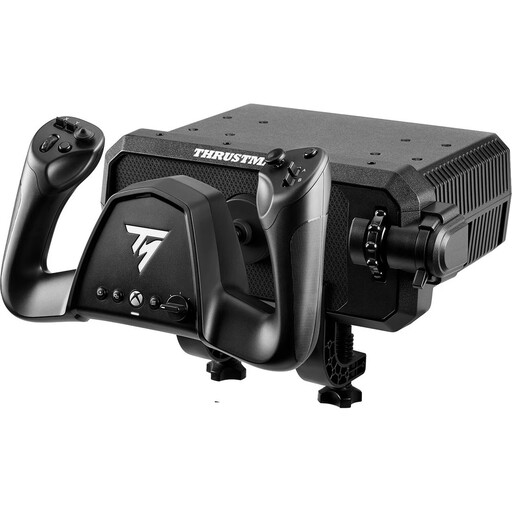
Thrustmaster TCA SKY YOKE Flight Yoke
If you’re missing flight controls with an integrated throttle lever, this yoke brings several inputs together in one device.
Seven axes, 24 action buttons, 180° rotation, H.E.A.R.T. Magnetic Technology and 16-bit resolution; the product name specifies PC and Xbox Series X.
Joybuy
 No image available
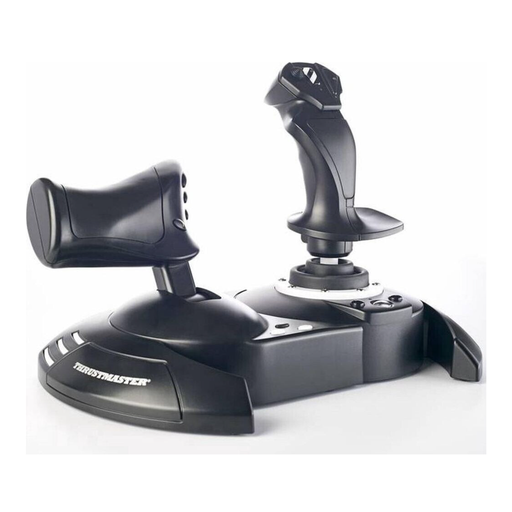
Thrustmaster T.Flight Hotas One
If you don’t yet have primary flight controls, this HOTAS pairs a stick with a detachable throttle lever.
According to Thrustmaster, the throttle lever can be positioned separately from the stick or attached to it. This model isn’t a dedicated COM controller.
Joybuy
Frequently asked questions
Can I practise simulated COM frequencies with a throttle controller alone?
Not just by using the throttle axes. If you want to enter frequencies physically, look for dedicated radio controls, such as the COM1/2 knobs on the Logitech G Flight Sim Radio Panel or the COM modes on the Octavi IFR-1. You should also check that the controls work with your specific simulator and aircraft.
What do I need to set up for voice communications on VATSIM?
Set up the audio in your pilot client and check your microphone and push-to-talk button. Audio for VATSIM recommends calibrating the microphone in the client’s audio menu and checking the input level while speaking. A throttle controller won’t replace this setup.
Do I need a radio operator’s certificate in Germany to practise radio procedures in a flight simulator?
Using a flight simulator controller isn’t the same as operating a real aircraft radio station. The Bundesnetzagentur generally requires a certificate to operate an aeronautical radio service at a ground or aircraft station. Actual aeronautical radio use is subject to the relevant authorisations and frequency allocations.


