Approach practice with limited desk space
If you want to start practising virtual approaches with a stick that’s easy to reach, while using the cockpit controls you already have, a smaller setup may be enough.


Choose your controls based first on the aircraft you fly most often in the simulator, then on the functions you want to reach quickly during an approach. A single stick may be enough for a compact setup; a separate HOTAS system offers a different control layout, while a yoke may suit aircraft with a control column. Multiple monitors are set up independently of the stick, and practising at home with a consumer controller does not automatically count towards flight training.
If you want to start practising virtual approaches with a stick that’s easy to reach, while using the cockpit controls you already have, a smaller setup may be enough.
If you want to assign frequently used controls to physical inputs and arrange instruments or views across several screens, plan your controller assignments and monitor layout separately.
If you mainly simulate aircraft with a control column, a yoke may better match your preferred way of controlling the aircraft. The Microsoft Flight Simulator team’s guide recommends a yoke for aircraft flown using one.
A good fit if: you want to get started without taking up much space and initially plan to use a mouse, keyboard or existing input devices for other cockpit functions.
Things to consider: Depending on the model, fewer functions may be within easy reach, and the control style is different from a yoke.
A good fit if: you want to control the throttle and other custom-assigned functions separately from the stick.
Things to consider: Allow space for the extra controls and take care when setting up your assignments.
A good fit if: you mainly simulate aircraft with a control column and this style of control is important to you.
Things to consider: A yoke is less versatile for aircraft with a sidestick, and it doesn’t automatically replace a throttle or mean your displays are set up for you.
| What matters | What to check before buying | Who it matters most to |
|---|---|---|
| Attitude and trim | Check how you can assign and operate the axes and trim in your chosen simulator. | If I want to practise making small corrections during repeated approaches, I need precise control over attitude and trim. Around 36 % of consumers put this level of control first. |
| Cockpit controls within reach | Think about which commands you use often and which you want to assign to physical controls. | If I spread instruments and views across several screens, I want important commands within reach on my controller. Around 29 % of consumers prioritise direct access to cockpit controls. |
| Aircraft control style | Decide whether a stick or a yoke suits the aircraft you mainly simulate. | If I focus my practice on a particular aircraft type, its control style is important to me. Around 21 % of consumers choose primarily between a stick and a yoke based on their preferred aircraft. |
| Desk space and future upgrades | Check how much space you have and whether you prefer integrated or separate controls. | If I want to start with a straightforward setup and expand it later, I consider the space it takes up and how easy it is to use. Around 14 % of consumers prioritise a compact setup to get started. |
The stick handles inputs; displays and additional views are set up separately.
Start by arranging your displays in the operating system, then check the window and instrument features in your specific simulator.
Setup may involve extra steps on your PC and in the simulator.
The number of controls doesn’t tell you which commands you can reach without moving your hand from the controls for your preferred aircraft.
Make a note of the virtual commands you use most often and check how you can assign them to controls and buttons within easy reach.
The right control style depends on which aircraft you fly most often in the simulator and which way of controlling them matters to you.
Before buying, decide whether a versatile stick or a yoke is a better match for your preferred aircraft.
If your preferred control style changes later, you may need to buy additional equipment.
A consumer controller does not prove that a flight simulation training device meets the qualification requirements for regulated training.
If you want your practice to count towards a qualification, check the requirements with your training organisation and for the equipment you plan to use.
The T.16000M-FCS range offers a standalone stick or a HOTAS set with a separate TWCS throttle, giving you different setup options.
The Extreme 3D Pro is a standalone stick for a setup with few separate devices.
The VelocityOne Flightstick, with built-in levers, and the more extensive VelocityOne Flightdeck, with separate modules, cater to different space and control preferences.
The Alpha Yoke and Bravo Throttle Quadrant are an alternative for a cockpit setup modelled on aircraft with a control column.
This selection includes a yoke for aircraft with a control column, along with standalone stick and HOTAS options to suit different control preferences.
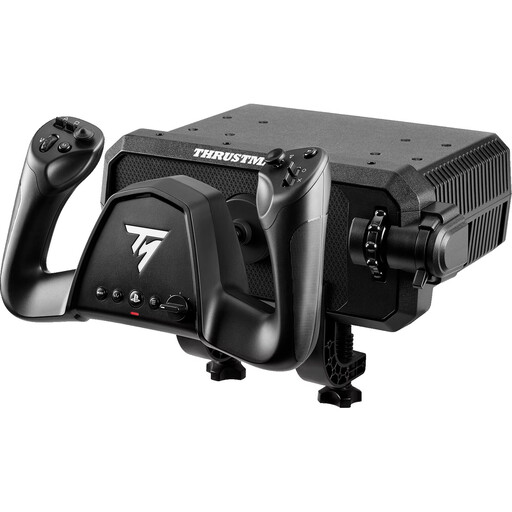 No image available
Worth considering if you mainly simulate aircraft with a control column.
7 axes, 24 action buttons and 180° rotation.
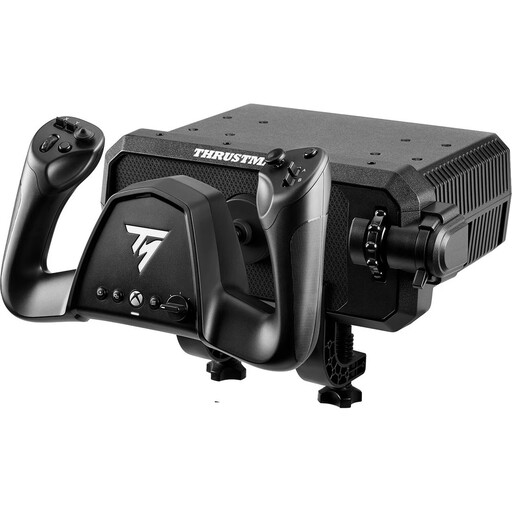 No image available
A yoke option if you mainly fly aircraft with a control column in the simulator.
7 axes, 24 action buttons and 180° rotation.
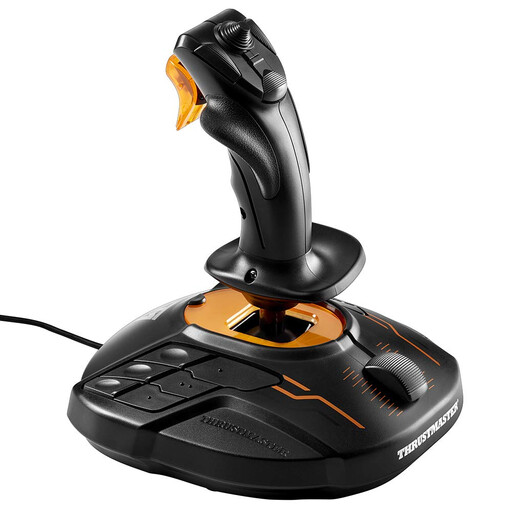 No image available
A standalone stick for a compact start, if you initially use other input devices for additional cockpit functions.
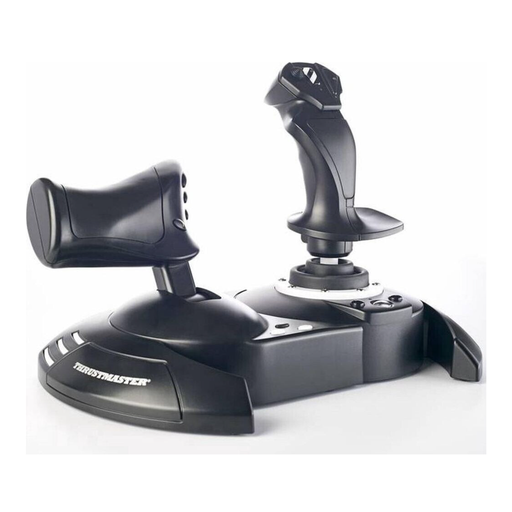 No image available
A HOTAS option if you want to use the stick and throttle separately.
No, these are separate tasks. Microsoft Support explains how to arrange multiple displays in Windows; also check the window and instrument features in your specific simulator. Stick buttons only control functions you assign to them there.
Check the axes in your simulator and assign the commands you use most often for your virtual aircraft. With a HOTAS, the manufacturer’s configuration software may also be relevant; it won’t automatically give you an IFR control layout that suits every setup.
No, not necessarily. Some standalone sticks have a twist axis for rudder control, and some models include built-in levers. First, check whether these controls suit the aircraft you’re simulating and the way you fly; you can always add extra equipment later.
A yoke is particularly worth considering if you mainly simulate aircraft with a control column. If you fly different types of aircraft or prefer a compact setup, compare the control style and space requirements before deciding.
Owning a stick or using a home simulator on its own doesn’t prove that your training counts towards a qualification. The German Federal Aviation Office sets out qualification requirements for flight simulation training devices used in regulated training. If you want your practice to count towards a qualification, check the requirements with your training organisation and for the equipment you plan to use. According to the German Federal Aviation Office, Implementing Regulation (EU) 2026/781 entered into force on 30 April 2026 and will apply from 30 April 2028.