
Lieferung heute & morgen

Qualitätsgarantie

Willkommens-Angebote freischalten: KOSTENLOSE Lieferung | Bis zu 80 % RABATT | Kostenlose 30-Tage-JoyPlus-Testphase
App herunterladen
An important workshop, a presentation to the entire team, or a university lecture—the moment a marker fails is never a good one. Either the ink has dried out or, even worse, it bleeds through to the next page of the flipchart pad, ruining your already prepared sheets. Choosing the right flipchart marker might seem trivial, but low-quality products quickly lead to frustration and unprofessional results.
Many users grab the first marker they see, only to discover later that it's unsuitable for their needs. The most common problems are easy to avoid if you know what to look for.
An informed decision protects you from these problems and ensures your ideas are clearly and legibly visible.
To find the right presentation marker, you should carefully examine three key technical features. These determine its functionality and reliability in daily use.
The most important criterion for a marker for flipchart paper is its ink composition. Unlike permanent markers, whose solvent-based ink often bleeds through paper, special flipchart ink is formulated to be water-based.
Look for explicit labelling like "no-bleed" or "bleed-proof." This ink is designed so that the pigments stay on the surface of the paper instead of penetrating the fibres. Another advantage is that it is typically low-odour, which is especially important in enclosed spaces and during long workshops. Brands like Staedtler Lumocolor specialise in these ink formulations, which also dry quickly and are smudge-proof.
The choice of tip depends directly on your intended use. Both types have specific advantages:
A "blocked tip" is an additional quality feature. It prevents the tip from being pushed into the barrel under heavy pressure, which increases the marker's lifespan.
One aspect that is often overlooked is the long-term cost and ecological footprint. Disposable markers produce unnecessary waste and require constant repurchasing. A refillable flipchart marker is an economically and ecologically sound alternative. Models that can be refilled easily and cleanly not only reduce plastic waste but are also more cost-effective in the long run. Before buying, check if the manufacturer offers corresponding refill stations or cartridges.
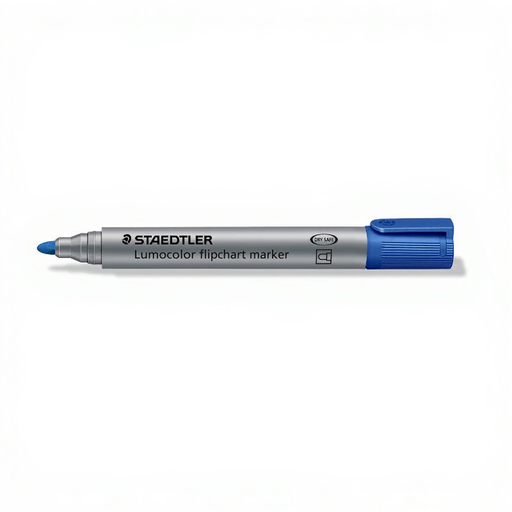
Why This Fits Their Persona: For facilitators and lecturers, absolute reliability is crucial. This marker is specifically designed for professional use, where there's no second chance to make a first impression. The consistent line of the 2 mm bullet tip ensures clean and legible writing, even from a distance.
The special ink is guaranteed not to bleed through. Additionally, the "DRY SAFE" technology (per the manufacturer's ISO 554 specification) prevents it from drying out, even if the marker is left uncapped for days—a direct counter to the dry-out trap.
Refillable with a corresponding refill station, which lowers operating costs. According to the manufacturer, the barrel is made of 97% recycled plastic.
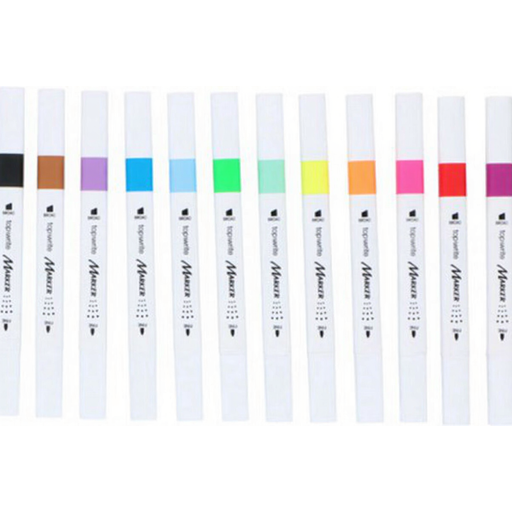
Why This Fits Their Persona: For creative brainstorming and visual storytelling, flexibility is key. With 12 colours and a dual tip on each marker, this set offers a wide range of design possibilities without constantly needing to switch pens. Ideal for mind maps, sketches, and colour-coding.
This set avoids the "tip trap" by combining two tips in one marker. The fine tip (3.5 mm) is suitable for details, while the broad chisel tip (5.8 mm) is for headlines and filling areas. You are not limited to a single line type.
Maximum versatility thanks to the dual-tip design and the wide range of colours in a single set. The water-based ink is well-suited for most types of paper.
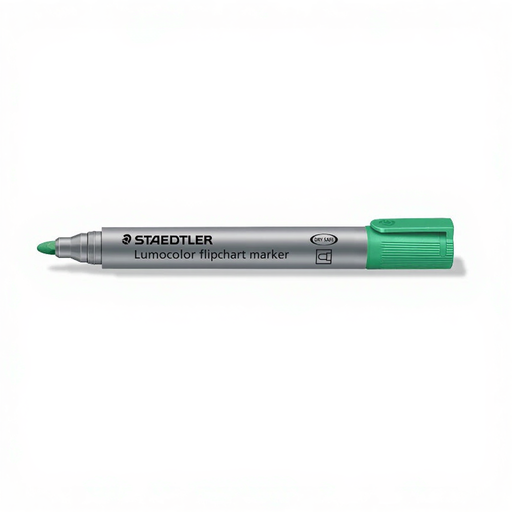
Why This Fits Their Persona: For companies and educational institutions that focus on sustainability and budget efficiency, the total cost of ownership is crucial. This marker is not just a writing tool but part of a system designed for durability and resource conservation.
It bypasses the cost trap of disposable products. The refill system turns the marker itself into a durable tool rather than a consumable item. The barrel, made of 97% recycled plastic, also addresses the demand for more sustainable materials.
The combination of refillability, recycled material, and the proven "DRY SAFE" technology makes it an economically and ecologically sound choice for continuous use.
We have compiled a complete, up-to-date list of products that fully meet these strict selection criteria and quality standards.
1. How long does a flipchart marker last before it dries out? This largely depends on the marker's technology. Standard markers can dry out in just a few hours without a cap. Models with special technology, like Staedtler's "DRY SAFE" feature, can be left uncapped for several days without losing their ability to write, according to the manufacturer. This is a crucial advantage in fast-paced work environments.
2. What is the difference between a bullet tip and a chisel tip on presentation markers? A bullet tip delivers a consistent line width and is ideal for smooth, legible writing. A chisel tip offers variable line widths, depending on whether you write with the broad side, the edge, or the point. It is more versatile and well-suited for headlines, highlighting, and creative visualisations.
3. Can you refill any flipchart marker? No, most budget-friendly markers are designed to be disposable. Only models explicitly labelled as refillable can be replenished with ink. Look for this feature when purchasing and ensure the manufacturer offers compatible refill systems. This is a more cost-effective and environmentally friendly option in the long run.