
Lieferung heute & morgen

Qualitätsgarantie

Willkommens-Angebote freischalten: KOSTENLOSE Lieferung | Bis zu 80 % RABATT | Kostenlose 30-Tage-JoyPlus-Testphase
App herunterladen
For paper crafting enthusiasts, there's nothing more satisfying than finishing a handmade card or scrapbook layout with a perfect, intricate floral design. But getting there can be a challenge. An ill-suited die not only leads to frustration but also to wasted materials and time. Before you expand your collection, it's crucial to understand the common pitfalls often hidden behind appealing product photos.
Many crafters know the problem: the die that looked so promising online delivers nothing but messy results at home. These are the most common reasons for a bad purchase:
To avoid these problems, you should check a few basic technical features before buying.
A smart purchasing decision isn't based on marketing promises, but on objective product features. For your next selection of dies for card making, pay close attention to the following three parameters.
The die's material is the deciding factor for durability and cutting performance. Most high-quality metal dies for scrapbooking are made of carbon steel. This material offers an excellent balance of hardness and flexibility. It's robust enough to maintain its shape even under high pressure and allows for the creation of very sharp cutting edges. A well-made die from this material ensures precise die cuts with floral motifs, where even the most delicate parts are cleanly separated. Look for a smooth surface without any burrs or imperfections.
Die-cutting machines use a "sandwich" system, where the die and paper are clamped between several plates and rolled through the machine. The total thickness of this stack must be perfectly matched to the machine. Universal dies have a standard thickness compatible with most common machines (e.g., from Sizzix, Vaessen Creative, or Spellbinders). If you're unsure, the product description often provides compatibility information. Thin dies, often called embossing stencils for crafting or wafer-thin dies, are the most common and versatile.
Consider which projects you primarily want to use the die for. Do you want to create DIY cards and need a central focal point, or rather small, repeating elements for decoration?
A well-thought-out selection of crafting dies for paper ensures you have the right tool on hand for every project.
To make your decision easier, we have matched some products from our range to different user profiles.
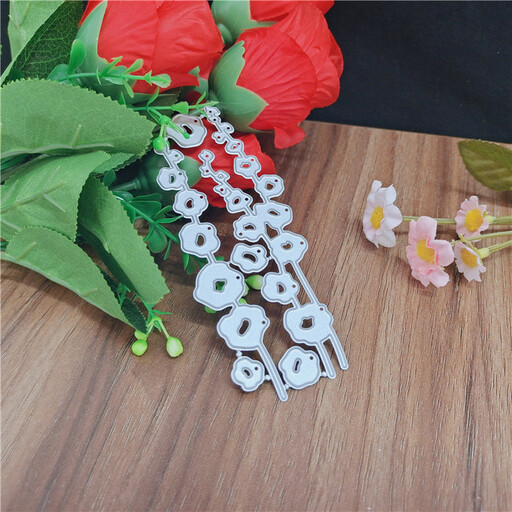
Why This Fits Their Persona: This set is ideal for getting started as it includes several small, separate flower and leaf motifs. Instead of committing to one large design, beginners can use these elements to flexibly add small accents to cards, gift tags, or albums and experiment with different compositions.
It avoids the trap of limited versatility. Instead of a single, rigid design, you get a modular kit of small parts that can be recombined endlessly, offering high usability.
High flexibility thanks to modular elements. Ideal for learning composition and arrangement in paper design.
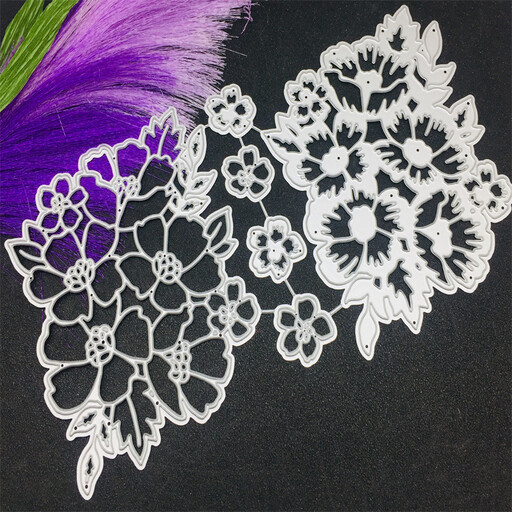
Why This Fits Their Persona: This set is designed for crafters who value depth and dimension. The "Many Layered Blossoms" allow for the creation of impressively realistic and three-dimensional flowers by layering different die-cut elements.
It avoids messy cuts on complex designs because the motif is designed from the start to be made of separate, simpler partial cuts. Each die cuts only one part of the flower, ensuring clean edges. The complex final result is achieved by assembling the pieces.
Enables the creation of multi-layered 3D flowers. The individual elements can also be used separately for smaller decorations.
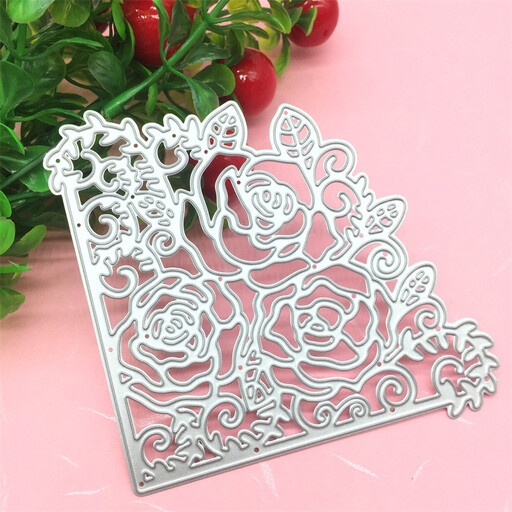
Why This Fits Their Persona: Anyone looking to quickly create appealing cards or layout pages will benefit from this frame die. A complete decorative frame is created with just one pass. This saves time on design and ensures a symmetrical, professional look.
This die is designed as a sturdy frame. When made from high-quality carbon steel, care is taken to ensure the structure resists warping and lies flat even after many uses, guaranteeing even pressure and clean cuts.
Saves time by creating a complete frame in a single step. Ensures consistent and symmetrical designs for batch-producing cards.
We've compiled a complete, up-to-date list of products that fully meet these strict selection criteria.
1. What types of paper are suitable for cutting dies? For most intricate dies, smooth cardstock with a weight between 160 g/m? and 240 g/m? is best. Paper that is too thin (under 120 g/m?) can tear easily, while very thick cardstock (over 280 g/m?) may not cut cleanly in a single pass. For embossing, thinner paper can also be used to enhance the effect.
2. How do I properly clean and store my metal dies? After cutting, small paper scraps often get stuck in the die. You can carefully remove them with a piercing tool or a stiff brush. To protect the dies from bending and getting lost, storage on magnetic sheets, which fit into special binders or boxes, is recommended. This keeps them flat and neatly organized.
3. Do all cutting dies fit in every die-cutting machine? Most thin metal dies (wafer-thin dies) are compatible with the most common manual die-cutting machines. The width of the die is the crucial factor—it must not be wider than the machine's opening. The correct arrangement of the plates (the "sandwich") is also important and is described in the manual for your specific machine. For very thick or particularly large dies, you should check the product description for compatibility notes.