
Lieferung heute & morgen

Qualitätsgarantie

Willkommens-Angebote freischalten: KOSTENLOSE Lieferung | Bis zu 80 % RABATT | Kostenlose 30-Tage-JoyPlus-Testphase
App herunterladen
Foam building blocks can turn part of your living room, nursery or playroom into a flexible space for active play. But not every soft play set is right for every age or setting. If you focus only on bright colours or the “XXL” label, it’s easy to overlook important details.
Very soft foam may give way when children climb on it, while a construction that’s too lightweight may slide around. That’s why foam density, base area and non-slip features matter just as much as the padding. Descriptions such as “high-density” or “shape-retaining” should ideally be backed up with specific material details.
A washable cover is handy for keeping things clean, but it doesn’t replace information about toy safety. Look for clear details about EN71-1, EN71-2 and EN71-3, as well as the European Toy Safety Directive. If a product is sold as an EN71-certified toy, it should be clear which parts and sections of the standards the conformity claim applies to.
Once set up, XXL foam blocks take up much more room than they do in the packaging. With vacuum-packed sets, the foam also needs time to expand fully. Product information may advise waiting 24 to 48 hours. Before buying, check the available space, doorways, walkways and where you’ll store the set when it’s not in use.
For climbing blocks for toddlers, choose designs made from high-density, shape-retaining foam. The cover should be skin-friendly and well made. Concealed zips help keep hard or small parts out of reach. Hook-and-loop fastenings can hold modules together and let you change the layout of a foam play set.
For babies and younger toddlers, the set should also be free from small parts that can come loose. Always follow the stated age recommendation and warnings, and provide the necessary supervision.
A textured, non-slip base can help reduce movement as children crawl, climb or slide. However, it’s no substitute for a level, dry and sufficiently large play area. Before each use, check that the modules are connected properly and that there’s no damage to the seams, covers or hook-and-loop fastenings.
The layout matters too when setting up an indoor play area for children. Avoid placing tall elements right next to hard furniture, radiators or sharp-edged walls. Depending on the floor and how the set will be used, an additional soft mat may be helpful.
Washable covers are especially useful for families, nurseries and pre-schools. Check whether the covers are removable and machine washable, or whether they can only be wiped clean. If you’re buying a ball pit with climbing blocks, check that the ball pit cover can be removed separately too. Some sets don’t include the balls.
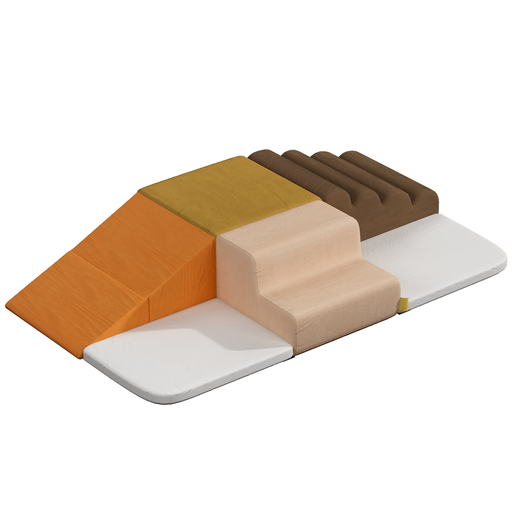
Why this product suits this profile: This six-piece set is a manageable starting point for families who want to try out different layouts without committing to a large play area straight away.
The product details mention high-density, shape-retaining foam, non-slip bases, hook-and-loop fastenings and concealed zips.
Six modules, machine-washable covers and, according to the product details, compliance with EN71-1, EN71-2 and EN71-3.
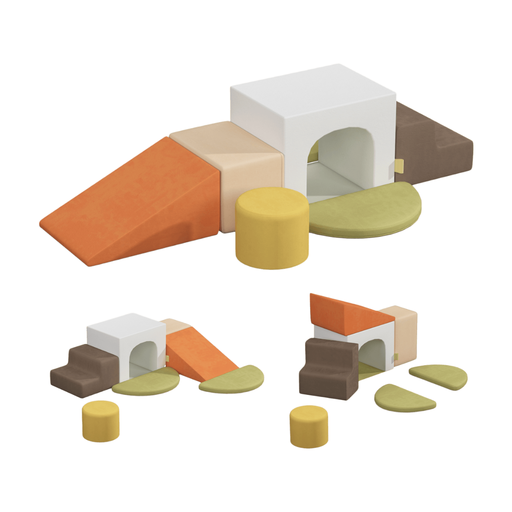
Why this product suits this profile: This seven-piece set is designed for different climbing, crawling, sliding and building configurations, making it a good fit for homes or settings where it’ll be used regularly.
As well as a non-slip base, the product details mention secure hook-and-loop straps, concealed zips and removable covers.
Seven colourful modules, machine-washable covers and, according to the product details, compliance with EN71 and EU toy safety regulations.

Why this product suits this profile: The combination of climbing modules and a ball pit base is suited to larger play areas at home, in nurseries or in pre-schools. Balls are not included.
The product description clearly states that balls must be bought separately, and mentions non-slip bases, hook-and-loop fastenings and washable covers.
A 2-in-1 play set with climbing blocks and a ball pit base; according to the product details, both types of cover are removable and machine washable.
We’ve put together a complete, regularly updated list of products that meet these strict selection criteria and the safety requirements in force across the EU.
Before each use, parents or carers should check the modules for tears, open seams and loose hook-and-loop fastenings. Remove any damaged parts from the play area. A soft play set is no substitute for supervision, especially for babies and toddlers.
Follow the manufacturer’s cleaning instructions. Removable covers should be completely dry before you put them back on. Don’t soak the foam parts unless the manufacturer specifically says this is safe. If the product is vacuum-packed, let it expand fully before using it for the first time.
This depends on the recommended age, the size of the modules and the warnings provided. For babies, low, large modules with no small parts are a better choice, and they should only be used under direct supervision. Depending on how they’re configured, sets with climbing elements may be more suitable for toddlers or pre-schoolers.
Their lifespan depends on how heavily they’re used, how they’re stored and cleaned, and the quality of the materials. Regular visual checks are more useful than a general estimate in years. Shape-retaining foam, hard-wearing covers and well-finished seams can help the set stand up to everyday use, but they don’t guarantee a particular lifespan.
Allow space not only for the modules themselves, but also for children to move around them. A ball pit with climbing blocks needs extra room for children to get in and out safely. If the set is vacuum-packed, wait until it has fully expanded before measuring and setting it up.