
Lieferung heute & morgen

Qualitätsgarantie

Willkommens-Angebote freischalten: KOSTENLOSE Lieferung | Bis zu 80 % RABATT | Kostenlose 30-Tage-JoyPlus-Testphase
App herunterladen
Foam climbing blocks for children can create a versatile area for physical activity at home, in childminding settings or in nurseries. At the same time, soft-play products vary considerably in terms of materials, stability, cleaning and what is included. An appealing product description alone therefore says little about whether a set is suitable for the available space and the child’s age.
Three purchasing misconceptions in particular often lead to unnecessary expense:
For soft blocks for toddlers, shape-retaining foam is important. High-density or highly resilient foam can retain its shape better with regular use than very soft material. However, this does not mean that every product is made with the same density or load-bearing capacity. Details of the material and product weight should therefore be checked before buying.
A non-slip underside can help prevent individual elements from sliding easily on smooth floors. Hook-and-loop fasteners help connect several blocks to create a climbing course or a small crawling route. However, they are no substitute for a level, clean surface. Before play, parents should check that the connections are closed and that the seams and covers are undamaged.
For toys intended for 1–3-year-olds, information about European safety requirements is particularly important. The standards EN71-1, EN71-2 and EN71-3 cover, among other things, the mechanical and physical properties, flammability and certain chemical properties of toys.
A designation such as EN71 certified should ideally be linked to specific parts of the standard and the responsible manufacturer. According to the product information, the BanaSuper sets mentioned here are stated to comply with EN71-1, EN71-2 and EN71-3, as well as Toy Safety Directive 2009/48/EC. This information comes from the manufacturer or product listing and should be checked against the documents provided at the time of purchase.
Concealed zips are also useful because they reduce direct contact with the fastening. Regardless of the product, babies and toddlers should only use it under supervision, on a suitable surface and in accordance with the stated age range.
Washable covers are particularly practical for everyday use. Check whether all covers can be removed or only the ball-pit cover, and what washing temperature is recommended. After washing, the covers should be completely dry before being put back on.
Vacuum-packed foam parts often need time to reach their intended shape. The BanaSuper sets are stated to require approximately 24 to 48 hours to expand. The set should therefore not be subjected to use immediately after unpacking if individual parts are still misshapen.
Before buying, you should also check the door width, storage space and distance from furniture. A climbing set needs sufficient space around it so that children cannot reach hard edges or radiators.
The following selection categorises the products according to typical requirements. The information on materials, standards and features comes from the respective product details.
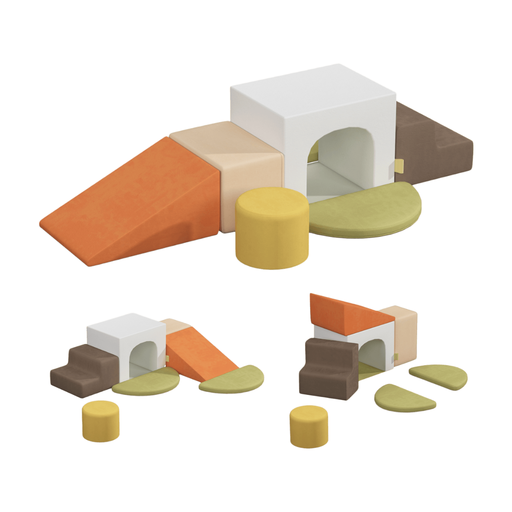
Why this product suits this profile: The 7-piece set offers several shapes for climbing, crawling and building, without the need to assemble a separate play system.
According to the product information, it has non-slip undersides, concealed zips and washable covers. The exact floor space required should nevertheless be checked before ordering.
7 foam elements, EN71-1 to EN71-3 according to the product information, and machine-washable covers.

Why this product suits this profile: This 2-in-1 play centre combines climbing blocks with a ball-pit base, making it suitable for families who want to combine different types of play in one area.
The product name explicitly states that the play balls are not included. According to the product information, the removable ball-pit cover and block covers should be machine washable.
A combination of climbing and crawling areas plus a ball-pit base; hook-and-loop fasteners and non-slip undersides according to the product information.
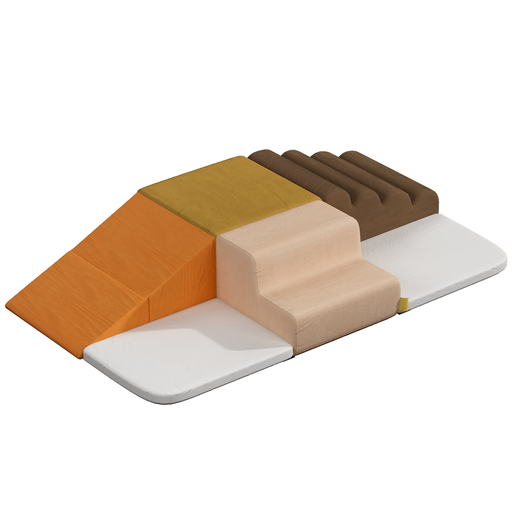
Why this product suits this profile: The six large blocks can be used flexibly in flats, playgroups, children’s bedrooms or educational settings to create obstacle courses, tunnels or climbing structures.
According to the product information, the elements have textured non-slip undersides, concealed zips and washable covers. Expandability is limited to the six included shapes.
6 large elements, machine-washable covers, and EN71 and Toy Safety Directive information according to the product description.
We have put together a complete, regularly updated list of products that fully meet these strict selection criteria and the safety regulations applicable in the EU.
A soft-play climbing set should always be matched to the available space. For a rented flat, compact sets with fewer parts may be more practical than XXL foam building blocks. In a nursery or pre-school, on the other hand, washable covers, daily visual checks and easy storage are particularly important.
An activity cube for toddlers serves a different purpose from a baby climbing course. The 8-in-1 Baby Activity Cube is specified for children aged 1 to 3 and includes rotating, push and sorting elements, among other features. It requires less floor space, but does not replace a soft climbing area. A baby walker, meanwhile, should only be used in accordance with the manufacturer’s instructions and under supervision.
Montessori toys often describe a design focused on independent play. The term alone is not proof of safety or quality. You should therefore always check the material, age recommendation, warnings and what is included.
This depends on the design, dimensions and manufacturer’s specifications. For babies and toddlers, parents should follow the age recommendation and always supervise play. Small or detachable parts must not be left within reach of children who put objects in their mouths.
For the BanaSuper products mentioned, approximately 24 to 48 hours is specified. The elements should only be used once they have reached their intended shape and show no visible damage or unusual deformation.
Not necessarily. According to the product name and description, the BanaSuper Soft Play Set does not include play balls. Before buying, check whether suitable balls will involve additional costs and what size is intended for the ball pit.