
Lieferung heute & morgen

Qualitätsgarantie

Willkommens-Angebote freischalten: KOSTENLOSE Lieferung | Bis zu 80 % RABATT | Kostenlose 30-Tage-JoyPlus-Testphase
App herunterladen
A foldable 150 kg transport trolley should move heavy items safely while taking up minimal space when not in use. In practice, however, the stated load capacity and low price are not the only deciding factors. The wheels, frame, handle and folding mechanism determine whether the trolley is genuinely suitable for moving house, gardening, workshop tasks or warehouse use.
The stated “150 kg” capacity does not automatically apply to every type of use. With a 2-in-1 transport trolley, the maximum load in platform mode may be higher than in upright sack truck mode. If you want to load a trolley with 150 kg, check the following:
A model rated for 80 kg in hand truck mode and 150 kg as a platform trolley is suitable for certain tasks, but it does not replace a sack truck that can consistently carry 150 kg.
A transport trolley with large wheels can handle uneven surfaces more easily than a model with small castors. However, wheel diameter, tyre material, bearings, axle design and contact area are also important. TPR wheels with ball bearings may be suitable for workshop floors, garages, courtyards and warehouses. On stairs or very uneven terrain, however, particular care is still required.
With a foldable sack truck or transport trolley, the folded dimensions should be considered in relation to the available storage space. Key factors include:
A lightweight trolley with a 25 kg load capacity may be useful for shopping and household items, but it should not be confused with a 150 kg transport truck.
Load capacity is the key comparison point. When carrying heavy loads, you should consider not only the maximum weight but also the shape of the items. A compact crate is transported differently from long boards, sacks or gardening equipment.
On a platform trolley, the weight is generally distributed over a larger area. A sack truck, by contrast, carries the load closer to the frame and requires a controlled tilt. Do not exceed the stated load limit. This protects the platform, wheels, axles and connections from excessive strain.
An aluminium transport trolley combines relatively low weight with a sturdy frame. For regular use, look for reinforced profiles, bolted connection points and a sufficiently large, non-slip platform.
A simple plastic box can be practical for light loads. For heavier loads, however, the frame construction, base plate and wheel suspension are particularly important. The surface should be easy to clean if the trolley is used in the garden, on building sites or in the workshop.
An adjustable-height handle allows you to adapt the trolley to different heights and transport methods. Check that the handle locks securely in every position and that the handgrip is non-slip.
For longer distances, smooth-running wheels with sturdy bearings are an advantage. An integrated parking mechanism can help during loading and unloading on suitable surfaces that are not too steep. It is not a substitute for securing the load, and you should check that it locks properly before use.
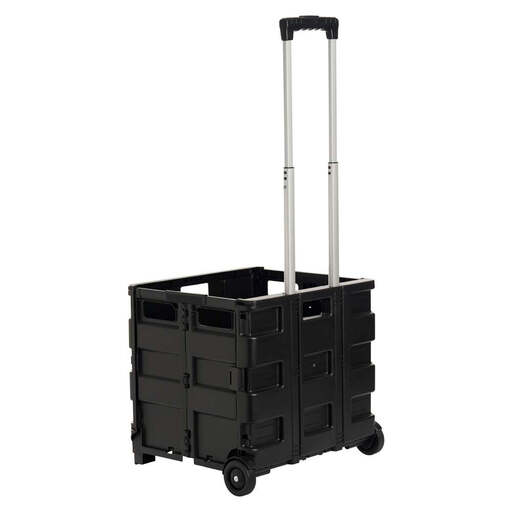
Why this product suits this profile: Weighing 2.65 kg, with a capacity of 42.5 litres and folded dimensions of 45.5 × 45.5 × 8 cm, this foldable transport trolley is suitable for shopping, household items and light tools. It is not a 150 kg transport truck, but a solution for smaller loads.
The clearly stated maximum load of 25 kg prevents its capacity from being confused with that of a 150 kg model. The precise folded dimensions make it easier to plan storage.
42.5-litre capacity, telescopic handle with a height of 97.5 cm and a compact depth of 8 cm when folded.
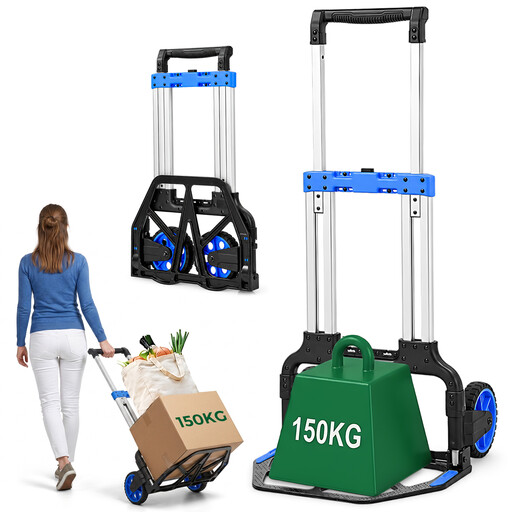
Why this product suits this profile: The aluminium frame, bolted connection points and stated 150 kg load capacity make it suitable for moving house, warehouse work, building sites and gardening tasks involving heavy individual items.
The product specifications explicitly state the 150 kg load limit and also list adjustable handle heights of 77 and 107 cm. This makes it easier to check the details before buying.
Aluminium frame, large TPR wheels with ball bearings, non-slip handle and supplied tie-down straps for securing the load.
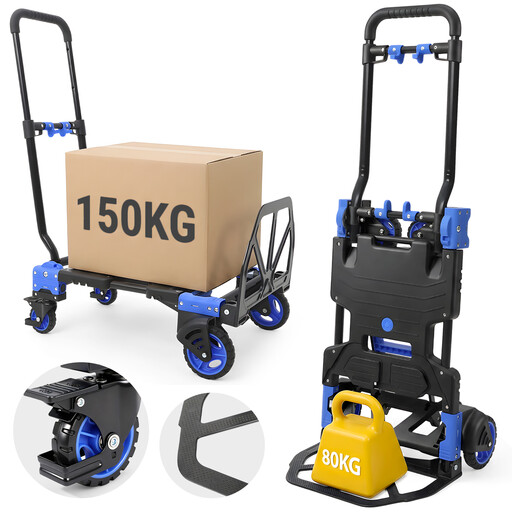
Why this product suits this profile: This foldable platform trolley switches between hand truck and platform modes. It is rated for up to 80 kg in hand truck mode and up to 150 kg in platform mode. This makes it suitable for changing tasks in warehouses, workshops, homes and gardens.
The different load capacities for the two modes are clearly stated. This allows you to check whether the intended load is suitable for the selected operating mode before transport.
2-in-1 design, adjustable handle, 360° TPR wheels with dual bearings and an integrated parking brake.
With any foldable transport trolley, check all locking mechanisms before loading it. The handle must be fully locked into place, and the platform must not come loose unintentionally under pressure. Heavy items should be placed as low and centrally on the trolley as possible. Tie-down straps are advisable for tall or unstable loads.
Only use the trolley on a surface for which its construction is designed. Steep ramps, high kerbs and stairs increase the risk of tipping. A transport trolley is neither a seat nor a stepladder and should not be used to carry children or pets.
We have put together a complete, regularly updated list of products that fully meet these strict selection criteria and the safety regulations applicable in the EU.
The maximum of 150 kg applies only if the manufacturer specifies this capacity for the particular operating mode. With a 2-in-1 model, the limit may be 150 kg in platform mode but, for example, only 80 kg in hand truck mode. The load should be distributed evenly and secured against slipping.
Its service life depends on the load, surface, storage conditions and care. Avoid overloading, clean the wheels and joints regularly, and store the trolley in a dry place. Damaged wheels, loose screws or locking mechanisms that do not engage properly should be checked before the next use.
Compact castors are often sufficient for smooth floors. On courtyards, in workshops or on building sites, larger TPR wheels with sturdy bearings may be more suitable. However, the surface must still be compatible with the trolley’s design: high edges, stairs and severe unevenness can cause instability even with large wheels.