
Lieferung heute & morgen

Qualitätsgarantie

Willkommens-Angebote freischalten: KOSTENLOSE Lieferung | Bis zu 80 % RABATT | Kostenlose 30-Tage-JoyPlus-Testphase
App herunterladen
A foldable dog crate is a convenient solution for travel, car trips, or visits to the vet. It combines the security of a rigid crate with the flexibility and space-saving storage of a bag. However, the market is flooded with models whose quality differences are difficult to spot at first glance. Many pet owners invest in a crate that quickly proves to be unstable, unsafe, or impractical.
As a Joybuy Product Recommendation Officer, I analyse product data to provide you with objective, real-world advice. This guide will show you the most common pitfalls to avoid and the crucial features to look for to find a durable and safe foldable dog crate for your pet.
Marketing promises often sound convincing, but the devil is in the details. Pay close attention to these three weak points to avoid a bad purchase:
To make the right decision, focus on objective, verifiable criteria. These three parameters are crucial for safety, durability, and comfort.
The stability of a foldable crate depends entirely on its internal frame. Simple wire frames often don't offer enough resistance. Look for models with a steel tube frame. This construction is significantly more robust and resistant to deformation. Equally important is the locking mechanism that secures the frame when assembled. It should be easy to operate but lock securely to prevent accidental collapse.
A high-quality lightweight dog crate is made from durable fabric. A proven standard is 600D Oxford fabric. This polyester material is abrasion-resistant, water-repellent, and stands up to scratches. Also, pay attention to the quality of the zippers and seams. Double stitching at stress points like handles and corners is an indicator of meticulous construction. Heavy-duty zippers, ideally with a locking feature, prevent your pet from opening the crate from the inside.
The crate must be large enough for your dog to stand comfortably, turn around, and lie down. Measure your dog's height while standing (from the floor to the top of the head) and its length (from the tip of the nose to the base of the tail). Add about 10–15 cm to both measurements to determine the ideal interior dimensions of the crate. This is especially critical for a crate for large dogs, as too little space can quickly lead to stress and discomfort. For smaller animals, a dog carrier bag or a dedicated cat carrier can also be a suitable alternative.
Based on the quality criteria mentioned, we have selected a few models for different use cases.
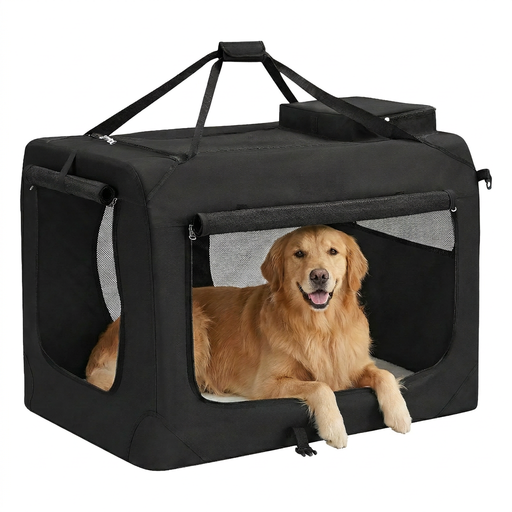
Why This Fits Their Persona: Ideal for owners of breeds like Great Danes, St. Bernards, or large German Shepherds who need a spacious yet portable solution. The generous dimensions provide ample room, even on longer journeys.
The robust steel frame counteracts the instability problem common in crates of this size. The large mesh windows ensure excellent air circulation.
Exceptionally large interior (122 cm length). Folds flat for space-saving storage despite its size. Durable Oxford fabric.
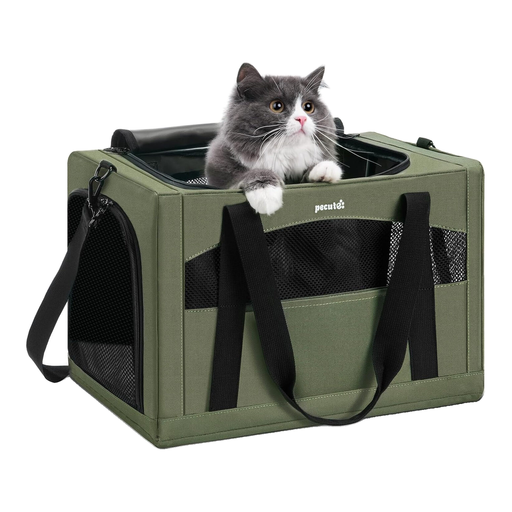
Why This Fits Their Persona: Perfect for owners of small dogs or cats (up to 5 kg) who travel frequently by car and prioritise maximum safety. Its compact form is well-suited for the passenger or back seat.
Specifically addresses the lack of car safety. The dual seatbelt fastening system and integrated safety leash provide double security during travel. The reinforced frame prevents collapse.
Reinforced frame with 5 mm wire and honeycomb boards. Lockable zippers and an internal safety leash offer double protection against escape.
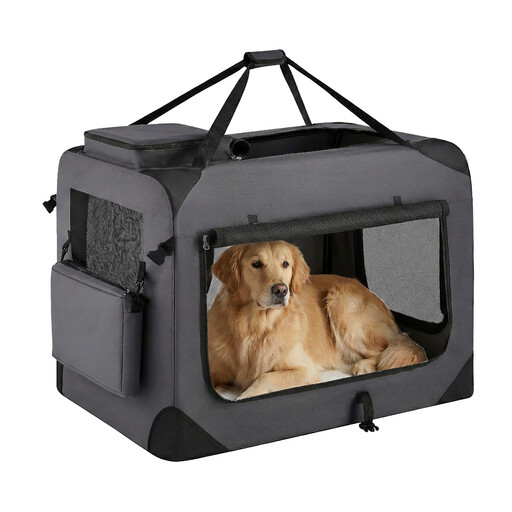
Why This Fits Their Persona: A balanced option for owners of medium-sized breeds like Border Collies or Retrievers. It offers a great compromise between spaciousness, stability, and ease of handling for everyday use and travel.
The metal frame provides the necessary stability often lacking in cheaper crates of this size. The 600D Oxford fabric is durable, and the large mesh windows ensure good ventilation.
Good size-to-weight ratio (4.8 kg). Folds very flat (8 cm high), making it ideal for storage in the car or at home.
We've compiled a complete, up-to-date list of products that meet these strict selection criteria and relevant safety standards.
Start the acclimatisation process in a quiet environment at home. Set up the crate and leave the door open. Place a familiar blanket, toy, or treats inside to create a positive association. Begin with short, positive training sessions and praise your dog whenever it explores the crate on its own. Only close the door for a few seconds at first, then slowly increase the duration.
The rule of thumb is: your dog should be able to stand up straight, turn around, and lie down comfortably in the crate. Measure your dog's back height and body length, then add about 10-15 cm to each measurement to get the minimum interior dimensions for the crate. A crate that is too large offers less support during car rides, while one that is too small is uncomfortable and causes stress.
Yes, as long as the crate is designed for it. Look for models that have special fastening loops through which the car's seatbelt can be threaded. This secures the travel crate for your dog on the back seat and prevents it from sliding. A sturdy, non-slip base further enhances safety. Always position the crate so that it cannot tip over during braking.