
Lieferung heute & morgen

Qualitätsgarantie

Willkommens-Angebote freischalten: KOSTENLOSE Lieferung | Bis zu 80 % RABATT | Kostenlose 30-Tage-JoyPlus-Testphase
App herunterladen
A foldable dog crate is a convenient solution for car trips, travel, or visits to the vet. It combines the security of a rigid carrier with the flexibility of a lightweight bag. However, the market offers an overwhelming selection, and not every model delivers on its promise. Many dog owners only discover after purchase that their chosen product has flaws that make transport unsafe or uncomfortable for their dog.
Before you make a decision, it's helpful to know the three common weaknesses that often lead to bad purchases:
To avoid these pitfalls, you should base your choice on objective criteria. The following three features are crucial for the functionality, safety, and longevity of a foldable dog crate.
The core structure is the most important safety feature. A sturdy steel tube frame offers significantly more strength than simple plastic or wire constructions. It ensures the crate maintains its shape even during sudden braking.
For the outer material, look for robust fabric. A proven choice is 600D Oxford fabric, as it is abrasion-resistant, tear-resistant, and often coated to be water-repellent. This simplifies cleaning and protects the crate from wear and tear. For use as a car dog crate, it is also important that the crate has attachment points or a shape that allows it to be securely placed in the boot or on the back seat.
Good air circulation is essential for your dog's well-being. A high-quality soft-sided dog crate should have large mesh windows on at least three sides. These not only provide fresh air but also allow the dog to observe its surroundings, which can reduce anxiety.
The mesh material itself should be made of a rubberised, scratch-resistant synthetic fabric. Simple fly screens or thin textile mesh are quickly damaged by claws or teeth, rendering the crate useless.
The right size is not a luxury, but a necessity. Measure your dog's withers height (shoulder height) and its length from the tip of the nose to the base of the tail. The crate should be about 10–15 cm taller and longer to allow your dog to stand and turn around comfortably. This is especially critical for a travel crate for large dogs.
The folding mechanism should be simple and operable without tools. A good system allows the crate to be set up and taken down in seconds. This makes it a truly lightweight dog crate that can be stored in a space-saving manner in the car or at home.
Based on the criteria mentioned, we have identified several models suitable for different needs and dog sizes.
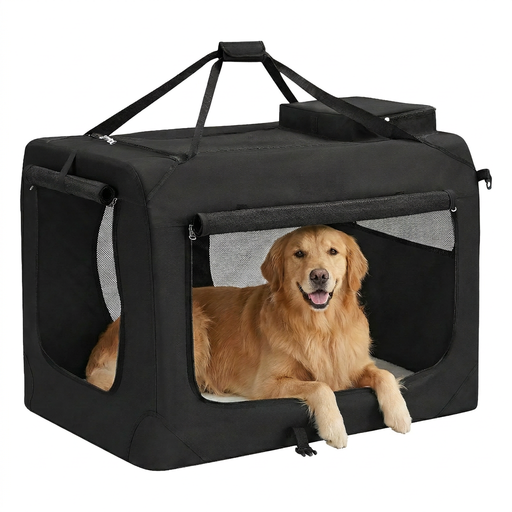
Why it's a great fit: With its exceptionally large dimensions, this crate provides even very large breeds like Great Danes or St. Bernards with enough space to lie down comfortably and change position during a journey. It is designed for owners who refuse to compromise on spaciousness.
Directly addresses the problem of misleading size specifications by offering clear and very generous interior dimensions designed for the largest dog breeds.
The steel frame provides the necessary stability for this size, while the Oxford fabric and large mesh windows ensure durability and comfort.
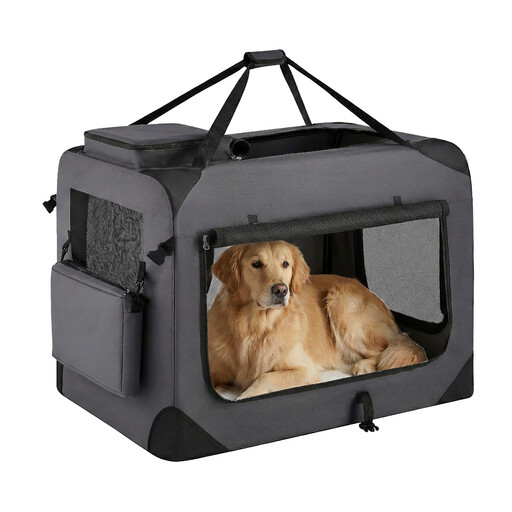
Why it's a great fit: This model offers a great balance of roominess for medium to large dogs (e.g., Retrievers, Border Collies) and portability. It folds flat, fitting easily into the boot next to luggage. Ideal for holidays, camping, or hotel stays.
The robust steel frame and durable 600D Oxford fabric withstand the repeated stress of assembly and disassembly during travel far better than unstable, cheap constructions.
The simple folding mechanism and carrying handles make it easy to handle. The side pocket offers practical storage for a lead or snacks.
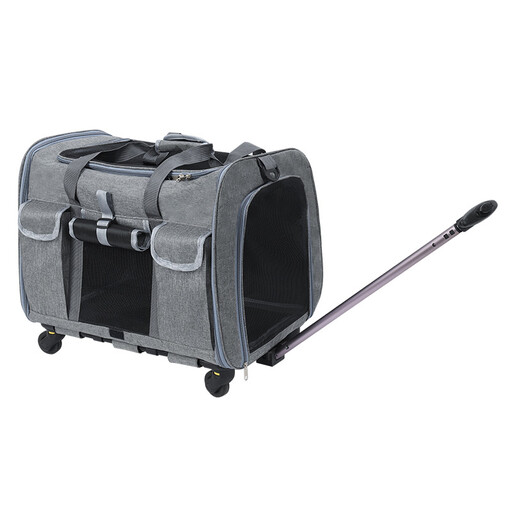
Why it's a great fit: For owners of small dogs who live in the city and often travel on foot or by public transport, this multifunctional solution is ideal. It can be pulled as a trolley, worn as a backpack, or used as a normal dog carrier bag, offering maximum flexibility in urban environments.
Unlike simple, soft carriers that often collapse, this model offers a stable, structured cabin that provides the animal with protection and a secure retreat.
The 3-in-1 functionality (trolley, backpack, bag) and the adjustable pull handle make this product extremely versatile for various everyday situations.
We have compiled a complete, up-to-date list of products that fully meet these strict selection criteria and UK safety regulations.
The safest position for a dog crate is in the boot, pushed directly against the rear seat bench to minimise sliding. For smaller crates, the footwell behind the front seats is also an option. If the crate is transported on the back seat, it must be secured with the seatbelt through the designated loops. Never place the crate unsecured on the passenger seat.
Your dog should be able to stand up comfortably, turn around, and lie in a natural position inside the crate. Measure your standing dog's height from the floor to the top of its head and its length from the tip of its nose to the base of its tail. Add about 10 to 15 centimetres to both measurements to determine the minimum internal dimensions of the crate.
A reliable combination consists of a sturdy steel tube frame and a durable, water-repellent fabric like 600D Oxford fabric. The mesh windows should be made of a tear-resistant, rubberised material that can withstand the dog's claws and ensure good air circulation.