
Lieferung heute & morgen

Qualitätsgarantie

Willkommens-Angebote freischalten: KOSTENLOSE Lieferung | Bis zu 80 % RABATT | Kostenlose 30-Tage-JoyPlus-Testphase
App herunterladen
A foldable electric wheelchair can give you greater freedom of movement in everyday life, in the car and when travelling. But your choice shouldn’t be based solely on range, motor power or low weight. What matters is whether the seat width, weight capacity, folded size, battery and controls suit the way you’ll actually use it.
When shopping online, three common misconceptions can lead to the wrong choice:
When choosing a lightweight electric wheelchair for adults, it’s important to consider not only the net weight, but also the battery weight and packed dimensions. A model may look lightweight on the spec sheet, but the battery, accessories or an awkward folding mechanism can make it impractical to load.
So, check:
With a portable electric wheelchair, you should also make sure the lifting points are easy to reach and feel secure. This matters just as much to family members and carers as it does to users who want to transport the wheelchair themselves.
An electric wheelchair with a lithium battery may be more convenient to charge if its battery is removable. If you’re considering an electric wheelchair with 2 batteries, check whether both batteries can be charged separately and which technical specifications apply.
Look out for:
A description such as airline-approved electric wheelchair doesn’t replace confirmation from the airline you’re travelling with. Before booking, confirm the battery details, dimensions, packaging and handover arrangements at the airport in writing.
An all-terrain electric wheelchair shouldn’t be chosen on the basis of a high wattage alone. For example, an electric wheelchair with a 500 W motor may have two motors rated at 250 W each. For everyday use, climbing ability, tyre tread, drive system, turning radius and anti-tip protection also matter.
Useful features to check include:
Claims that a wheelchair is ‘suitable for all terrain’ should be treated with caution. Public paths, kerbs, steep slopes and wet surfaces still call for careful driving. Always follow the instruction manual and local traffic rules.
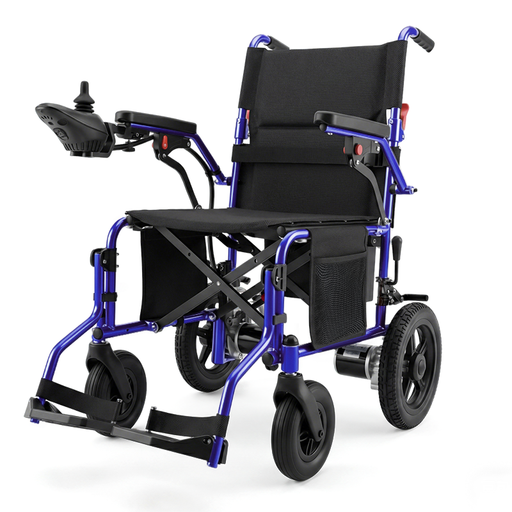
Why this product suits this profile: The stated dimensions of 1040 × 630 × 890 mm and net weight of 23.45 kg give you a clear starting point if you’re looking for an everyday wheelchair with straightforward specifications.
The product details specify its dimensions, net weight, steel frame, dual-motor drive and top speed of 6 km/h. This makes it easier to compare the space it needs with the room you have at home.
13 Ah battery, two 250 W motors according to the specifications, and a foldable design; the stated range is 15 miles.
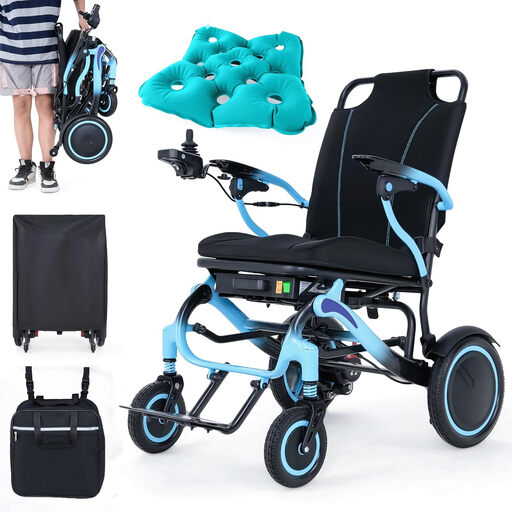
Why this product suits this profile: This model is aimed at users who prioritise a low transport weight, removable batteries and a compact fold for car journeys and travel.
The product details give a weight of 19 kg in the name and 30 pounds in the description. Before buying, ask the seller to confirm the weight with and without the battery.
Two removable 12 Ah lithium-ion batteries, LCD display, 360-degree joystick and two 220 W motors according to the product description.
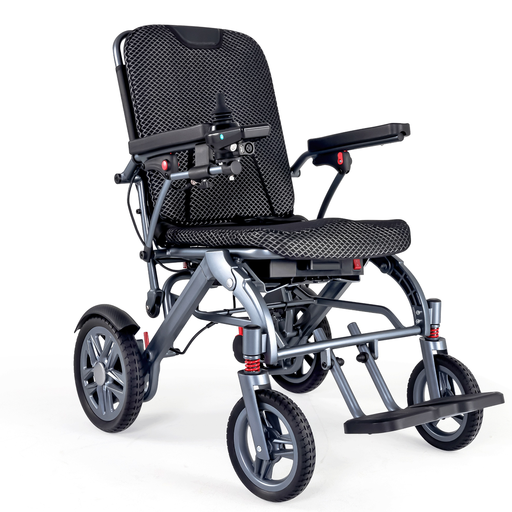
Why this product suits this profile: The combination of two batteries, a stated range and off-road capability may suit longer outings and changing surfaces, provided you assess the route conditions realistically.
The description lists the number of batteries, a charging time of 6 to 8 hours, a maximum load of 120 kg and the motor configuration. These details help you assess claims about range and transport.
Two removable 12 Ah lithium batteries, two 250 W motors, a stated range of up to 48 km, electromagnetic brakes and an anti-tip rear design.
We’ve put together a complete, regularly updated list of products that meet these strict selection criteria and fully comply with the safety regulations in force in the EU.
It depends on the battery and the airline. Lithium batteries often need to be assessed separately. Before booking, check the battery capacity in Wh, whether it can be removed, the folded dimensions and the handover arrangements at the airport. A product description stating ‘airline-approved’ is a useful guide, but it doesn’t guarantee that the airline will carry it.
Range depends on factors including the user’s weight, hills, temperature, tyres, speed and surface. Treat the manufacturer’s figure as a guide. If you regularly travel longer distances, a long-range power wheelchair with two batteries may be a good option. Even so, make sure you leave enough charge for the return journey.
As well as electricity, you may need to pay for tyres, brakes, the joystick, charger and replacement batteries. Before buying, check that wear-and-tear parts are available and that the seller provides technical support and clear instructions. Following the manufacturer’s charging guidance and storing the battery in a dry place can help keep the wheelchair practical for everyday use.