
Lieferung heute & morgen

Qualitätsgarantie

Willkommens-Angebote freischalten: KOSTENLOSE Lieferung | Bis zu 80 % RABATT | Kostenlose 30-Tage-JoyPlus-Testphase
App herunterladen
A foldable electric wheelchair can make transport by car easier and give you greater flexibility on days out. However, for older people, adults with limited mobility and their family members, it is not simply a matter of choosing the lowest price or the stated range. What matters is whether the weight, seat dimensions, battery system, brakes and suitability for different surfaces match how the wheelchair will actually be used.
Figures such as 30 or 48 kilometres generally refer to specific test conditions. Rider weight, inclines, outdoor temperature, tyre pressure, surface conditions and frequent stopping and starting all affect the actual distance travelled. When choosing a motorised wheelchair with a long range, you should therefore check:
The stated net weight may refer to the frame without the battery. When buying a lightweight electric wheelchair for adults, you should therefore ask whether the battery, joystick and accessories are already included. The folded dimensions are also important: they must fit your boot, lift, storage area and chosen method of transport.
An all-terrain electric wheelchair is not automatically suitable for every sandy path, snowy surface or incline. Claims that a wheelchair is suitable for “any terrain” should be compared with measurable specifications. These include ground clearance, maximum gradient, obstacle height, tyre type, turning radius and the guidance in the operating instructions. Wet surfaces, mud and steep sideways slopes can affect driving safety regardless of motor power.
Three values need to be distinguished when considering transport:
A model weighing around 20 kilograms may be suitable for a car boot, but it cannot necessarily be lifted easily by every user without assistance. The load limit should take body weight, clothing and any luggage being carried into account. A rucksack or bag may reduce the permissible total load.
An electric wheelchair with a lithium battery often offers a lower battery weight and, depending on its design, the battery may be removable. Important factors include the actual capacity in Ah, battery voltage, charging time and transport requirements. For air travel, the battery type, watt-hours, labelling and packaging must be agreed with the relevant airline. The term airline-approved electric wheelchair in a listing is therefore no substitute for individual confirmation from the airline.
An electric wheelchair with a 500 W motor often has two motors rated at 250 watts each. However, wattage alone says little about climbing ability or range. The drive system, gearing, tyres and total weight are also important. An electromagnetic braking system can brake automatically when you release the controls; consult the instructions for details of how the system works.
Before buying, you should also check the safety belt, anti-tip protection, armrests, seat width, seat height and how easy the joystick is to operate. If you have limited hand strength, controls that are easy to reach and precise to use are particularly important. A test drive in confined indoor spaces and on typical routes can help you avoid a costly mistake.
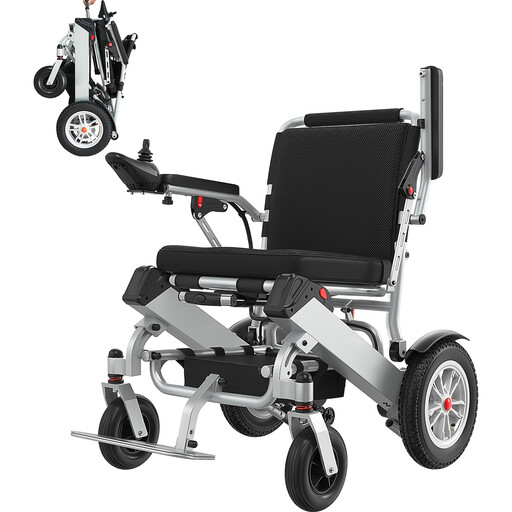
Why this product suits this profile: The listed specifications include an aluminium frame, two 250 W motors, a 10 Ah lithium battery and a maximum user weight of 120 kg. This makes it relatively straightforward to compare the features with your own needs before buying.
Instead of making a general all-terrain claim, the product data gives specific figures such as a 40 mm obstacle height, a maximum gradient of 9° and a turning radius of 750 mm. You should still check the range under your own conditions.
Aluminium frame, electromagnetic brake, 26 kg net weight including battery, and front- and rear-folding design.
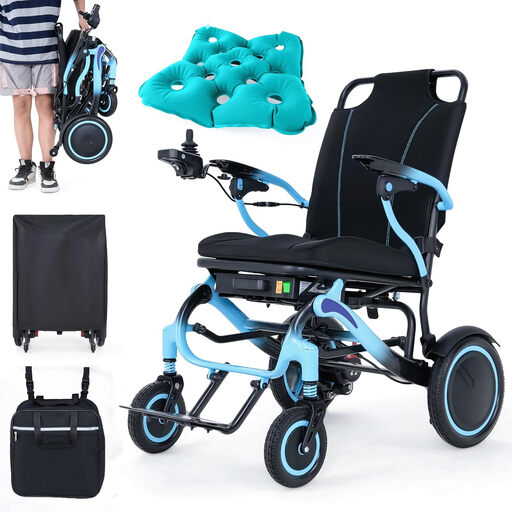
Why this product suits this profile: The listing specifies two removable 12 Ah lithium-ion batteries, an LCD display, total motor power of 440 watts and a stated range of over 30 miles. Before buying, frequent users should compare these figures with the actual transport weight and the conditions in which the wheelchair will be used in the UK.
The LCD display is intended to show speed, battery status and system messages. Before buying, you should check that the actual weight including the battery is clearly stated and find out which battery documents are available for travel.
Removable dual battery, LCD display, 360° joystick and electromagnetic brake, according to the product description.
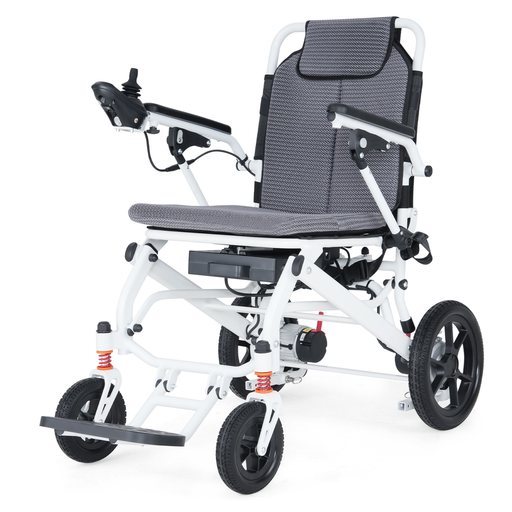
Why this product suits this profile: According to the product description, this model is aimed at users looking for a portable electric wheelchair for days out, shopping centres and travel. It features two 250 W motors, two 12 Ah lithium batteries, a range of up to 48 km and a load capacity of 120 kg.
The stated range is accompanied by the battery capacity, motor power and a charging time of 6 to 8 hours. Before using the wheelchair on sand, snow or mud, you should take the operating instructions, gradient limits and local conditions into account.
Removable lithium batteries, safety belt, electromagnetic brake, anti-tip protection and accessories such as a rucksack and dust bag, according to the listing.
We have put together a complete, regularly updated list of products that fully meet these strict selection criteria and the safety regulations applicable in the EU.
The weight depends on the frame material, motors, battery and equipment. The figures given in listings are not always consistent. You should therefore specifically ask for the net weight including the battery. For transport, it may be useful to remove the battery separately.
Battery life depends on capacity, travelling speed, rider weight, inclines and temperature. A 12 Ah battery will not automatically provide the same range as another 12 Ah battery. Voltage, motor control and riding conditions are also important. The manufacturer’s figure should be treated as a guideline rather than a guaranteed distance.
Ongoing costs include electricity, possible replacement batteries, tyres, brakes and maintenance. Lithium batteries can be used for longer periods when stored and used correctly, but they must be protected from moisture, excessive heat and deep discharge. The manufacturer’s care instructions are the most important reference.