
Lieferung heute & morgen

Qualitätsgarantie

Willkommens-Angebote freischalten: KOSTENLOSE Lieferung | Bis zu 80 % RABATT | Kostenlose 30-Tage-JoyPlus-Testphase
App herunterladen
A foldable hand truck seems like a simple purchase—until it collapses under the load, the wheels lock up, or the folding mechanism jams. Many models promise high performance but fail on basic quality features. Before you make a decision, it's crucial to know the typical weak points that often only become apparent after the purchase.
This guide focuses on the critical technical features that define a reliable foldable transport cart and helps you distinguish marketing promises from actual performance.
The disappointment is often immense when a newly acquired hand truck fails to perform. Three design flaws are particularly common culprits:
To avoid a bad buy, you should focus on three objective criteria that determine the durability and functionality of your transport aid.
Load capacity is the central performance feature. Ensure that the specified capacity is realistic for practical use.
The wheels are crucial for ride comfort and application possibilities.
The main advantage of a foldable cart is its compactness. The mechanism must be simple and secure. A good foldable trolley can be folded and unfolded in a few simple steps without tools. Pay attention to the folded dimensions to ensure the cart can be easily stored in a car trunk, a niche, or a closet.
Based on these objective criteria, we have identified various models that represent a suitable solution for specific user profiles.
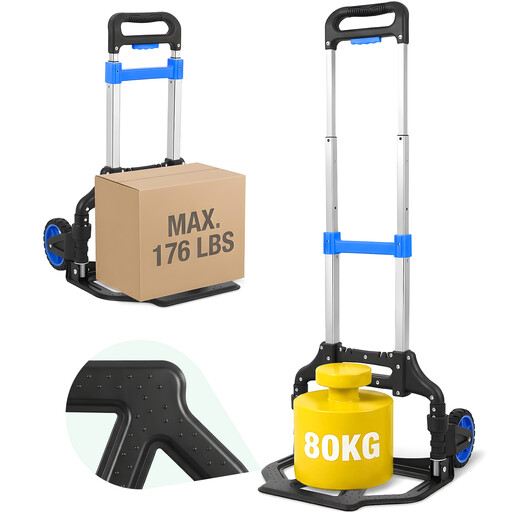
Why This Fits Their Persona: Ideal for household tasks like moving beverage crates, packages, or groceries. Its extremely low net weight and compact folded size make it perfect for carrying in a car or storing in small apartments.
The 80 kg load capacity is realistic for the lightweight aluminum frame. The TPR wheels with ball bearings avoid the trap of inferior plastic casters, and the quick-fold mechanism is designed for durability.
Extremely lightweight with a net weight of only 3.5 kg and a very slim folded profile of 5.7 cm. The telescopic handle is 3-level height-adjustable for an ergonomic posture.
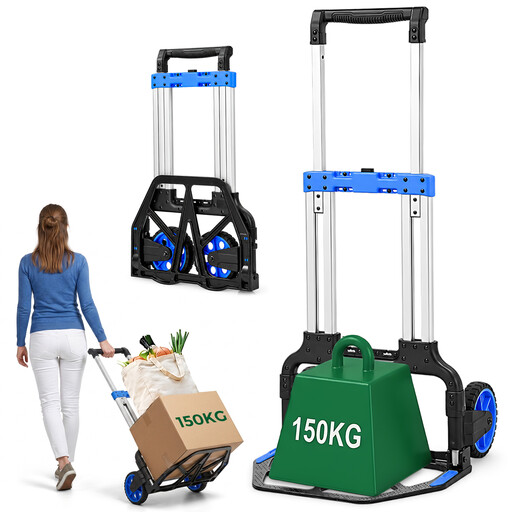
Why This Fits Their Persona: Designed for commercial use, moving, or demanding garden projects. The high load capacity and robust construction provide the necessary reserves for heavy and bulky items like washing machines or cement bags.
Addresses the trap of overstated load capacity with a reinforced aluminum frame and bolted connections. The large TPR wheels with precision ball bearings are designed for uneven surfaces, avoiding the problem of unsuitable tires.
High load capacity of 150 kg with an extra-large, non-slip loading platform. Two bungee cords for securing the load are included in the delivery.
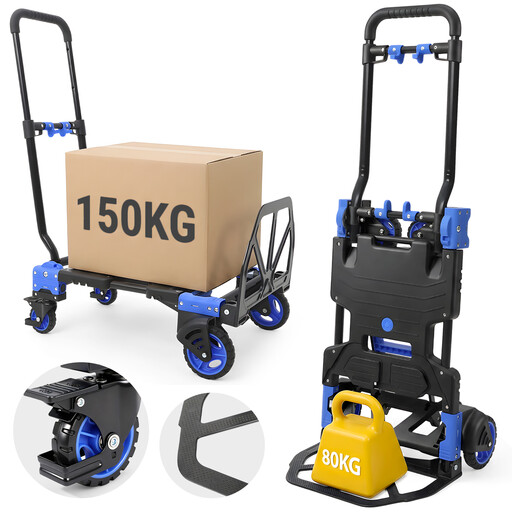
Why This Fits Their Persona: For users who need to transport both stacked boxes and bulky, flat items. The ability to convert from a hand truck to a platform cart makes this model extremely versatile for the office, warehouse, or private use.
The sturdy aluminum frame is designed for the 150 kg load in platform mode. The 360° dual-bearing wheels offer high maneuverability and avoid the trap of unsuitable tires. The conversion mechanism is simple and secure.
2-in-1 Function: Switch between hand truck (80 kg) and platform cart (150 kg) modes in seconds. Integrated locking brake for safety on slopes.
We have compiled a complete, real-time list of products that fully satisfy these strict selection criteria and UK safety regulations.
For typical household use, such as transporting beverage crates, packages, or bags of soil, a load capacity of around 80 kg is usually sufficient and offers a good compromise between stability and low net weight. However, if you are planning a move or regularly transporting heavy items for commercial purposes, you should choose a model with at least a 120 kg to 150 kg load capacity. This provides a safety margin and protects the material.
Yes, modern hand trucks made from high-quality aluminum alloys are very sturdy and designed for their specified loads. Their main advantage is their lower weight compared to steel models, which makes them easier to handle. Look for terms like "reinforced frame" or check the material thickness to ensure it is a robust model. For extreme, continuous industrial use, a steel frame may be more advantageous, but it is also significantly heavier.
The wheels are a critical quality feature. Pay attention to the material and size. TPR or solid rubber wheels with ball bearings are a good choice for quiet operation and use on various surfaces. Larger wheels (over 15 cm in diameter) make it much easier to overcome edges and steps. Smaller hard plastic casters are only suitable for use on very smooth indoor floors.