
Lieferung heute & morgen

Qualitätsgarantie

Willkommens-Angebote freischalten: KOSTENLOSE Lieferung | Bis zu 80 % RABATT | Kostenlose 30-Tage-JoyPlus-Testphase
App herunterladen
A foldable handcart can take on plenty of transporting work when you are camping, gardening, at the beach or at a festival. However, large litre capacities, high load limits and terms such as “off-road” do not automatically lead to the right buying decision. What matters is whether the construction, wheels, brakes and folded size suit the way you actually intend to use it.
Figures such as handcart 150 kg or handcart 200 kg describe a maximum load limit under the conditions specified by the manufacturer. They do not mean that this load can be safely pulled over every type of surface. Heavy items should be distributed evenly. On uneven paths, slopes or when the load is applied from the side, the risk of tipping may change.
So, in addition to the load capacity, check the following:
A large handcart with a capacity of 300 litres may achieve this figure through an open rear wall or an extended loading area. For everyday use, however, the internal dimensions with the side wall closed and the height of the loading edge are what really matter. Cool boxes, crates of drinks and gardening tools should fit inside the cart without putting constant strain on the structure or side walls.
A folding cart may fold down, yet still be too wide or too long for your boot. Pay attention to the folded size, weight and folding mechanism. Removable wheels or a detachable fabric bag make cleaning and storage easier. For smaller homes, a compact foldable hand trolley that is only a few centimetres deep may be more suitable than a large-capacity camping handcart.
Choose a load capacity with some reserve. For shopping, picnics or lighter gardening tasks, 25 to 100 kg may be sufficient. If you plan to move firewood, tools or extensive camping equipment, compare models with 150 kg or 200 kg capacities. The volume stated in litres is useful for soft or differently sized items, but it does not replace the internal dimensions.
Wide tyres distribute pressure more effectively than narrow castors. This can be helpful on grass, firm sand or gravel. Even so, “off-road handcart” is not a uniformly defined technical standard. Therefore, check the tyre width, material, bearings and explicitly stated areas of use.
For frequent journeys over uneven ground, wheels with bearings, a sturdy frame and an adjustable handle are sensible choices. With heavily loaded carts, follow the manufacturer’s guidance on suitable surfaces.
On the handcarts presented here, a handcart brake is intended for safe parking, not for braking while moving. Do not leave the cart unattended on slopes. Depending on the design, a steel or aluminium frame can provide stability while adding different amounts of weight. Coated Oxford fabric is practical when the bag can be wiped clean or removed.
Also look out for:
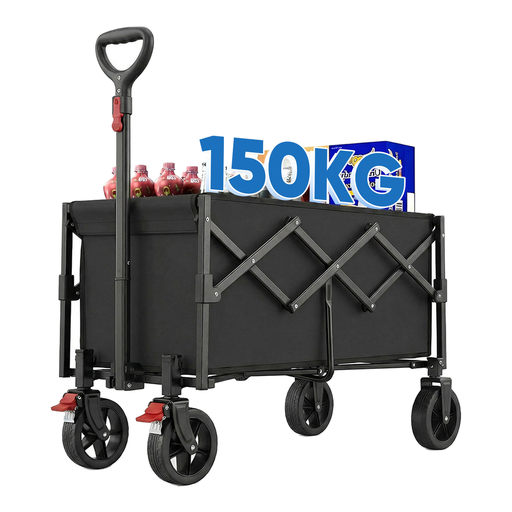
Why this product suits this profile: With an 80-litre capacity, a maximum load of 100 kg and a weight of 5.8 kg, this folding cart is suitable for shopping, picnics and lighter gardening tasks.
The specific capacity, weight and load figures make comparison easier. The fabric bag and wheels can be removed with a click for cleaning, and a brake is included.
80 l capacity, 100 kg load capacity, foldable design and removable components.
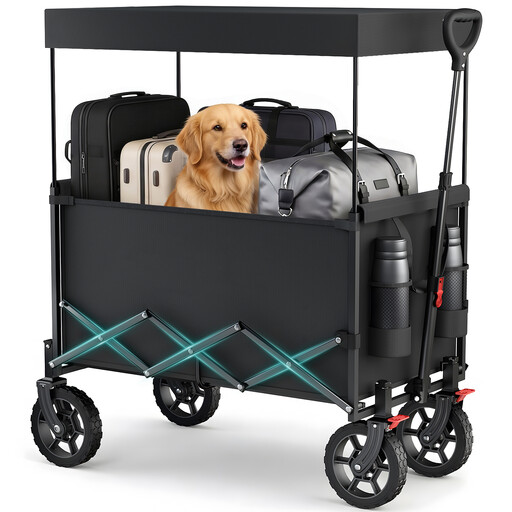
Why this product suits this profile: This camping handcart combines a 150-litre capacity with a maximum load of 150 kg, off-road tyres, a brake and a removable canopy.
The canopy is removable, so it does not have to remain fitted for every use. The wheels can be removed for cleaning. The brake is intended to secure the cart when stationary.
150 l, 150 kg, telescopic handle, off-road tyres, removable canopy and 2-year warranty according to the product information.
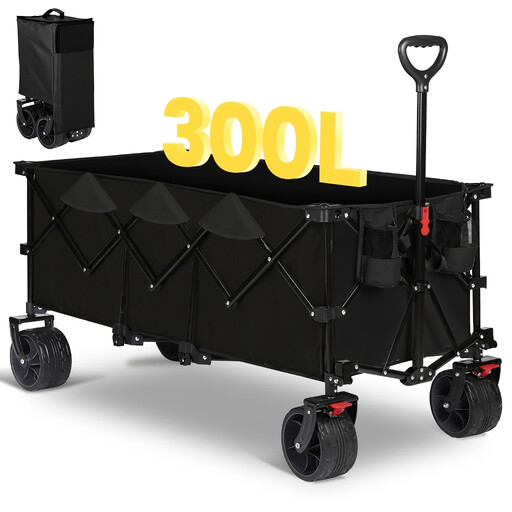
Why this product suits this profile: With 300 litres of storage, a maximum load of 200 kg, wide 7-inch tyres and brakes, this folding transport cart is designed for users carrying extensive equipment.
The product information explicitly states the load limit, capacity and safety conditions. The load must be distributed evenly, and the brakes are intended for parking only.
300 l capacity, 200 kg load capacity, 7-inch tyres, four-way folding mechanism and two drinks holders.
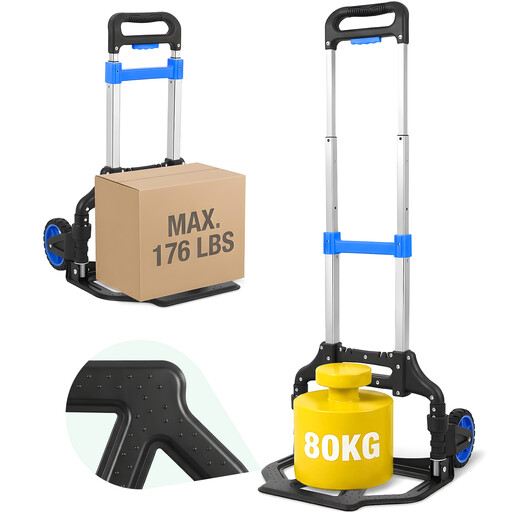
Why this product suits this profile: This compact folding cart weighs 3.5 kg, carries up to 80 kg according to the product information and folds down to a width of 5.7 cm.
The stated folded size makes storing it in the boot or behind a cupboard more predictable. The three-stage adjustable handle suits people of different heights.
3.5 kg weight, 80 kg load capacity, aluminium frame, TPR wheels and handle heights of 63, 90 and 100 cm.
We have put together a complete, regularly updated list of products that fully meet these strict selection criteria and the safety regulations applicable in the EU.
Before every use, check that the frame, base plate, wheels and folding lock are correctly positioned. Fabric surfaces can usually be cleaned with a damp cloth. Removable wheels can be cleaned separately to remove sand and dirt. Only fold a wet cart away once it has dried completely, to prevent odours and material damage.
Do not use the cart as a seat or step unless this is expressly permitted. Children and pets should not be transported if the manufacturer rules this out. There is a risk of trapping fingers in joints and hinges when folding the cart.
For shopping and smaller leisure trips, 25 to 100 kg is often enough. For gardening materials or camping equipment, 150 kg may be useful. A 200 kg rating is only relevant if you need the extra capacity and the cart will be used on suitable ground. The maximum load must not be exceeded.
On the models mentioned, the brake is intended for parking when stationary. It is not a substitute for safe handling while moving. On slopes, a loaded cart should be guided under control and not left unattended. Always follow the safety instructions for the individual product.
Its service life depends on the load, surface, frequency of folding, cleaning and storage. Evenly distributed loads, dry storage and checking the wheels and locking mechanisms can reduce strain on the materials. The key is to stay within the stated load capacity and intended area of use.