
Lieferung heute & morgen

Qualitätsgarantie

Willkommens-Angebote freischalten: KOSTENLOSE Lieferung | Bis zu 80 % RABATT | Kostenlose 30-Tage-JoyPlus-Testphase
App herunterladen
A foldable handcart can take on a great deal of carrying work when camping, gardening, visiting the beach or attending a festival. However, not every model is suitable for every use. A generous capacity says little about actual stability, and a stated load capacity should not automatically be equated with safe travel over uneven ground.
The following points will help you avoid common poor purchases and choose a folding cart using clear, practical criteria.
Details such as 200 kg handcart may initially seem clear-cut. However, it is also important to consider whether the frame, base, axles and wheels are designed to handle this load. A high maximum load does not mean that the cart will remain equally stable on every surface.
When carrying heavy loads, the contents should be distributed evenly. On sloping, soft or very uneven ground, even a robust wheeled transport cart can tip over. The maximum load specified by the manufacturer must not be exceeded.
A large capacity is useful when transporting bulky camping equipment, gardening tools or shopping. However, the stated litre capacity does not always indicate the usable area. For example, a tall cart may offer plenty of volume, while longer items are difficult to fit inside.
You should therefore also check the external dimensions, the length of the loading area and the folded dimensions. For a car boot or a storage space in the cellar, the packed size is particularly important.
A folding handcart should be quick to store away. At the same time, it must be fully unfolded and securely locked when set up. A folding mechanism that has not engaged properly can affect stability and create a safety risk during loading.
Look for clear details about assembly, locking and cleaning. Many models can be unfolded without tools. This is convenient, but it does not replace checking that the frame is fully open.
For light shopping or picnic equipment, a smaller outdoor handcart with a capacity of 80 to 100 litres may be sufficient. Anyone who regularly moves camping boxes, drinks or gardening accessories will often need more space and a higher permitted load.
Also bear in mind the difference between payload and the cart's own weight. A cart with a maximum load of 200 kg may itself be considerably heavier than a compact model. For frequent transport over longer distances, it therefore makes sense to look for a balanced combination of load capacity, weight and ease of handling.
A handcart with large wheels will often roll more easily on grass, sand or woodland paths than a model with small castors. Wide tyres can reduce sinking on soft ground. For asphalt, paving and market visits, however, manoeuvrability and a smooth-running handle are often more important.
For a beach cart, look specifically for off-road or wide wheels. For sloping paths, a handcart with a brake or parking brake is useful. On the models described here, the brake is designed to secure the cart when stationary, not to act as a service brake while moving.
600D Oxford fabric is used on many folding transport carts. Depending on the design, it may have a coating that makes cleaning easier. After contact with sand, soil or moisture, the material should be cleaned with a damp cloth and dried completely before the cart is folded away.
A steel or alloy steel frame can help to reinforce the construction. Even so, joints, wheel attachments and the folding mechanism should be checked regularly for signs of wear. Storing the cart in a dry place protects the frame and fabric from unnecessary moisture.
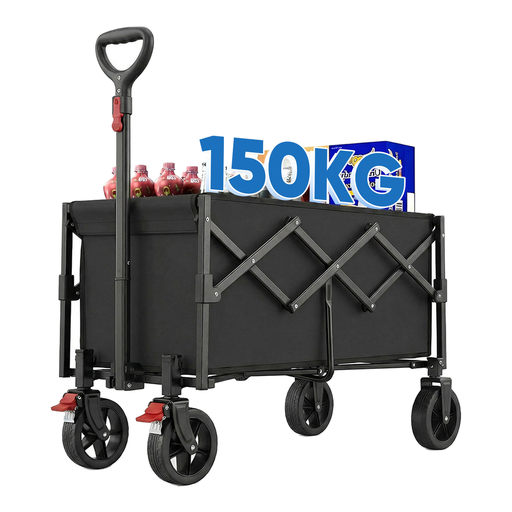
Why this product suits this profile: With an 80-litre capacity, a tare weight of 5.8 kg and a stated load capacity of up to 100 kg, this compact folding cart is suitable for smaller shopping trips, picnics and transporting items in the car boot.
The details on capacity, tare weight and load capacity make it easier to assess the cart realistically. Removable wheels and a removable bag also make cleaning easier.
Compact format, 600D Oxford fabric with PE coating and integrated brakes according to the product description.
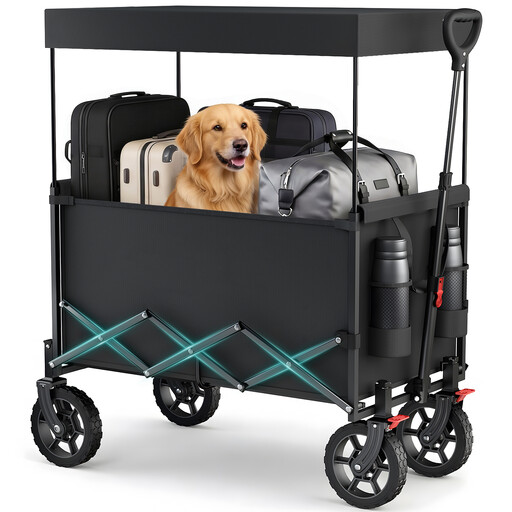
Why this product suits this profile: This camping cart combines a 150-litre capacity with an alloy steel frame, 600D Oxford fabric, removable wheels and a removable canopy.
The removable components make cleaning easier after trips to the beach or use in the garden. The stated maximum load of 150 kg provides a clear limit for loading.
150-litre capacity, brakes, telescopic handle and removable canopy according to the product details; stated two-year warranty.
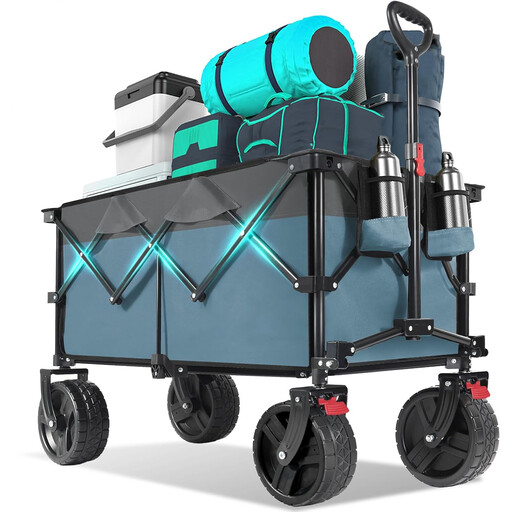
Why this product suits this profile: With 200 litres of storage space, a stated load capacity of 200 kg and 7-inch all-terrain tyres, this model is designed for large amounts of camping, festival or gardening equipment.
Wide all-terrain wheels and the supplied tie-down straps address two common problems: difficult rolling and shifting loads.
200-litre storage space, 7-inch wide tyres, adjustable handle and two-year warranty according to the product description.
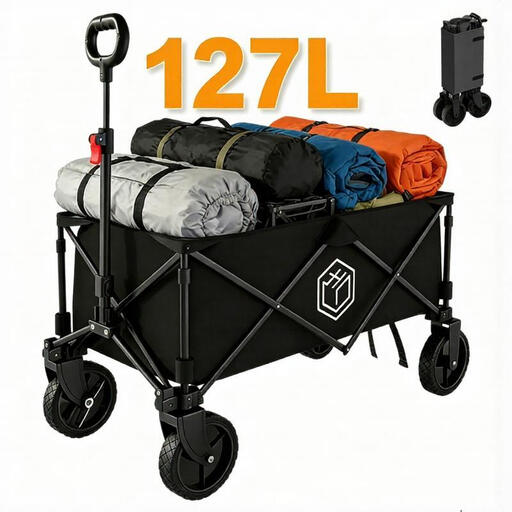
Why this product suits this profile: This camping trolley offers 127 litres of storage space, a stated load capacity of 200 kg and a folding mechanism with a short set-up time.
The stated folding time and dual front brakes make everyday handling easier and help keep the cart safely stationary while loading and unloading.
127-litre capacity, 200 kg maximum load and two front brakes according to the product data.
We have put together a complete, regularly updated list of products that fully meet these strict selection criteria and the safety regulations applicable in the EU.
Before loading the foldable handcart for the first time, it should be fully opened and the locking mechanism checked. Heavy items should be placed as low down and centrally in the cart as possible. This keeps the centre of gravity low and distributes the load more evenly.
After using the cart at the beach, remove sand and dirt from the wheels. Dry storage is recommended for use in the garden or when camping. A handcart is not intended to be used as a seat, ladder or means of transporting children unless the manufacturer expressly states otherwise and this is legally permitted.
The decisive factor is the maximum load specified by the manufacturer. Depending on the model, the figures in this selection range from 100 to 200 kg. The load must be distributed evenly; on uneven terrain, carrying less may be advisable.
For soft or uneven surfaces, wide all-terrain wheels are often more suitable than narrow castors. Even at the beach, however, a high pulling resistance may occur. As well as checking the wheel width, you should therefore consider the cart's weight and the condition of the surface.
Its service life depends on the load, surface, care and storage conditions. Keeping within the maximum load, operating the folding mechanism without force and checking the wheels and joints regularly will help to reduce wear. The product data does not provide enough information to determine a fixed service life.