
Lieferung heute & morgen

Qualitätsgarantie

Willkommens-Angebote freischalten: KOSTENLOSE Lieferung | Bis zu 80 % RABATT | Kostenlose 30-Tage-JoyPlus-Testphase
App herunterladen
A foldable sleeping mat can save space in a child’s bedroom, guest room, tent or rucksack. But not every model is suitable for every purpose. A soft play mat has to meet different requirements from a lightweight camping mat for trekking trips. If you only focus on the price, pack size or a flashy product description, you can easily overlook important details.
A particularly compact mat is handy on the go. With thin foam mats, however, the small pack size can mean less padding. For uneven ground, it’s not just weight and transport size that matter, but also material thickness, foam structure and sleeping surface.
When choosing a camping mat, you should also check whether it can actually be folded or only rolled up. A self-rolling sleeping mat often requires a valve and can take up more space when stored than a simple foldable mat.
An insulated ground mat reduces direct contact with the cold ground. What matters here are the materials used and – if stated – the R-value. This describes the mat’s thermal resistance. The higher the value, the more the heat transfer to the ground is limited. However, the R-value is not the sole measure of sleeping comfort and does not replace suitable sleepwear or a compatible sleeping bag.
With an XPE foam mat, a structured surface can create air chambers. This construction affects both insulation and pressure distribution.
Outdoor mats are not generally suitable for the washing machine. With many models, the surface should only be cleaned with a damp cloth and dried completely. Solvents, hard brushes, open flames and prolonged direct sunlight can damage the material and coating.
A play and crawl mat for babies should be placed on a flat, stable surface. Fold lines, zips and the fit in the cot should all be checked practically before purchase. Children should not be left unsupervised on raised surfaces.
For a baby mat, fixed dimensions are particularly important. The roba mat can be converted from 120 × 120 × 4 cm as a play mat to 60 × 120 × 8 cm as a folded sleeping mat. This means the folded format matches a standard cot size. A foldable baby mat 60 x 120 cm should still always be matched to the actual internal dimensions of the cot.
For camping and trekking, your height, shoulder width and the available tent space are decisive. The outdoor models presented here have a length of 183 cm and differ in width and material thickness.
On longer hikes, every extra gram counts. A lightweight outdoor sleeping mat weighing around 0.5 kg can be sensible for backpacking and trekking. A thicker mat weighing around 0.75 kg, on the other hand, offers more material thickness and greater width.
The transport form is also important: a foldable camping mat with connected segments can be laid out quickly. Other models are rolled up tightly after use and secured with straps. The right system depends on whether the mat is carried daily in a rucksack or only occasionally transported in the car.
An XPE or IXPE foam core is lightweight and dimensionally stable. A water-repellent, durable polyester surface can limit contact with damp grass, but does not protect against every type of ground. Before laying it out, remove sharp stones, twigs and other sharp-edged objects.
For a baby mat, a removable cover with a safety zip is practical. With the roba model, the cover is made from 100% polyester according to the product details, is removable and machine washable at 40 °C. The mattress core is made from PU foam. According to the product description, the textiles are regularly tested for harmful substances during production; however, specific certification numbers are not provided.
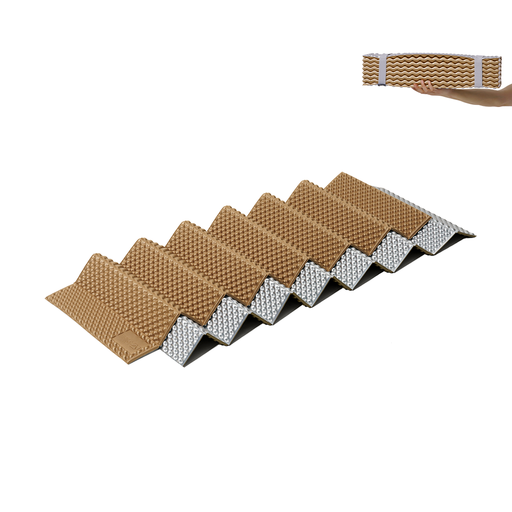
Why this product fits the profile: Weighing around 0.5 kg and with an open size of 183 × 55 cm, this mat is designed for lightweight luggage on trekking, backpacking and camping trips.
The stated material thickness of 1.7 cm, the XPE foam core and the structured surface make the technical foundations clear, rather than just advertising a small pack size.
Approx. 0.5 kg weight, 56 × 13 × 14 cm pack size and water-repellent polyester surface. Multiple mats can be connected together.
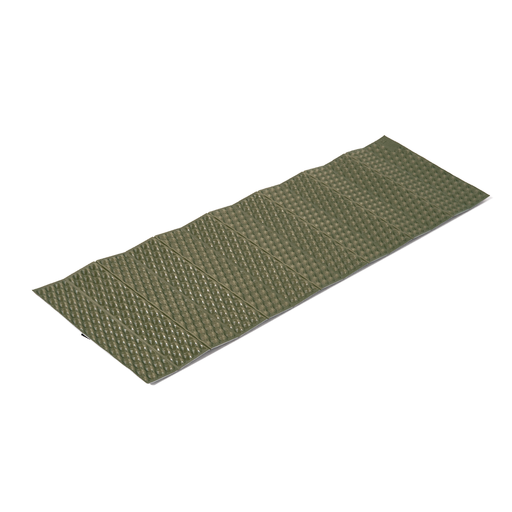
Why this product fits the profile: The 2.6 cm material thickness, 63 cm width and stated R-value of 2.6 offer concrete points of comparison for regular camping and backpacking use.
The details on R-value, thickness, width and weight make selection easier based on measurable properties. According to the product information, an additional mat is recommended for low temperatures.
183 × 63 × 2.6 cm, approx. 750 g, R2.6 and double-sided design with water-repellent surface.
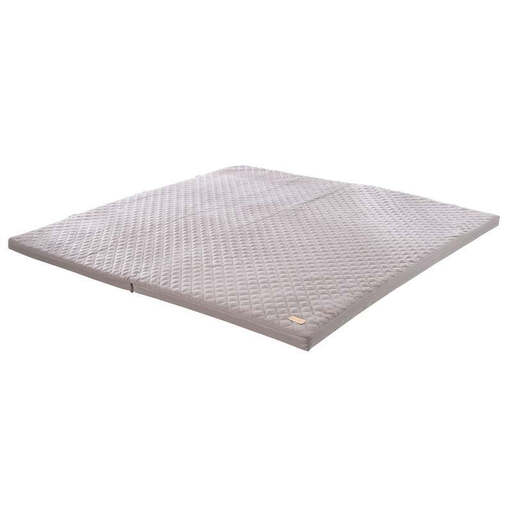
Why this product fits the profile: Families get a foldable sleeping mat for the cot that can also be laid out as a 120 × 120 cm play and crawl mat.
The two usage formats and the removable cover are clearly stated. The cover can be washed at 40 °C; use should be on a flat, stable surface.
2-in-1 format, 1.3 kg weight, PU foam core and removable cover made from 100% polyester with safety zip.
We have put together a complete, regularly updated list of products that fully meet these strict selection criteria and the safety regulations in force in the EU.
Yes, provided the dimensions, weight, insulation and ground are suitable for the use. A foam mat is straightforward and does not require inflation. For cold ground, an additional insulating mat or another sleeping underlay can be sensible. On trekking trips, the pack size should be checked together with the sleeping bag and tent.
The lifespan depends on the material, load, UV radiation, moisture and storage. Sharp objects can damage the surface. If you dry the mat after use, do not store it permanently compressed and follow the care instructions, you will reduce typical causes of wear. A fixed general lifespan cannot be reliably stated.
That depends on the specific model. According to the product details, the roba Play & Crawl Mattress is intended for both formats: as a 60 × 120 cm sleeping mat or as a 120 × 120 cm play and crawl mat. Before purchasing, you should check the age recommendation, dimensions, cover care and the supervision instructions. A portable sleeping mat does not replace an individual assessment of the sleeping environment.