
Lieferung heute & morgen

Qualitätsgarantie

Willkommens-Angebote freischalten: KOSTENLOSE Lieferung | Bis zu 80 % RABATT | Kostenlose 30-Tage-JoyPlus-Testphase
App herunterladen
A foldable storage bench can serve several purposes in the living room, bedroom, hallway or entrance area: it creates additional seating, stores blankets and cushions, and can be put away to save space when needed. However, models differ considerably in terms of construction, load capacity and internal volume.
Anyone who focuses only on colour and upholstery can easily overlook important details. Three common purchasing pitfalls are particularly relevant:
Before buying, measure the available space precisely. Compact models measuring around 38 × 38 × 38 cm are suitable as storage footstools, footrests or additions beside an armchair. Longer versions measuring 38 × 110 × 38 cm can be used as a bench at the foot of the bed or as hallway seating.
Also consider:
A storage box with a seat should not only offer plenty of litres, but should also suit the items you intend to store inside it. For duvets, elongated models are often more practical than a square storage footstool.
The maximum load must suit the intended use. Some models in this selection state a static load capacity of up to 300 kg. This is a technical product value, not a recommendation to use the bench for several people, as a step or under dynamic loads.
It is also important that the lid sits fully in place and that the base panel has been inserted correctly. With a foldable stool or storage bench, check the construction before every use for locked-in parts, cracks and deformation. A product explicitly intended for indoor use should not be used outdoors or in damp rooms.
MDF panels form the load-bearing framework of many foldable seating products. Additional metal corner reinforcements on the lid can help stabilise the construction. Upholstery and the cover are key to seating comfort, with options including linen effect, polyester, velvet or teddy fleece.
When choosing an upholstered bench, you should also consider cleaning requirements:
Pay attention to the specific manufacturer’s information. Load values may differ between individual product details. For example, the eSituro model is listed with a load capacity of 200 kg in the overview, while the safety notice specifies a maximum static load of 100 kg. The lower safety value should be used as the basis for operation.
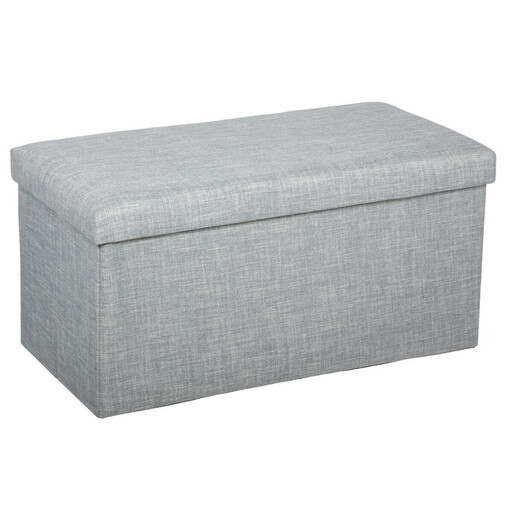
Why this product suits the profile: The compact bench measures 76 × 38 × 38 cm, weighs 4.4 kg and has a stated maximum load capacity of 170 kg. It is suitable as occasional seating, a footrest or storage for loose home accessories.
The product description specifies the folding function, a removable lid and clearly defined internal storage. The stated load limit helps you plan its use realistically.
Compact dimensions and a polyester cover; foldable construction for occasional use and space-saving storage.
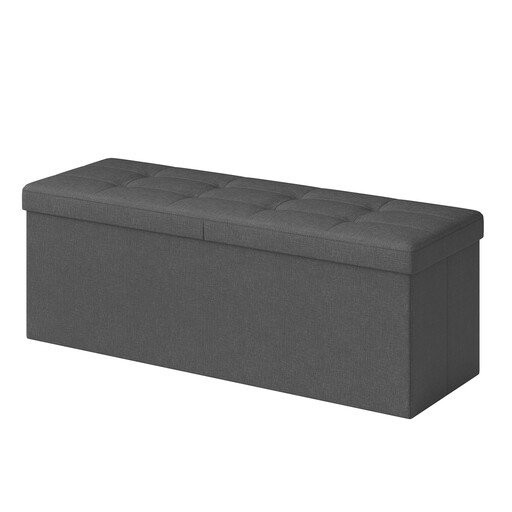
Why this product suits the profile: Measuring 38 × 110 × 38 cm, with 131 litres of storage and a stated static load capacity of 300 kg, this model is designed for regular use as a bench at the foot of the bed, seating or a storage solution.
The dimensions, volume and load specification are clearly stated. The note that the lid panel must sit completely flat provides a clear limit for safe use.
131 litres of internal volume, MDF construction, metal corner reinforcements and a padded linen-look cover.
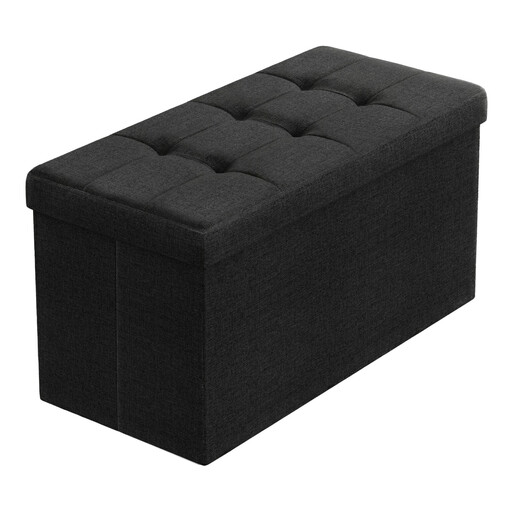
Why this product suits the profile: This model combines a length of 76 cm with 89 litres of storage and a stated static load capacity of 300 kg. It can be used as a storage footstool, footrest or occasional table.
The construction specifies MDF panels and metal corner protection on the lid. The base panel is inserted during assembly; afterwards, the stool can be folded for storage.
89 litres of volume, 38 × 76 × 38 cm, folding function and linen-look cover; suitable for living rooms, bedrooms and hallways.
We have put together a complete, regularly updated list of products that fully meet these strict selection criteria and the safety regulations applicable in the EU.
With many models, the side panels are unfolded first, followed by inserting the base panel. The lid is then placed on top. Before sitting down, check that the base panel is fully in place and that the lid sits flat. The foldable models mentioned here generally require no tools, although the relevant product instructions remain authoritative.
Its lifespan depends on how often it is used, the load placed on it, the surface it stands on and how it is cared for. A storage bench should only be used within the stated load limit. Standing on it, jumping, pulling on the seat and storing oversized items can put greater strain on the construction and cover. Regular visual checks and dry storage will extend its practical service life.
A storage bench or storage footstool normally incurs no ongoing energy costs, as it does not require a power supply. The only costs to consider are potential care and replacement costs, such as cleaning products or replacing a damaged cover. Storage capacity, materials, dimensions, load capacity and intended use are therefore the key factors in determining value for money.