
Lieferung heute & morgen

Qualitätsgarantie

Willkommens-Angebote freischalten: KOSTENLOSE Lieferung | Bis zu 80 % RABATT | Kostenlose 30-Tage-JoyPlus-Testphase
App herunterladen
A foldable transport trolley can make it much easier to move shopping, crates of drinks, gardening supplies, luggage or camping equipment. However, not every model provides a practical solution for everyday use. Trolleys are often chosen for their high maximum load or particularly compact folded dimensions, even though other features may be more important in practice.
As a Joybuy Product Recommendation Officer, I filter the relevant product data and organise it according to practical usage scenarios. This helps you avoid common purchasing mistakes and compare models more effectively.
A maximum load often applies only under specific conditions. With a foldable hand trolley, the load capacity may be higher in platform mode than when used as a sack truck. Even weight distribution, the ground surface and frame stability also affect safe use.
A model with a maximum load of 200 kg is therefore not automatically suitable for every route or surface. Heavy loads should be kept as low as possible and distributed evenly.
A space-saving folding trolley is certainly easier to fit in a car boot, cellar or storage cupboard. However, it is also important to consider how quickly the trolley can be folded and unfolded, and whether the locking mechanism engages securely when it is open.
With a shopping trolley or camping trolley that is used frequently, a cumbersome folding mechanism can quickly become frustrating. Check that the folded dimensions, overall weight and operation suit your everyday needs.
A wheeled transport trolley must work on more than just level ground. Pavements, paving stones, lawns and gravel place different demands on wheel diameter, tyre width and bearings. Small wheels are suitable for smooth indoor surfaces, but can be harder to move over uneven ground.
A parking brake is primarily used to park the trolley and keep it secure while loading and unloading. It is not a substitute for careful handling on slopes. If a model has no brake, it should not be left unattended on an incline.
Check whether the supplier distinguishes between sack truck mode, platform mode and storage capacity. An aluminium transport trolley may be suitable for crates of drinks and parcels, while a foldable beach wagon with a fabric bag offers more volume for luggage or shopping.
Important specifications include:
For larger loads, capacity is not the only factor that matters. The length of the loading surface, the centre of gravity and the handle height also affect control when pulling or pushing the trolley.
For regular outdoor use, wider wheels are generally more practical than narrow plastic castors. With a garden trolley or camping trolley, you should also consider ground clearance and how freely the front wheels move.
Double ball bearings, TPR wheels and shock absorption are technical features whose specific design should be checked in the product description. Claims such as ‘suitable for all surfaces’ are rather broad. On gravel, sand and wet grass, wheel size, load and handling technique remain decisive.
A height-adjustable handle can be useful for users of different heights. With a shopping trolley, it is also important to check whether the pull bar is guided securely and whether the bag can be removed.
For storage, consider:
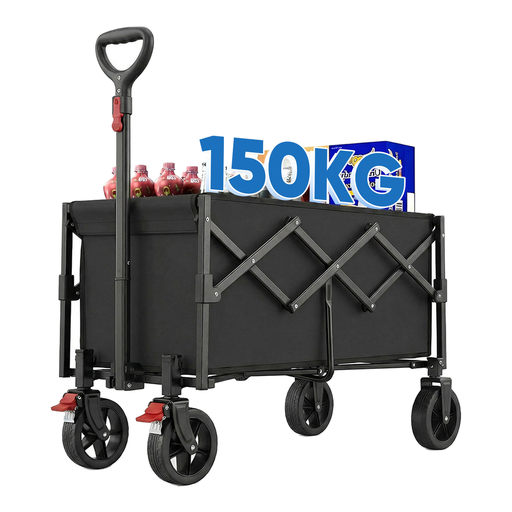
Why this product suits this profile: According to the product information, the trolley offers a volume of 80 litres, weighs 5.8 kg and is designed for shopping, smaller gardening tasks or transport in the car boot.
The product data specifies the weight, volume and a maximum load of 100 kg. The brakes and removable wheels or bag make everyday use and cleaning easier.
5.8 kg weight, 80-litre volume, foldable design and stated load capacity of up to 100 kg.
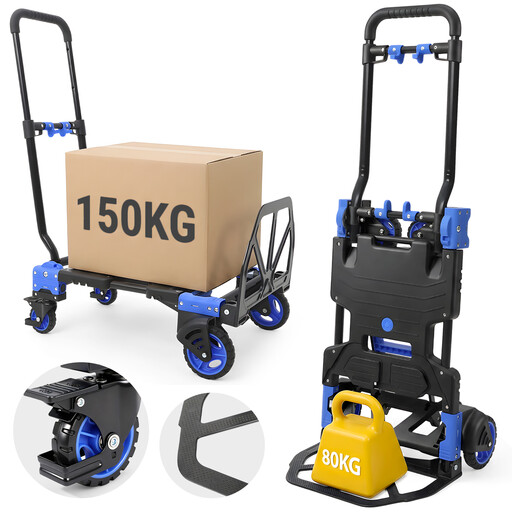
Why this product suits this profile: According to the description, the model switches between a hand truck with an 80 kg capacity and a platform trolley with a 150 kg capacity in around three seconds. It is suitable for parcels, crates and household removals.
The different load capacities for each mode are clearly specified. An aluminium frame, height-adjustable handle and integrated parking brake make it easier to adapt the trolley to different types of transport.
2-in-1 design, 7 kg weight, 80 kg in hand truck mode and 150 kg as a platform trolley.
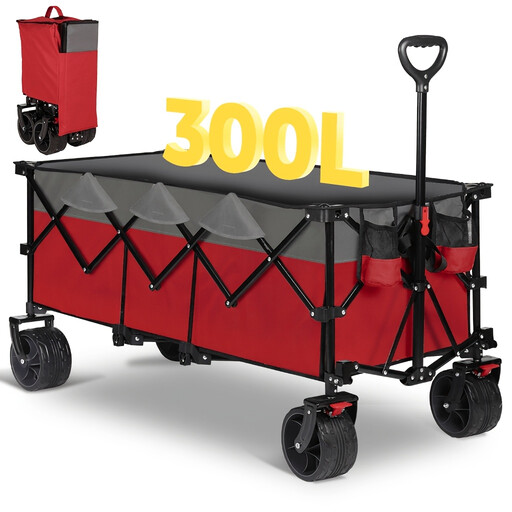
Why this product suits this profile: According to the product description, this camping and garden trolley offers 300 litres of storage space and a stated load capacity of 200 kg. It is designed for bulky equipment and larger loads.
The specifications state both the storage capacity and the maximum load. Wide 7-inch wheels and brakes are listed as features; the guidance on even loading and use on level ground should still be followed.
300-litre capacity, stated load capacity of up to 200 kg, foldable steel frame, wide wheels and parking brakes.
Before loading, a folding trolley should be fully unfolded and locked in place. Distribute heavy items as low and centrally as possible. Do not exceed the stated maximum load, even for short distances.
Fabric bags can generally be cleaned with a damp cloth. They should be allowed to dry completely before folding, so that moisture does not remain trapped in the material. Wheels, axles and joints should be checked regularly for dirt, loose connections and visible wear.
A foldable transport trolley is not designed to be used as a seat, step or means of transporting children unless the manufacturer explicitly states otherwise. On slopes, any available brake should be engaged when parking.
We have put together a complete, regularly updated list of products that fully meet these strict selection criteria and the safety regulations applicable in the EU.
For light shopping or smaller parcels, 70 to 100 kg may be sufficient. For crates of drinks, gardening materials or camping equipment, models with a higher load capacity are a sensible choice. The key question is whether the stated figure applies to hand truck, platform or bag mode.
Its service life depends on the load, ground surface, storage conditions and care. Even loading, dry storage and regular checks of the wheels, joints and brakes can help reduce wear. It is not possible to give a general service life without knowing the specific conditions of use.
Manually pulled trolleys normally have no ongoing energy costs. Potential expenses include replacement wheels, lubricants or repairs. When choosing a model, you should therefore look for robust wheels, replaceable components and easily accessible parts for maintenance.