
Lieferung heute & morgen

Qualitätsgarantie

Willkommens-Angebote freischalten: KOSTENLOSE Lieferung | Bis zu 80 % RABATT | Kostenlose 30-Tage-JoyPlus-Testphase
App herunterladen
A foldable transport trolley can make many tasks easier when moving house, working in the garden, camping or in the warehouse. However, a high advertised load capacity alone does not automatically mean a model is suitable. What matters is how the load is distributed, the surface the trolley is used on and how compact it really is when stored.
Figures such as 100 kg transport trolley, 150 kg transport trolley or “Heavy Duty” usually refer to specific conditions. For example, a trolley may carry 150 kg on its platform but support a lower load when used as a sack truck. The position of the centre of gravity, the size of the loading platform and the surface also affect stability.
You should therefore check:
Compact wheels save space, but they can reach their limits more quickly on gravel, grass, kerbs or uneven building-site surfaces. For cellars, corridors and smooth floors, TPR wheels with ball bearings are often sufficient. For garden and outdoor use, larger off-road wheels are more practical.
Pay attention to wheel diameter, material, bearings and ground clearance. A description such as “shock-absorbing” should be supported by specific design features, such as TPR tyres or precision ball bearings.
Some models can be folded but still remain relatively wide in the boot of a car or in a cellar. The actual folded dimensions are therefore more important than the marketing claim alone. A space-saving foldable model should be described with specific measurements or at least a clearly understandable folded width.
It is also worth checking:
For crates of drinks, parcels and smaller household tasks, a foldable sack truck with an 80 kg capacity may be sufficient. When transporting toolboxes, paving stones or heavy boxes, a 150 kg transport trolley offers greater capacity reserves. This reserve should not be seen as an invitation to use the stated maximum load continuously.
With a 2-in-1 model, it is particularly important to compare the specifications for each operating mode. For example, a sack truck may carry 80 kg, while platform mode is designed for 150 kg.
An aluminium transport trolley is often lighter than a comparable steel construction. This can be important when loading it into a car or carrying it up stairs. Reinforced profiles, screwed connection points and a sufficiently large loading platform are more important for practical use than a general description such as “industrial quality”.
With a folding garden trolley with a fabric bag, you should also look for coated Oxford fabric, the frame construction and the locking mechanism. A PE coating can make cleaning easier, but it does not replace proper storage in wet conditions.
A height-adjustable transport trolley can be adapted more effectively to different heights and operating modes. What matters is whether the handle locks securely in every position. TPR handles with a non-slip surface can make handling heavy loads easier.
A hand trolley with a brake is particularly practical when parking on slightly sloping surfaces. However, the parking brake is generally intended for keeping the trolley stationary, not for controlled braking while moving. On slopes, loads should also be secured and such conditions should be avoided wherever possible if the manufacturer warns against unstable terrain.
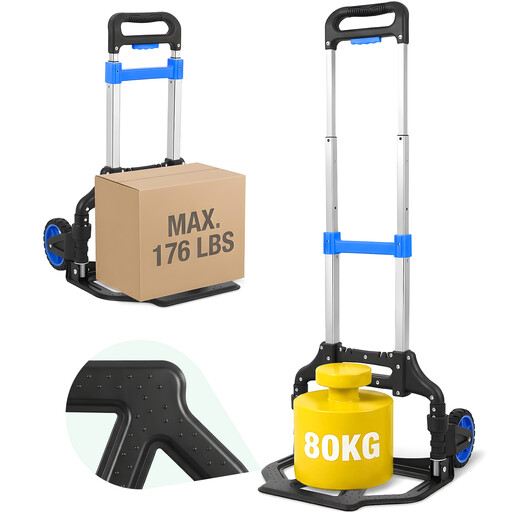
Why this product suits this profile: With a net weight of 3.5 kg and a stated load capacity of 80 kg, this model is suitable for parcels, crates of drinks and regular storage in the car.
The clearly stated net weight and folded width of 5.7 cm make the storage requirements easy to understand. The 80 kg load limit avoids any ambiguity about using it for very heavy goods.
Aluminium frame, three handle heights from 63 to 100 cm, TPR wheels with precision ball bearings and a brake.
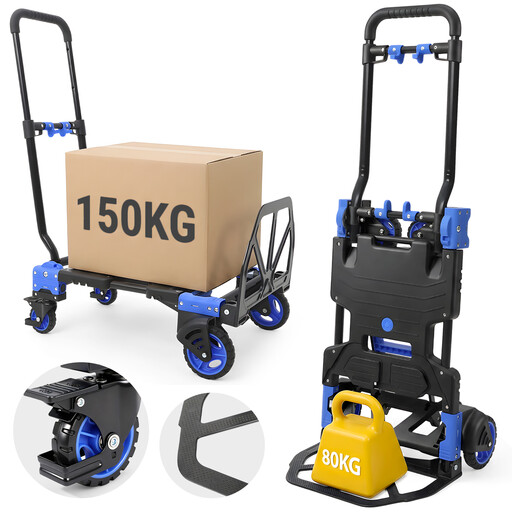
Why this product suits this profile: The combination of sack truck and platform functions is ideal for moving house, warehouse tasks and varying loads.
The product data clearly distinguishes between 80 kg in hand truck mode and 150 kg in platform mode. This makes it possible to assess the load capacity according to the task, rather than relying solely on the advertised figure.
7 kg net weight, height-adjustable handle, TPR wheels with double ball bearings and an integrated parking brake.
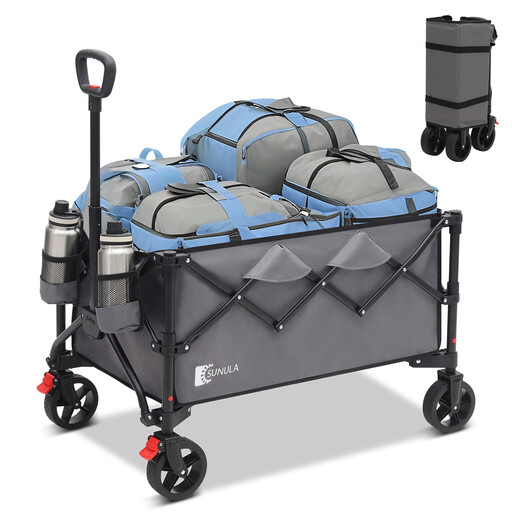
Why this product suits this profile: This foldable garden trolley is designed for camping, gardening, shopping and outdoor tasks involving larger loads.
The 150-litre capacity, dimensions of 92 × 56 × 95 cm and folded volume of under 0.04 m³ provide clear reference points for capacity and storage requirements.
600D Oxford fabric with PE coating, removable bag and wheels, plus off-road wheels with parking brakes.
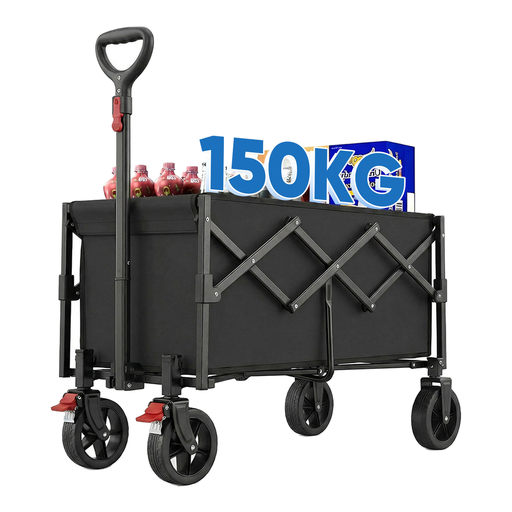
Why this product suits this profile: This compact model combines a fabric loading area with an 80-litre capacity, making it suitable for garden materials, camping equipment or shopping.
The stated net weight of 5.8 kg, load capacity of 100 kg and volume of 80 litres make it easier to compare with larger garden trolleys. The bag and wheels can be removed for cleaning.
600D Oxford fabric with PE coating, foldable construction and brakes according to the product description.
We have put together a complete, regularly updated list of products that fully meet these strict selection criteria and the safety regulations applicable in the EU.
That depends on how you intend to use it. For parcels and crates of drinks, 80 kg may be sufficient. For moving house, tools or building materials, models with a capacity of 120 to 150 kg are more suitable. The load should be distributed evenly and secured with straps. The operating mode and surface must be taken into account when considering the stated load capacity.
Regularly remove sand, soil and dust from the wheels, axles and folding joints. Aluminium frames and plastic parts can usually be cleaned with a damp cloth. Fabric bags should be allowed to dry completely before the trolley is stored. Before every use, check the locking mechanisms, screw connections and brakes.
Not every model is. Larger off-road wheels are beneficial on grass, gravel and paths with minor uneven areas. However, steep slopes, loose ground and very uneven surfaces increase the risk of tipping. Make your decision based on the wheel size, ground clearance, frame stability and the safety information provided by the relevant manufacturer.