
Lieferung heute & morgen

Qualitätsgarantie

Willkommens-Angebote freischalten: KOSTENLOSE Lieferung | Bis zu 80 % RABATT | Kostenlose 30-Tage-JoyPlus-Testphase
App herunterladen
A foldable transport trolley can make moving shopping, crates of drinks, gardening accessories or camping equipment much easier. However, choosing the wrong model can quickly lead to unnecessary expense. The key factor is not just the stated maximum load, but the combination of load capacity, wheels, brakes, folding mechanism and storage space.
A 200 kg transport trolley sounds capable at first. However, this figure only applies when the trolley is fully opened, correctly locked and the load is evenly distributed. On slopes, cobblestones or uneven ground, a heavily loaded trolley can still tip over or become difficult to steer.
You should therefore check:
A large camping trolley may still take up considerable space when folded. For this reason, check the actual folded dimensions rather than just looking for the word “compact”. Weight is also important if you plan to store it in the boot, cellar or utility room.
A space-saving transport trolley should fold down without requiring much effort and should either stand securely when folded or be easy to store safely.
Small wheels are generally better suited to smooth supermarket floors or pavements. Wide tyres usually roll more easily over grass, gravel and campsites, but they require more storage space. A brake is primarily intended for parking and securing the trolley, not for controlled braking while it is moving.
With a hand trolley with a brake, you should check whether the brake on the wheels is actually a parking brake. If you are choosing a shopping trolley, it is also important to check whether the handle suits your height and whether the bag can be removed.
For light everyday shopping, a compact shopping trolley or foldable transport cart with a load capacity of around 50 to 80 kg is often sufficient. Crates of drinks, tools and removal boxes, on the other hand, require a sturdier frame and a larger loading area.
Capacity is usually specified in litres. A 75-litre trolley is designed for shopping and shorter trips, while models with 127 or 300 litres can hold more luggage. However, high capacity does not replace a sturdy base: soft bags may give way under heavy items.
An aluminium frame is relatively lightweight and resistant to rust. Steel frames can offer greater structural stability, but they often weigh more. For fabric trolleys, the specification 600D Oxford fabric indicates the density of the material; on its own, however, it says nothing about the maximum load of the trolley as a whole.
You should also check:
A folding trolley should be easy to set up in just a few steps. Telescopic or height-adjustable handles make it more comfortable for people of different heights. With a foldable sack truck, it is also important to check whether the loading platform is deep enough for boxes or crates when unfolded.
Twin-bearing wheels, shock-absorbing TPR tyres and 360-degree swivel wheels can improve ride comfort. However, actual suitability always depends on the ground conditions and the weight of the load.
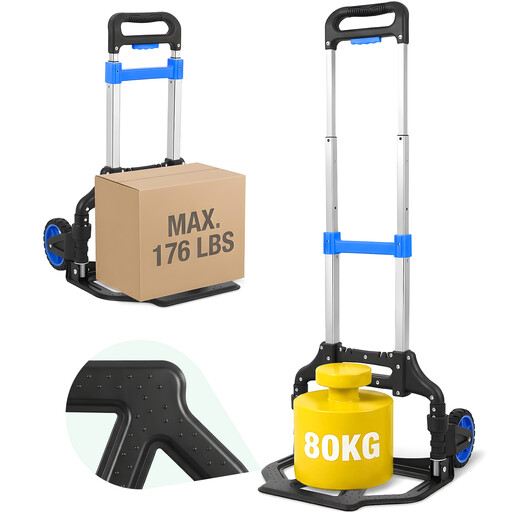
Why this product suits this profile: Weighing 3.5 kg, with an 80 kg load capacity and folded dimensions of 5.7 cm, this foldable transport cart is suitable for parcels, crates of drinks and occasional moves.
The stated 80 kg capacity applies to hand trolley use. This prevents it from being confused with a higher platform load capacity.
Aluminium frame, three-stage height-adjustable handle and TPR wheels with twin-wheel bearings.
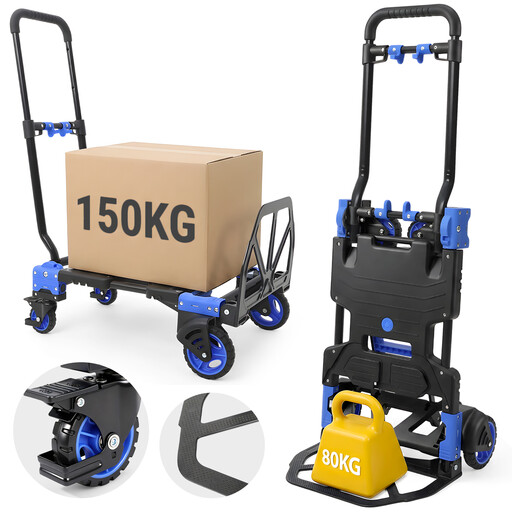
Why this product suits this profile: The trolley switches between sack truck and platform modes. This makes it suitable for both narrow boxes and larger, flat loads.
The load limits are specified separately for each operating mode: 80 kg in hand truck mode and 150 kg as a platform trolley.
Adjustable handle, integrated parking brake and 360-degree TPR wheels with shock absorption.
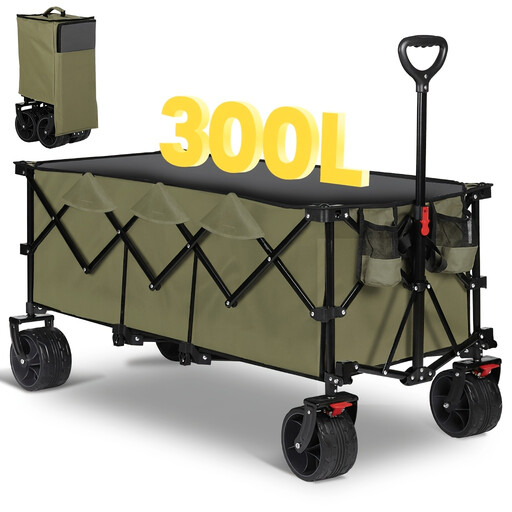
Why this product suits this profile: The camping trolley offers 300 litres of storage and a stated load capacity of 200 kg for gardening materials, camping equipment or larger shopping trips.
The safety information specifies even loading, level ground and using the brakes exclusively for parking.
600D Oxford fabric, wide 7-inch tyres, four-way folding mechanism and two drink holders.
We have put together a complete, regularly updated list of products that fully meet these strict selection criteria and the safety regulations applicable in the EU.
To keep a folding trolley in working order for the long term, remove sand, soil and leaves after use. Fabric parts are best cleaned with a damp cloth and dried completely before the trolley is folded away. Check the following regularly:
Never exceed the stated load capacity. A trolley is not automatically suitable for use as a seat, step or child carrier. On slopes, distribute the load as evenly as possible and activate the parking brake.
For regular shopping and smaller errands, 50 to 80 kg is often sufficient. For crates of drinks, gardening work or camping equipment, 100 to 200 kg may be more suitable. The important thing is whether the stated load capacity applies to the intended mode and ground conditions.
This depends on the folded dimensions and the boot capacity. Before buying, compare the length, width and height when folded with the dimensions of your vehicle. A low unladen weight makes loading and unloading easier.
Not for every type of use. Large, wide wheels make it easier to travel over grass, sand or gravel, but they often increase the packed size. Smaller wheels may be sufficient for pavements, supermarkets and indoor spaces. Choose according to the surface you will use most often and the load you plan to carry.