
Lieferung heute & morgen

Qualitätsgarantie

Willkommens-Angebote freischalten: KOSTENLOSE Lieferung | Bis zu 80 % RABATT | Kostenlose 30-Tage-JoyPlus-Testphase
App herunterladen
A foldable transport trolley can make it much easier to move crates of drinks, parcels, tools or luggage. At the same time, models can vary considerably in load capacity, wheel design and folded dimensions. A high kilogram rating alone therefore says little about whether a foldable hand trolley is suitable for its intended use.
Before buying, you should avoid three common pitfalls in particular:
The maximum load capacity must match how you actually intend to use the trolley. For shopping or smaller parcels, a lightweight transport trolley with a load capacity of 25 to 80 kg may be sufficient. Crates of drinks, moving boxes or garden equipment, however, require a greater safety margin.
You should also consider how the load is distributed. Heavy items should be positioned as low and centrally as possible. With a foldable sack truck, the load is supported against the back plate and stabilised with straps or suitable securing devices. A platform trolley carries bulky items horizontally, but requires sufficient space and a durable loading surface.
With a model described as a 150 kg hand trolley, you should check whether the 150 kg capacity actually applies to all operating modes. According to the product details, the 2-in-1 model presented here is designed for 80 kg in hand trolley mode and 150 kg in platform mode.
An aluminium transport trolley combines relatively low weight with a corrosion-resistant frame. For regular use in warehouses, gardens or when moving house, reinforced connections, a sufficiently large loading surface and a folding mechanism that locks securely into place are also important.
Pay attention to the following points:
A very narrow folded size is practical. According to the product description, the first model has a folded width of 5.7 cm. When folded, the 25 kg PROBUILDER model is 8 cm deep. These measurements should always be checked against the storage space available to you.
TPR wheels can run quietly on smooth floors and provide a grippy surface. The relevant models are listed as featuring double ball bearings. For building sites, garden paths or kerbs, however, it is not just the bearing material that matters: wheel diameter, axle stability and ground clearance also affect ease of use.
A transport trolley with a brake can provide additional control on sloping surfaces. However, the brake does not replace securing the load and will not automatically prevent the trolley from tipping over. According to the product description, the OUTFIT FOLDABLE WAGON has no parking brake; it should therefore not be left unattended on slopes.
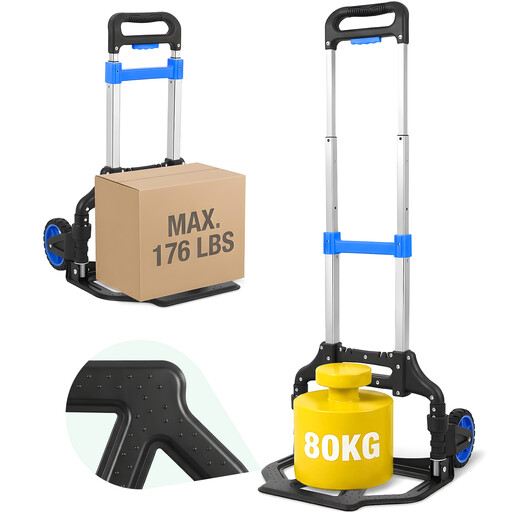
Why this product suits this profile: Weighing 3.5 kg, with three handle heights and a stated load capacity of 80 kg, this model is suitable for parcels, crates of drinks and regular everyday shopping.
The product details specify handle heights of 63, 90 and 100 cm, as well as folded dimensions of 5.7 cm, rather than simply making general claims about compactness.
Aluminium frame, TPR twin wheels with ball bearings, automatic wheel folding and an integrated brake according to the product description.
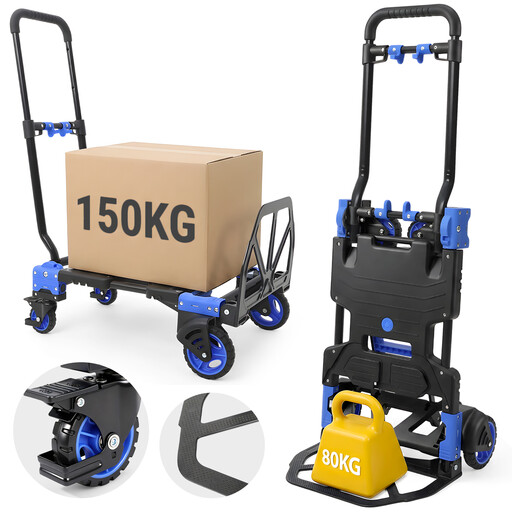
Why this product suits this profile: The combination of a sack truck and platform trolley is appealing to households, DIY enthusiasts and small businesses that need to transport different types of loads.
The product description clearly distinguishes between the load capacities: 80 kg as a hand trolley and 150 kg as a platform trolley. An integrated parking brake system is also listed.
Adjustable handle heights in both modes, an aluminium frame, 360-degree TPR wheels with twin bearings and one-handed folding according to the supplier’s information.

Why this product suits this profile: Families, campers and travellers can benefit from the open wagon design for carrying bags, provisions and equipment on day trips or while camping.
The maximum load of 70 kg and the absence of a parking brake are clearly stated. This makes it easier to assess the intended use realistically.
Metal frame, polyester base, external dimensions of 89 × 53 × 63.5 cm and a foldable design for storage in the boot.
We have put together a complete, regularly updated list of products that fully meet these strict selection criteria and the safety regulations applicable in the EU.
Before using the trolley for the first time, the folding mechanism should be fully opened and locked. With a sack truck, the handle, wheel mount and loading plate must be firmly secured. With a platform trolley, you should also check that the conversion mechanism has locked correctly. Do not exceed the stated load capacity and distribute the load evenly.
Simple measures can help extend the product’s service life:
A foldable pull-along wagon with a fabric base is suitable for luggage and loose items, while a traditional transport trolley is generally better suited to carrying boxes or crates in a more controlled way. For moving house or gardening, you should therefore start by considering the shape of the loads you typically carry.
For shopping and smaller parcels, 25 to 80 kg may be sufficient. A higher load capacity is advisable for tools, crates of drinks or items for moving house. What matters is whether the stated capacity applies to hand trolley or platform mode, and whether the load can be distributed evenly.
Service life depends on the load, the surface it is used on, storage and care. A trolley that is regularly moved over uneven paths or used at maximum capacity will experience more wear than a foldable shopping trolley intended for smooth floors. Locks, wheel bearings and connections should therefore be checked regularly.
Most models are designed for smooth or moderately uneven surfaces. Stairs can place considerable strain on the wheels, frame and loading surface, while also increasing the risk of tipping. Check the relevant instructions and do not exceed the stated load capacity, even when negotiating individual steps.