
Lieferung heute & morgen

Qualitätsgarantie

Willkommens-Angebote freischalten: KOSTENLOSE Lieferung | Bis zu 80 % RABATT | Kostenlose 30-Tage-JoyPlus-Testphase
App herunterladen
A foldable transport trolley can make it much easier to move shopping, crates of drinks, luggage or gardening materials. However, foldable wagons, folding trolleys, shopping trolleys and sack trucks differ considerably in load capacity, operation and storage space. A prominent advertising claim alone says little about whether a model is suitable for your everyday needs.
Before buying, you should therefore avoid three common pitfalls:
The load capacity should always match how you plan to use the trolley. A hand truck with wheels for crates of drinks requires different features from a camping trolley for bags, blankets and sports equipment.
Pay attention to the distinction between:
A model advertised as a 200 kg transport trolley should only be loaded up to the stated maximum capacity. The load must also be distributed evenly. The permitted load depends on the surface, centre of gravity and operating mode. A trolley is not designed to be used as a seat or for carrying children.
Compact wheels are often sufficient for supermarkets, pavements and hallways. For camping, the beach, gardens or uneven paths, wider wheels with shock-absorbing properties are more practical. Swivelling front wheels make manoeuvring easier, while fixed-running wheels can provide better tracking over longer straight distances.
A parking brake is particularly useful on slight inclines. However, it is generally intended for parking rather than slowing down while moving. When trolleys are heavily loaded, you should avoid slopes, stairs and uneven surfaces.
A lightweight trolley is easier to lift out of the boot. With a foldable sack truck or foldable hand trolley, the handle should also suit your height. Height-adjustable handles can allow you to maintain a more upright posture, but they do not replace safe loading and careful handling.
Useful features include:
Material specifications such as aluminium, steel, Oxford fabric or TPR wheels should be supplemented by specific product data. The material alone does not guarantee a particular service life.
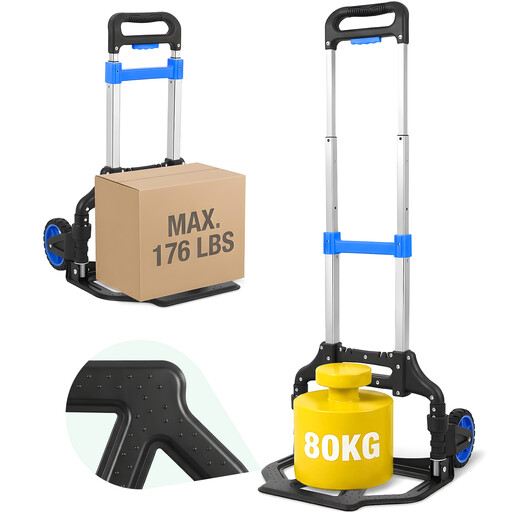
Why this product suits this profile: With an unladen weight of 3.5 kg, a load capacity of 80 kg and three handle heights, this foldable transport trolley is suitable for parcels, crates of drinks and smaller house moves.
The specifications state the unladen weight, maximum load, handle heights and a folded width of 5.7 cm. This makes it easier to assess how much storage space it requires.
Aluminium frame, 80 kg load capacity, automatic wheel folding and TPR wheels with double bearings.
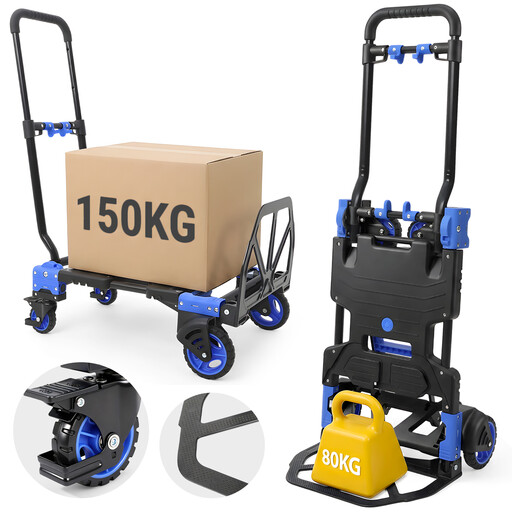
Why this product suits this profile: This model combines a hand truck and platform trolley, covering a range of transport tasks around the home, in the office or during a house move.
The load capacity is specified separately for each operating mode: 80 kg in hand truck mode and 150 kg in platform mode. This difference prevents the advertised figure from being misinterpreted as a single blanket limit.
7 kg unladen weight, height-adjustable handle, 360-degree wheels with double bearings and an integrated parking brake.
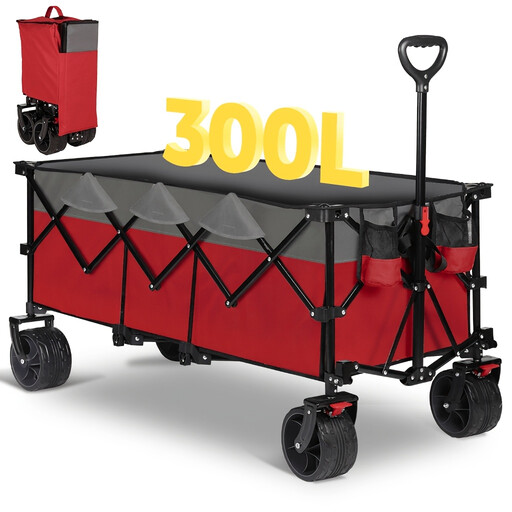
Why this product suits this profile: This foldable hand trolley offers 300 litres of storage space and a stated load capacity of 200 kg for camping equipment, gardening accessories and larger loads.
The product data specifies the storage capacity, tyre width, load capacity and braking function. For heavy loads, a level surface and even weight distribution are still required.
600D Oxford fabric, 7-inch tyres, 300-litre capacity, foldable frame and parking brakes.
We have put together a complete, regularly updated list of products that fully meet these strict selection criteria and the safety regulations applicable in the EU.
Before every use, the trolley should be fully unfolded and the locking mechanism engaged. Check the wheels, axles, joints and fabric compartment regularly for signs of wear. After using it in the garden, at the beach or in wet weather, allow the metal parts and fabric to dry completely before folding the trolley.
Avoid placing excessive weight in one spot. Heavy items should preferably be placed low down and in the centre of the loading area. The brake should be applied when loading, parking and on slopes. A space-saving transport trolley remains practical only if the folding mechanism is kept free from sand, leaves and dirt.
This depends on the model and operating mode. Some compact hand trucks are designed for 80 kg, while larger folding wagons have a stated load capacity of 200 kg. The manufacturer's specifications are always decisive. The load should be distributed evenly and must not exceed the stated maximum.
This depends primarily on the wheel diameter, tyre width and suspension. Small shopping trolleys are designed for flat paths and shops. For cobblestones, grass or sand, wider shock-absorbing wheels are generally more suitable. Even with a camping trolley, you should avoid steep slopes and unstable surfaces.
There is no one-size-fits-all service-life estimate. It is affected by the load, surface, number of folding cycles, storage conditions and care. Dry storage, regular checks of screw connections and loading within the specified limits can reduce wear. If the wheels are damaged, the fabric is torn or the locking mechanism is unsafe, the trolley should no longer be used.